
Marai Uraitta Irai
The Lord Revealed by the Veda
[Sri. U.V. Vidwan Mukkur Lakshminarasimhacharya Swami, Vijayawada]
(Article published in the Masi 1971 issue of Sri Nrusimhapriya)
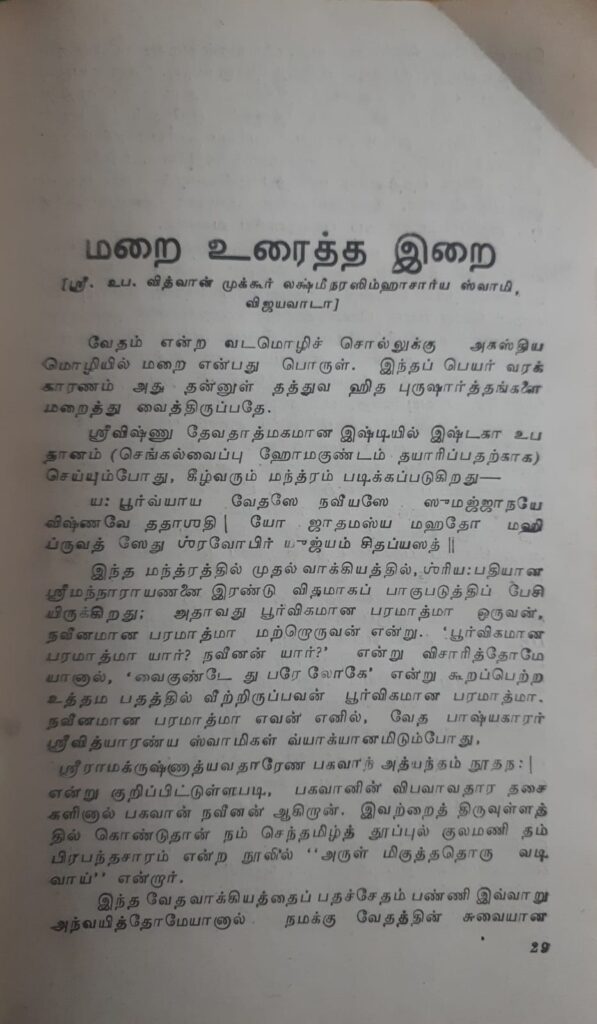
The Sanskrit word Veda means Marai in Tamil. It has received this name because it conceals within itself the truths concerning Tattva, Hita and Purushartha.
When the Ishti in which Sri Vishnu is the presiding Deity is being performed and the Ishtaka Upadanam—the laying of the bricks for preparing the sacrificial altar—is undertaken, the following Mantra is recited—
Ya: poorvyaya vedase naviyase
Sumajjanaye Vishnave dadasati |
Yo jatamasya mahato mahi bruvat
Setu sravobhir yujyam chidabhyasat ||
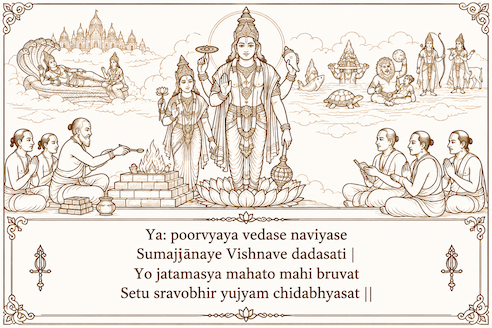
In the first sentence of this Mantra, Sriyapati Sriman Narayana is spoken of by making a distinction in two ways: one is the ancient Supreme Self and the other is the newer Supreme Self. If we inquire, “Who is this ancient Supreme Self? And who is the newer one?”, the ancient Supreme Self is the One who is seated in the supreme abode spoken of as Vaikunthe tu pare loke. As for the newer Supreme Self, Sri Vidyaranya Swami, the commentator on the Vedas, explains—
Sri Ramakrishnat yavatārena Bhagavan atyantam nutanah.
As indicated by this statement, Bhagavan becomes “new” through His various Vibhava Avatara manifestations. Bearing this in mind, our revered Acharya, the jewel of the Tuppul lineage, says in his Prabandha Saram, “Arul miguttha thoru vadivai”—“in a form filled with abundant grace.”
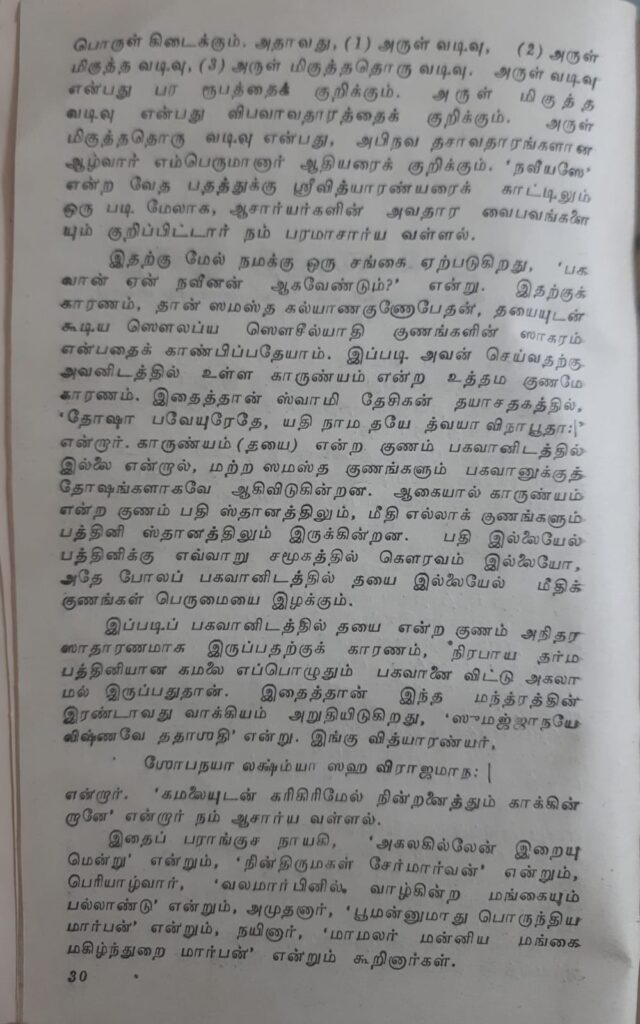
If we divide this Vedic statement word by word and understand its anvaya in this manner, we obtain the delightful inner meaning of the Veda. It is: (1) a form of grace, (2) a form filled with grace, and (3) a form filled with abundant grace. “Form of grace” refers to the Para Rupa, the supreme transcendental form of Bhagavan. “A form filled with grace” refers to His Vibhava Avatara. “A form filled with abundant grace” refers to the later and ever-new manifestations of the Alvars, Emberumanar and the Acharyas. With regard to the Vedic word Naviyase, our Paramacharya and benefactor went one step beyond Sri Vidyaranya and indicated even the glory of the incarnations of the Acharyas.
At this point, a doubt naturally arises: “Why should Bhagavan become ‘new’?” The purpose is to reveal that He is endowed with all auspicious qualities and is an ocean of qualities such as Saulabhya and Sausilya, together with boundless compassion. The supreme quality that causes Him to manifest Himself in this manner is Karunya, compassion. This is precisely what Swami Desika says in the Daya Satakam, “Dosha bhaveyur ete, yadi nama Daya tvaya vinabhutah”. If the quality of compassion, Daya, were absent in Bhagavan, all His other auspicious qualities would themselves become defects. Thus, Karunya occupies the position of the husband, while all the remaining auspicious qualities occupy the position of the wife. Just as the wife does not receive honour in society in the absence of the husband, so too, if compassion were absent in Bhagavan, the remaining qualities would lose their glory.
The reason why this quality of compassion exists in Bhagavan in an incomparable manner is that Kamala, the faultless and eternally devoted Divine Consort, never leaves His side. This is firmly established by the second sentence of the Mantra, “Sumajjanaye Vishnave dadasati”. Here Vidyaranya says—
Shobhanaya Lakshmya saha virajamanah.
He is ever resplendent together with the auspicious Sri Lakshmi. Our Acharya benefactor likewise says, “Kamalayudan Karigirimel nindranaiththum kakkinrane.”
Parankusa Nayaki says, “Agalakillen iraiyum enru” and “Nin Tirumagal Sermarvan”; Periyalvar says, “Valamarbinil vazhginra Mangaiyum Pallandu”; Amudanar says, “Poomannumathu porundhiya Marban”; and Nayinār says, “Mamalar manniya Mangai magizhndurai Marban”.
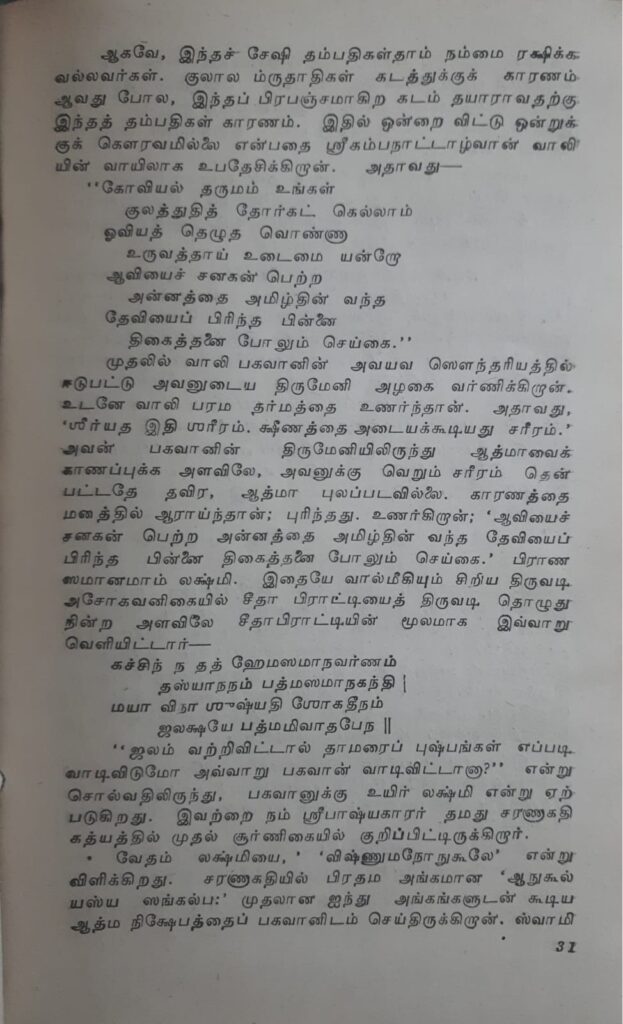
Therefore, it is this Divine Couple—the Seshi Dampatis—who alone have the power to protect us. Just as the potter and the clay are together responsible for the making of a pot, these Divine Consorts are together responsible for the creation of this universe, which is like a great pot. Without one, the other has no honour. Sri Kambanattalvar teaches this through the words of Vali:
“Koviyal dharumam ungal
Kulaththudith thorgatkellam
Oviyath thezhudha vonna
Uruvaththai udaimaiyandro
Aviyai Janakan petra
Annaththai amudhin vantha
Deviyai pirindha pinnai
Thigaiththanai polum seygai.”
At first, Vali becomes captivated by the beauty of Bhagavan’s limbs and describes the beauty of His divine form. Immediately thereafter, Vali understands the supreme principle of Dharma. “Seeryata iti sariram”—that which is subject to decay is called the body. When Vali attempts to perceive the Atma beyond the divine body of Bhagavan, he sees only the body and is unable to perceive the Atma. He reflects upon the reason for this and understands. He realizes: “Aviyai Janakan petra Annaththai amudhin vantha Deviyai pirindha pinnai thigaiththanai polum seygai.” “It appears that You have become bewildered after being separated from the Divine Lady whom Janaka received as his daughter and who came forth from the nectar.” Lakshmi is indeed the very life-breath of Bhagavan.
Valmiki too brings this truth out through Hanuman, when he stood worshipfully before Sita Piratti in the Ashoka grove. Through Sita Piratti he expressed it thus—
Kachin na tad hema samanavarnam
Tasyananam padma samanakanti |
Maya vina sushyati shokadinam
Jalakshaye padmam ivatapena ||
“Has His face, golden in complexion and radiant like the lotus, become withered by sorrow in My absence, just as a lotus withers when its water dries up beneath the heat of the sun?” From this statement, it becomes evident that Lakshmi is the very life of Bhagavan. Our Sri Bhashyakarar too has indicated this in the first Churnika of His Saranagati Gadyam.
The Veda refers to Lakshmi as “Vishnum anonukule”—She who is ever favourable and agreeable to Vishnu. In Saranagati, the first limb is “Anukulyasya Sankalpah”. Together with the five limbs beginning with “Anukulyasya Sankalpah”, one performs Atma Nikshepa, surrendering oneself completely to Bhagavan. Swami Desika, following the Acharya Parampara, teaches that one must take refuge at the divine feet of Bhagavan. In the hymn beginning “Ennuyir tandalitta varai”, he says, “Innamudat Tirumagal enru ivarai munnittu Emberuman Tiruvadigal adaigindrene.”
Just as Bhagavan rejoices in having Mahalakshmi seated upon His right chest, Swami Desika has taught that He likewise bears all the Jivatmas upon His chest and protects them.
The Paramatma, who is the One who sustains us and the Lord who governs us, regards the Jivatma—who is established in the Sastras as His disciple, servant, Dasabhuta and Seshabhuta—as belonging to Him and carries that Jivatma within His heart, protecting him at all places, at all times and in every state. If every Jivatma worships these Primordial Divine Consorts with heartfelt devotion, he can attain the exalted abode and rise to the highest state.
Here again a doubt arises: “Will this small measure of devotion that we offer be sufficient for the Supreme Bhagavan?” The Veda itself removes this doubt—
Yavad eka devata kamayate
Yavad eka tavad ahutih
Pratate nahi tadasthi |
The meaning is this: Suppose, in an offering to Indra, one takes a Uttarani measure of ghee and performs the Homa saying, “Indraya Svaha.” Is that tiny quantity of ghee sufficient for Indra? When the Homa is performed with devotion, that very drop of ghee reaches Indra in the measure that is appropriate and sufficient for him. In exactly the same manner, the loving service rendered by the Jivatmas gives pleasure to the Paramatma.
All these lofty truths were graciously taught in a single Anushtubh Sloka by our Acharya benefactor, who bears the Tridanda, protects the three worlds and reigns from Mukkur—
Eko Narayanah Sriman
Param tattvam iti srutau |
Jivachetanayukta
Tayor atmeti nischitah ||
Thus. Let us bow at the sacred feet of that Acharya and seek the grace of the Lord.