
Śrī Mantrarāja Pada Stotram
[Śrī. U. Ve. Vidvān Mukkūr Lakshmīnarasimhāchārya Swāmi]
Chapter 1
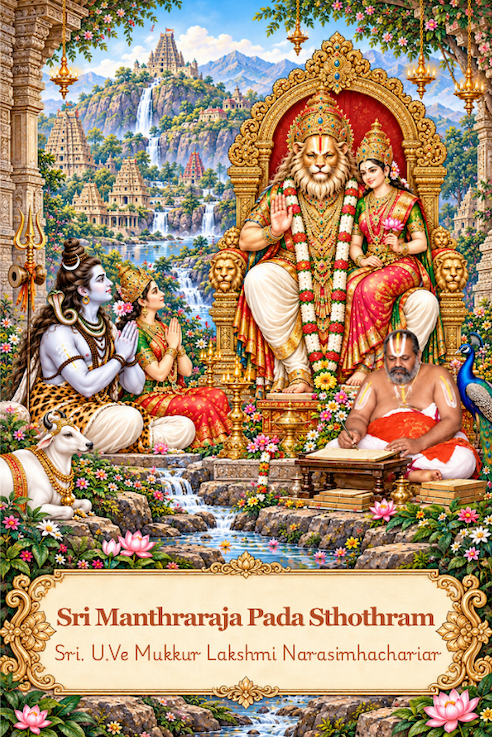
Emperumān Śrī Lakshmī Nrusimhan’s mantras are countless in number. To firmly fix all His innumerable mantras in one’s mind is an extremely arduous task. Therefore, the omniscient Śrī Rudra Bhagavān, as a means of pouring out all the anubhavam (divine experience) he received from Śrī Nrusimhan, mercifully details word-by-word the “Śrī Nrusimha Anuṣṭup Mantra,” which shines as the sovereign of all mantras. That very exposition has acquired the name “Śrī Mantrarāja Pada Stotram” and shines with magnificent glory on this earth. This is found in the Śrī Ahirbudhnya Samhitā. Ahirbudhnyan is a name of Śrī Īśvara (Rudra). This is a stotram that has been accepted and utilized as pramāṇam (authority) by the Āchāryas of all three schools of Vedānta.
Mantrarāja padasthotraṃ
Stotrāṇāṃ uttamaṃ śubham |
Mantrārūḍhaṃ śrī nṛsiṃhaṃ
Stotreṇānena kītaye ||
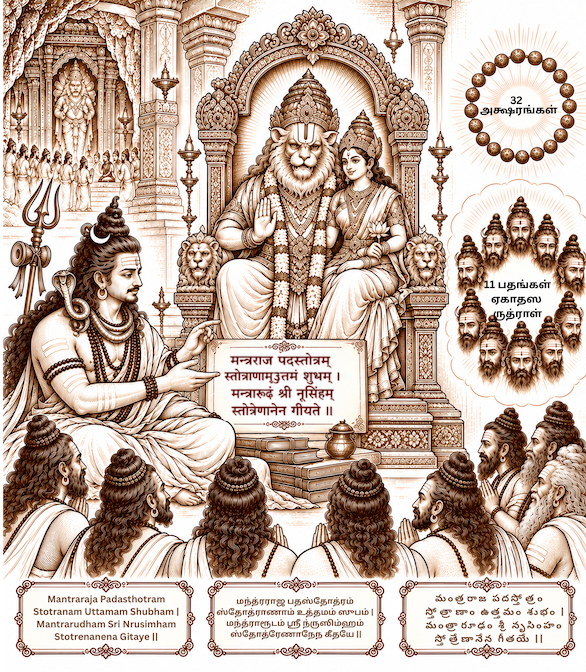
There are countless stotrams in this world. Far superior and infinitely more auspicious than all of them is this Śrī Mantrarāja Pada Stotram. I praise Śrī Lakshmī Nrusimhan, who inherently resides in the mantra, through this Śrī Mantrarāja Pada Stotram.
This mahā-mantra consists of 32 akṣaras (syllables). All 32 Brahma Vidyās are contained within it. There are 11 padas (words) comprised within this mantra. The Ekādaśa Rudras (the eleven Rudras) offer their praises to Him. Therefore, this stotram shines gloriously with 12 ślokas in total: 11 ślokas serving as detailed explanations for the 11 padas, and one śloka as the phala-śruti (fruit of recitation). If one performs anusandhānam (recitation with contemplation) of this stotram during all three sandhyas (twilight periods), the immense benefits we attain cannot be adequately described. It is a highly auspicious stotram that bestows all mangalams.
All our Śrīmad Azhagiyasingars, the most exalted Āchāryas who have adorned the Pīṭham of Śrī Ahobila Mutt, are Mahāns who attained magnificent glory through this very stotram. Have we not all constantly heard the 45th Paṭṭam Śrīmad Azhagiyasingar melting in his heart and divinely instructing that it is only through the anusandhānam of this stotram that the exceptionally rare Śrī Nrusimhārādhanam (worship of Lord Nrusimha) was mercifully bestowed upon him!
It is strictly by the daily pārāyaṇam (recitation) of this stotram that adiyen (this humble self) too receives all the śakti (strength) and sāmarthyam (capability) to flawlessly execute the 108 Śrī Nrusimha Mahāyajñas. Like the Kalpakavṛkṣa (wish-fulfilling tree), this stotram is a sweet fountain of bliss that grants everything one desires. It is an inexhaustible flood of bliss. It never diminishes, no matter how much grace is drawn from it.
The profound beauty with which this stotram walks within the Divya Śrī Suktis of the Azhwars, who incarnated as the very embodiment of abundant grace, is unparalleled. One can endlessly relish how Śrī Thiruppāṇāzhwār, in his Amalanāthipirān, describes the opening phrase of this stotram, “vṛttotphullaviśālākṣaṃ,” as “araṅgattamalaṉ mugattu kariyavāgip puḍaiparandu miḷirndu sevvariyōḍi nīṇḍa apperiyavāya kaṇgaḷ” (The large, broad, dark, radiant eyes with red lines of the pure Lord of Srirangam).
Therefore, many exalted Mahāns have already mercifully documented its greatness. It is being written once again now. If we properly learn the indescribable greatness and inner meanings of this stotram by sitting at the feet of great Mahāns and perform anusandhānam daily, we can auspiciously attain all conceivable benefits. We can attain true glory both in this world (iham) and above (param).
श्री:
Srī Iśvara uvāca —
॥ श्रीमन्त्रराज पद स्तोत्रम् ॥
śrī:
|| Srī Mantrarāja Pada Stotram ||
श्री ईश्वर उवाच —
वृत्तोत्फुल्लविशालाक्षं
विपक्षक्षयदीक्षितम् ।
निनादत्रस्तविश्वाण्डं
विष्णुं उग्रं नमाम्यहम् ॥ १ ॥
Vṛttotphullaviśālākṣaṃ
Vipakṣakṣayadīkṣitam |
Ninādatrastaviśvāṇḍaṃ
Viṣṇuṃ ugraṃ namāmyaham || 1 ||
सर्वैरवध्यतां प्राप्तं
सबलौघं दितेः सुतम् ।
नखाग्रैः शकलीचक्रे
यस्तं वीरं नमाम्यहम् ॥ २ ॥
sarvairavadhyatāṃ prāptaṃ
sabalaughaṃ diteḥ sutam |
nakhāgraiḥ śakalīcakre
yastaṃ vīraṃ namāmyaham || 2 ||
पदावष्टभ्यपातालं
मूर्धाविष्टत्रिविष्टपम् ।
भुजप्रविष्टाष्टदिशं
महाविष्णुं नमाम्यहम् ॥ ३ ॥
padāvaṣṭabhyapātālaṃ
mūrdhāviṣṭatriviṣṭapam |
bhujapraviṣṭāṣṭadiśaṃ
mahāviṣṇuṃ namāmyaham || 3 ||
ज्योतींष्यर्केन्दुनक्षत्र
ज्वलनादीन्यनुक्रमात् ।
ज्वलन्ति तेजसा यस्य
तं ज्वलन्तं नमाम्यहम् ॥ ४ ॥
jyotīṃṣyarkendunakṣatra-
jvalanādīnyanukramāt |
jvalanti tejasā yasya
taṃ jvalantaṃ namāmyaham || 4 ||
सर्वेन्द्रियैरपि विना
सर्वं सर्वत्र सर्वदा ।
यो जानाति नमाम्याद्यं
तमहं सर्वतोमुखम् ॥ ५ ॥
sarvendriyairapi vinā
sarvaṃ sarvatra sarvadā |
yo jānāti namāmyādyaṃ
tamahaṃ sarvatomukham || 5 ||
नरवत्सिंहवच्चैव
यस्य रूपं महात्मनः ।
महासटं महादंष्ट्रं
तं नृसिंहं नमाम्यहम् ॥ ६ ॥
naravatsiṃhavaccaiva
yasya rūpaṃ mahātmanaḥ |
mahāsaṭaṃ mahādaṃṣṭraṃ
taṃ nṛsiṃhaṃ namāmyaham || 6 ||
यन्नामस्मरणाद्भीताः
भूतवेतालराक्षसाः ।
रोगाद्याश्च प्रणश्यन्ति
भीषणं तं नमाम्यहम् ॥ ७ ॥
yannāmasmaraṇādbhītāḥ
bhūtavetālarākṣasāḥ |
rogādyāśca praṇaśyanti
bhīṣaṇaṃ taṃ namāmyaham || 7 ||
सर्वोपि यं समाश्रित्य
सकलं भद्रमश्नुते ।
श्रिया च भद्रया जुष्टः
यस्तं भद्रं नमाम्यहम् ॥ ८ ॥
sarvopi yaṃ samāśritya
sakalaṃ bhadramaśnute |
śriyā ca bhadrayā juṣṭaḥ
yastaṃ bhadraṃ namāmyaham || 8 ||
साक्षात्स्वकाले संप्राप्तं
मृत्युं शत्रुगणान्वितम् ।
भक्तानां नाशयेद्यस्तु
मृत्युमृत्युं नमाम्यहम् ॥ ९ ॥
sākṣātsvakāle saṃprāptaṃ
mṛtyuṃ śatrugaṇānvitam |
bhaktānāṃ nāśayedyastu
mṛtyumṛtyuṃ namāmyaham || 9 ||
नमस्कारात्मकं यस्मै
विधायऽऽत्मनिवेदनम् ।
त्यक्तदुःखोऽखिलान्कामान्
अश्नन्तं तं नमाम्यहम् ॥ १० ॥
namaskārātmakaṃ yasmai
vidhāyātmanivedanam |
tyaktaduḥkhokhilānkāmān
aśnantaṃ taṃ namāmyaham || 10 ||
दासभूताः स्वतस्सर्वे
ह्यात्मानः परमात्मनः ।
अतोऽहमपि ते दासः
इति मत्वा नमाम्यहम् ॥ ११ ॥
dāsabhūtāḥ svatassarve
hyātmānaḥ paramātmanaḥ |
atohamapi te dāsaḥ
iti matvā namāmyaham || 11 ||
शङ्करेणाऽऽदरात्प्रोक्तं
पदानां तत्वनिर्णयम् ।
त्रिसन्ध्यं यः पठेत्तस्य
श्रीर्विद्याऽऽयुश्च वर्धते ॥ १२ ॥
śaṅkareṇādarātproktaṃ
padānāṃ tatvanirṇayam |
trisandhyaṃ yaḥ paṭhettasya
śrīrvidyāyuśca vardhate || 12 ||
If one desires true siddhi in this exalted mantra, one must possess unwavering bhakti (devotion) in three specific matters.
मन्त्रे तद्देवतायांश्च
तथा मन्त्रप्रदे गुरौ ।
त्रिषु भक्तिः सदा कार्या
सा हि प्रथमसाधनम् ॥
mantre taddevatāyāṃśca
tathā mantraprade gurau |
triṣu bhaktiḥ sadā kāryā
sā hi prathamāsādhanam ||
That is to say, one must always maintain deep devotion towards the mantra, towards the inner presiding Devatā of the mantra, and towards the Āchāryan who mercifully imparted the mantra. That alone is the righteous and most exalted path to attain mantra siddhi. Performing mantra japam crores of times without having bhakti towards the Āchāryan who granted us the upadeśam will yield absolutely no fruit. Similarly, one must have supreme devotion towards the Devatā who is to be realized through the mantra. Furthermore, we must have complete viśvāsam (faith) and bhakti in the mantra itself. Only when such a state is achieved can we attain the complete phalam (fruit) of the mantra.
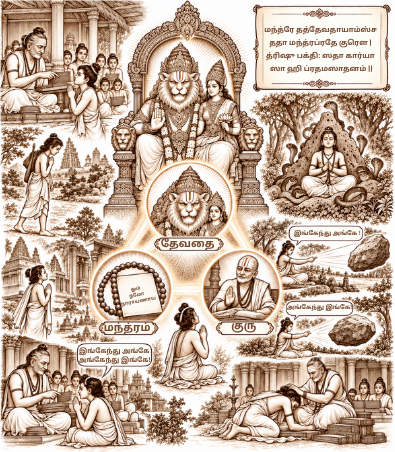
Therefore, Śrī Īśvara praises Śrī Lakshmī Nrusimhan through the Śrī Mantrarāja with parama bhakti and śraddhā (supreme devotion and faith).
Once upon a time, there was a Veda Vidvān (Vedic scholar). He was teaching the Vedas to many young boys. One day, a young boy prostrated at his feet, pleading to be taught the Vedas as well. He too, out of sheer compassion, recited a small Vedic phrase to him and said, ‘Recite this correctly.’ However, despite trying many times, the boy could not recite it perfectly with the correct svara (intonation). Hence, the Veda Vidvān told him, ‘You will not get the Vedas. Do not harbor false hopes. Leave from here.’ The boy left with immense sorrow. Returning ten days later, the young boy approached him and said, ‘Swāmin! Adiyen visited many temples. There, great Vedic scholars were performing Veda pārāyaṇam beautifully. I listened to it to the absolute delight of my ears. A deep desire has arisen in adiyen to learn the Vedas and perform pārāyaṇam like that. Is there a more exalted adhikāri (authority) than Devarīr! Therefore, please show affection towards adiyen and mercifully teach me the Vedas somehow,’ he prayed with utmost humility and reverence.
Hearing this, he closed his eyes, performed anusandhānam of a much more difficult portion of the Veda than before for about ten minutes, and when he opened his eyes, the boy was nowhere to be seen in front of him. He had run away.
Many days later, the boy returned again. ‘Swāmin! Only what Devarīr recites is difficult. I listen to the Vedas here and there. It is fluent without being so hard. Therefore, you must mercifully instruct adiyen to an extent that I can recite,’ he prayed, clasping his Thiruvadi (divine feet) with tear-filled eyes.
His heart melting, the scholar said, ‘This is the mantra, “From here to there! From there to here!” Recite this correctly.’ The boy said it perfectly. ‘Is this a mantra, Swāmi?’ he asked. ‘Yes, this is indeed the mantra,’ he replied. Taking leave from him, the boy went straight into a large forest. There was a huge boulder in the middle of the forest. Sitting in front of that stone, he closed his eyes and continuously chanted, ‘From here to there! From there to here!’ He chanted without food or water. Ten years rolled by. Termites built an anthill around him. Many snakes were climbing up and down his body. He felt none of it. He chanted with such intense niṣṭha (single-minded focus). One morning, a heavy downpour suddenly occurred. In that rain, the anthill slowly began to dissolve. The snakes hissed and slithered away. Only then did he regain his senses. He opened his eyes and looked. He saw the huge boulder sitting exactly as it was. He began to utter the mantra again. ‘From here to there!’ he said. The boulder in front of him leapt up and fell over there. ‘From there to here!’
he said. From there, the rock came back and fell here again. He was astonished. He said it many times. The rock jumped back and forth numerous times. He felt immense joy. ‘The mantra taught by the Āchāryan has yielded full siddhi! Alas, I came away without offering Guru Dakshiṇai to the Āchāryan,’ he felt deeply remorseful and went to him to submit his Guru Dakshiṇai. All the Vidyārthis (students) who had been learning the Vedas that day were still learning the Vedas from him exactly as before. He fell at his Thiruvadi and said, ‘Swāmin! The mantra Devarīr imparted has started to yield fruit! I have come here to submit my Guru Dakshiṇai to you. You must bless adiyen.’
Astonished, he asked, ‘Where have you been all these days! You were nowhere to be seen! I searched for you many times. You say the mantra has yielded fruit! What mantra is that? How did it yield fruit?’ he asked in wonder. (Since ten years had passed, he had forgotten everything).
‘Shall I recite that mantra, Swāmi?’ he asked. ‘Tell me,’ he said. Immediately, the boy said, ‘From here to there!’ It lifted the Āchāryan himself and threw him over there. He went and fell there. ‘From there to here!’ he said, and from there he came and fell back here. His head spun. ‘Shall I say it one more time, Swāmi?’ the boy asked. ‘Alas, no, no! Who wants to go flying and falling? Did I not tell you that you wouldn’t get the Vedas? I too have been chanting the Vedas for so many years. I have taught it to many people as well. But have I attained siddhi in even a single mantra? No. “There is no Praṇavam! There is no Bījākṣaram!” It is just a mere phrase, “From here to there! From there to here!” By chanting it many times, you have proven that even that possesses śakti (power). Through this, you have demonstrated to the people of the world the special śakti inherently present in mantras coupled with Praṇavam and Bījākṣarams. Is there a sat-śiṣya (true disciple) like you!’ Saying this, he taught him the entirety of the Vedas.
That is why the Atharvaṇa Veda states that Yantra śakti is limited. It is bound by a certain measure. Mantra śakti is aparimita (boundless/limitless). Mantra śakti cannot be measured. When even the Mahāns who have chanted it and attained siddhi can only partially comprehend its greatness, what can be said of the state of ordinary people?
How can one possibly write about the greatness of the Śrī Mantrarāja, the Śrī Nrusimha Anuṣṭup Mantra, which is the undisputed king of all such mantras! Emperumān declares Bhakti Yoga as the Rājavidyā (King of Knowledge) among all vidyās. Similarly, the Mahāns call this mantra, which is the sovereign over all mantras, the ‘Mantrarājam‘.
We are all well aware that the 40th Paṭṭam Śrīmad Azhagiyasingar (Kāraikkurichi Periya Śrīmad Azhagiyasingar), who was enthroned at our glorious Śrīmad Ahobila Mutt, attained paripūrṇa siddhi (complete mastery) in this mantra and bestowed special anugraham upon his multitude of disciples.
What more is there to say of the greatness of this Śrī Mantrarāja Pada Stotram? It is praised by the Ekādaśa Rudras. It shines brilliantly like the Dvādaśa Ādityas. Like the Aṣṭavasus, it is capable of bestowing whatever is desired. It is a grand stotram that stands with undiminished prosperity, like the Aśvinī Devatās.
Pade pade mantrarāje
Dṛśyate tatpadaṃ śubham |
Rahasyaṃ tāpanīyasya
Phalaṃ tatra pradṛśyate ||
In this Śrī Mantrarāja Pada Stotram, the glory of His auspicious divine feet (Thiruvadi) is clearly revealed in every pada (word). The greatness of the realm where He resides, the faultless eternal land described as ‘tad viṣṇoḥ paramaṃ padam‘ (the supreme abode of Viṣṇu), is also revealed. The supreme esoteric meaning of the Śrī Nrusimha Tāpanīya Upaniṣad, and the greatness of Mālolān (the Lord with the Mother), who is its ultimate fruit, is clearly manifested.
This stotram is a veritable encyclopedia of esoteric wisdom. Whatever is not here is nowhere else. The subjects found within this stotram are:-
(1) Lakshmīpatitvam
(2) Ubhayavibhūti Nirvāhakatvam
(3) Āśrita Saṃrakṣakatvam
(4) Āśrita Virodhi Nirasanatvam
(5) Satyakāmatvam
(6) Satyasaṅkalpatvam
(7) Apahatapāpmatvam
(8) Śubhāśrayatvam
(9) Sarvajñatvam
(10) Sarvatomukhatvam
(11) Vimṛtyutvam
(12) Sarvāntaryāmitvam
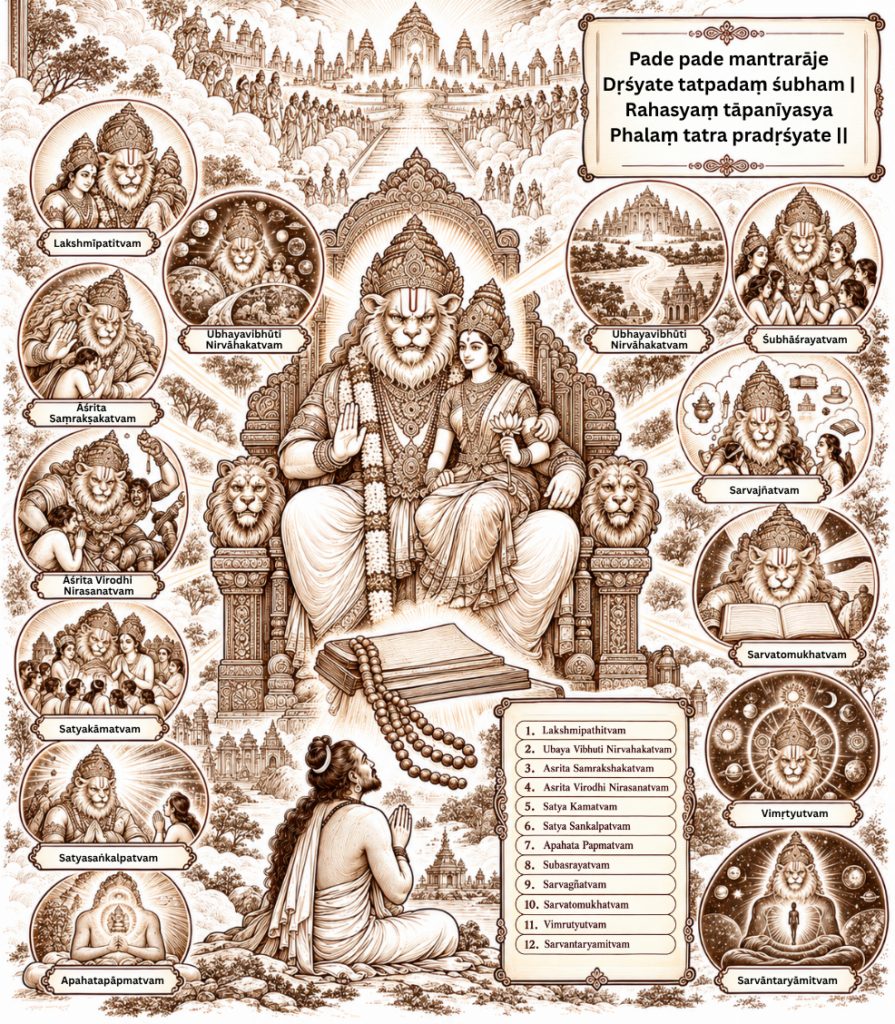
(1) Lakshmīpatitvam :- The state of shining as the wealth of Wealth herself, as the Consort of Thirumagal, as the One whose chest is inhabited by Bhūmi Pirāṭṭi, as the One on whose chest the Lady of the great lotus happily resides, as the One who does not separate from Thirumagal even for the measure of a millet seed, as the One on whose chest the Lady on the Lotus dwells declaring ‘I will not leave even for a moment,’ and as the One bearing Thirumagal on His chest.
tadetatsūkṣmamithunaṃ
parasparavicinivitam |
ādāvanyonyamiśratvāt
anyonyapratipādakam ||
As per this Śrī Pāñcarātra Āgama śloka, which states that the greatness of one lies within the other, one must understand the greatness of this Divine Couple (Divya Dampati)—who shine together inseparably from the very beginning—in mutual relation to one another.
”Keeping this sweet ambrosial Thirumagal in the forefront, I attain the Thiruvadi of Emperumān” are the nectarine words of Swāmi Deśikan.
(2) Ubhayavibhūti Nirvāhakatvam :- ”The Lord who rules without slip the earthly worlds surrounded by swelling oceans and the heavenly realms.” He is the supreme ruler of both the Nitya Vibhūti (Śrī Vaikuṇṭham) and the Līlā Vibhūti, which encompasses the fourteen worlds.
(3) Āśrita Saṃrakṣakatvam :- He is Prapanna-sulabhan (easily accessible to those who surrender). The exalted quality of protecting those who fall at His feet.
(4) Āśrita Virodhi Nirasanatvam :- The great quality of entirely annihilating the enemies of those who surrender at His feet.
(5) Satyakāmatvam :- Possessing truthful and unfailing desires. His saṅkalpa (will) never fails.
(6) Satyasaṅkalpatvam :- Possessing a flawless, unhindered resolve.
(7) Apahatapāpmatvam :- Untouched by even the slightest taint of sin or impurity.
(8) Śubhāśrayatvam :- The auspicious supreme form (Maṅgala Mūrti) worthy of our taking refuge.
(9) Sarvajñatvam :- ”As a flawless radiant body, neither blossoming nor closing, as flawless wisdom,” it is His nature of perfectly cognizing and knowing everything.
(10) Sarvatomukhatvam :- As declared, ”viṣṇuḥ sarvatomukhaḥ,” He possesses faces in all directions (omnipresence).
(11) Vimṛtyutvam :- He who is Death unto Death itself. He is utterly devoid of the fear of death.
(12) Sarvāntaryāmitvam :- Residing as the Inner Controller within all moving and non-moving entities. Pervading everywhere, hidden like the soul within the body. As declared, ”eko devaḥ sarvabhūteṣu gūḍhaḥ,” He resides concealed within everything.
In this manner, His immense glory is spoken of in many ways in this stotram. In the upcoming chapters, let us relish the magnificent glories of Śrī Lakshmī Nrusimhan, the inner presiding Devatā of this mantra!
(To be continued)
śrī:
Śrī Mantrarāja Pada Stotram
[Śrī. U. Ve. Vidvān Mukkūr Lakshmīnarasimhāchārya Swāmi]
Chapter 2
The krupā of Śrī Mālolān that shines forth within the Śrī Mantrarāja cannot be adequately expressed in words.
saptaprākāramadhyasthaṃ
saptasāle virājitam |
sapte muktiprade mukhyaṃ
trisapte bhāvaye harim ||
In Śrīraṅgam, the Bhūloka Vaikuṇṭham, the Swāti Nakṣatra Mahā Nārasimha Mahāyajñam is currently taking place. Thousands upon thousands of bhaktas are rejoicing by rendering sevā to this Mahā Yajñam. At this auspicious time, when Yatīśvaras such as Śrīraṅgam Śrīmad Āṇḍavan and Śrī Pauṇḍarīkapuram Śrīmad Āṇḍavan have graciously arrived, bestowing maṅgalāśāsanam and anugraham, adiyen is continuing to write this from within the very Śrī Yajñavāṭikā itself. This is the anugraham of Śrī Mālolān.
mālola: puṇḍarīkākṣa:
śete praṇavamandire |
yajñaṃ karoti sarvātmā
yajñamūrti: sanātana: ||
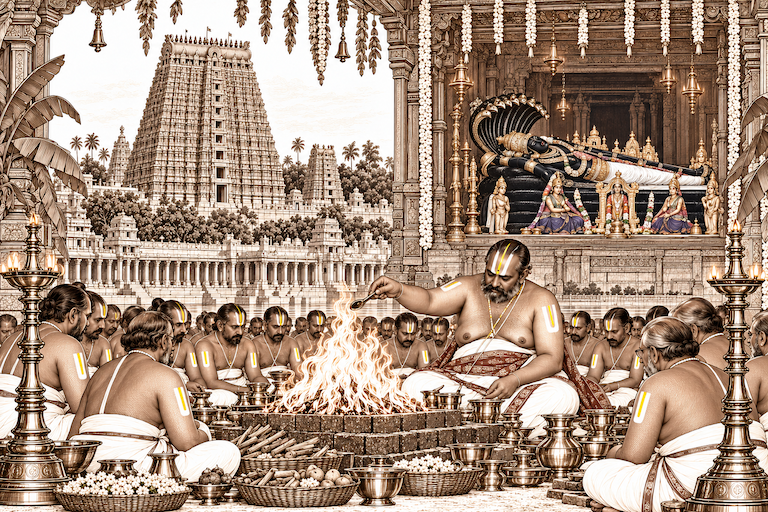
The One who mercifully reclines (kaṇvaḷarndaruḷpavaṉ) within the Praṇavākāra Vimānam at Śrīraṅgam is none other than Śrī Nṛsiṃhan Himself. He is the very embodiment of Yajña, and it is He Himself who conducts this Yajñam.
In this great Yajñam, the Śrī Mantrarāja Pada Stotram is being chanted 32,000 times. Even a single chanting is capable of bestowing great benefit. What can one possibly write about the special and immense benefits that may arise from chanting it 32,000 times?
This stotram begins with the words ”śrī īśvara uvāca”. This means ”Śrī Īśvara spoke”. In the Śrī Nṛsiṃha Tāpanīya Upaniṣad, this Mantrarāja—the Śrī Nṛsiṃha Anuṣṭup Mantra—is detailed akṣara by akṣara (syllable by syllable).
(1)
Oṃ um oṃ yo vai nṛsiṃho devo bhagavān
yaśca Brahmā tasmai vai namo nama: ||
(2)
Oṃ kram oṃ yo vai nṛsiṃho devo bhagavān
yaśca Viṣṇu: tasmai vai namo nama: ||
(3)
Oṃ vīm oṃ yo vai nṛsiṃho devo bhagavān
yaśca Maheśvara: tasmai vai namo nama: ||
(4)
Oṃ ram oṃ yo vai nṛsiṃho devo bhagavān
yaśca Puruṣa: tasmai vai namo nama: ||
(5)
Oṃ mam oṃ yo vai nṛsiṃho devo bhagavān
yaśca Iśvara: tasmai vai namo nama: |
(6)
Oṃ hām oṃ yo vai nṛsiṃho devo bhagavān
yā Sarasvatī tasmai vai namo nama: ||
(7)
Oṃ vim oṃ yo vai nṛsiṃho devo bhagavān
yā Srī: tasmai vai namo nama: ||
(8)
Oṃ ṣṇum oṃ yo vai nṛsiṃho devo bhagavān
yā Gaurī tasmai vai namo nama: ||
(9)
Oṃ jvam oṃ yo vai nṛsiṃho devo bhagavān
yā Prakṛti: tasmai vai namo nama: |
(10)
Oṃ lam oṃ yo vai nṛsiṃho devo bhagavān
yā Vidyā tasmai vai namo nama: |
(11)
Oṃ tam oṃ yo vai nṛsiṃho devo bhagavān
Yaścoṅkāra: tasmai vai namo nama: |
(12)
Oṃ sam oṃ yo vai nṛsiṃho devo bhagavān
yā: Catasrordhamātrās tasmai vai namo nama:
(13)
Oṃ vam oṃ yo vai nṛsiṃho devo bhagavān
ye ca Vedā: sāṅgā: saśākhā: tasmai vai namo nama: ||
(14)
Oṃ thom oṃ yo vai nṛsiṃho devo bhagavān
ye Pañcāgnaya: tasmai vai namo nama: ||
(15)
Oṃ mum oṃ yo vai nṛsiṃho devo bhagavān
yā: Sapta vyāhṛtaya: tasmai vai namo nama: ||
(16)
Oṃ kam oṃ yo vai nṛsiṃho devo bhagavān
ye Cāṣṭau lokapālā: tasmai vai namo nama: ||
(17)
Oṃ nrum oṃ yo vai nṛsiṃho devo bhagavān
ye Cāṣṭau vasava: tasmai vai namo nama: ||
(18)
Oṃ sim oṃ yo vai nṛsiṃho devo bhagavān
ye ca Rudrā: tasmai vai namo nama: ||
(19)
Oṃ ham oṃ yo vai nṛsiṃho devo bhagavān
ye ca Adityā: tasmai vai namo nama: ||
(20)
Oṃ bīm oṃ yo vai nṛsiṃho devo bhagavān
ye cāṣṭau grahā: tasmai vai namo nama: ||
(21)
Oṃ ṣam oṃ yo vai nṛsiṃho devo bhagavān
yāni Pañca mahābhūtāni tasmai vai namo nama: ||
(22)
Oṃ ṇam oṃ yo vai nṛsiṃho devo bhagavān
yaśca Kāla: tasmai vai namo nama: ||
(23)
oṃ bham oṃ yo vai nṛsiṃho devo bhagavān
yaśca Manu: tasmai vai namo nama: ||
(24)
Oṃ dram oṃ yo vai nṛsiṃho devo bhagavān
yaśca Mṛtyu: tasmai vai namo nama: ||
(25)
Oṃ mrum oṃ yo vai nṛsiṃho devo bhagavān
yaśca Yama: tasmai vai namo nama: ||
(26)
Oṃ tyum oṃ yo vai nṛsiṃho devo bhagavān
yaśca antaka: tasmai vai namo nama: ||
(27)
oṃ mrum oṃ yo vai nṛsiṃho devo bhagavān
yaśca prāṇa: tasmai vai namo nama: ||
(28)
oṃ thyum oṃ yo vai nṛsiṃho devo bhagavān
yaśca Sūrya: tasmai vai namo nama: ||
(29)
Oṃ nam oṃ yo vai nṛsiṃho devo bhagavān
yaśca Soma: tasmai vai namo nama: ||
(30)
Oṃ mām oṃ yo vai nṛsiṃho devo bhagavān
yaśca Virāṭpuruṣa: tasmai vai namo nama: ||
(31)
Oṃ myam oṃ yo vai nṛsiṃho devo bhagavān
yaśca Jīva: tasmai vai namo nama: ||
(32)
Oṃ ham oṃ yo vai nṛsiṃho devo bhagavān
yaśca Sarvaṃ tasmai vai namo nama: ||
If we carefully observe the above 32 declarations, it becomes clearly evident that it is none other than Emperumān Śrī Lakshmī Nṛsiṃhan who resides as the Antaryāmi (Inner Controller) within all Devatās, directing their respective functions. Various authoritative pramāṇas (scriptural statements), such as ”eko deva: sarva bhūteṣu gūḍha:” (The One Lord is hidden within all beings) and ”uḍal miśai uyireṉak karandeṅgum paranduḷaṉ” (He pervades everywhere, hidden like the soul within the body), forcefully emphasize His omnipresence. The One who is all-pervading is Śrī Nṛsiṃhan alone. Affirming that even today the One who shines forth in all entities in the form of Śrī Nṛsiṃha is Śrī Nṛsiṃhan Himself, Śrī Swāmi Deśikan declares in his Śrī Varadarāja Pañcāśat, ”athānāpi karīśa nūnaṃ trailokyametadakhilaṃ narasimha garbham” (Oh Lord of Hastigiri! Even now, surely this entire universe of three worlds holds Narasimha in its womb).
Therefore, since He alone is the Antaryāmi even to Śrī Īśvara, is it an exaggeration to say that Emperumān Himself has mercifully spoken of His own glories in this stotram?
On the banks of the wave-lashed Kṛṣṇaveṇī stands the great Śrī Maṭṭapalli Mahā Nṛsiṃha Kṣetram, adding immense glory to Andhra Pradesh.
ceṭṭullo cemallo ṛgvedamu
koṇḍallo koṇallo yajurvedamu |
kṛṣṇaveṇītaraṅgāllo sāmavedamu
dhvanin̄ceḍi atharvaṇamu vanamandayu ||
As described here, the Ṛg Veda resounds in the rustling of the trees and bushes; the Yajur Veda echoes in the wind sweeping across the mountain peaks and valleys; the Sāma Veda is heard in the rhythmic crash of the Kṛṣṇā river’s waves; and the sound of the Atharvaṇa Veda pervades the entire forest—such is the exquisitely beautiful atmosphere. In a manner that makes us realize how Emperumān resides within the cave of our own hearts, the beauty of Emperumān Śrī Nṛsiṃhan standing enshrined within the cave at the Śrī Maṭṭapalli Kṣetram is a sight of unparalleled majesty.
maṭṭapallinivāsāya
mathurānandarūpiṇe |
mahāyajñasvarūpāya
śrīnṛsiṃhāya maṅgalam ||
Supreme Maṅgalam to Śrī Nṛsiṃhan, who resides in Śrī Maṭṭapalli, who is full of sweetness and bliss, and who is the very embodiment of the Mahā Yajñam—worshipping Him in this highly venerated Śrī Maṭṭapalli Kṣetram, I sit at His divine feet (Thiruvadi) and write these words.
During this exalted time when our Śrī Mālolān and our Śrīmad Azhagiyasingar, the supreme sovereign among Āchāryas (Āchārya Sārvabhauma), are gracefully present at Śrī Badarikāśramam, the preeminent spiritual seat of our Bhārata Deśam, adiyen has been blessed with the great fortune of commencing the exposition of this supreme stotram, the Śrī Mantrarāja Pada Stotram, right here.
If one desires true siddhi in this exalted mantra, one must possess unwavering bhakti (devotion) in three specific matters.
Śrī Mantrarāja Pada Stotram
śrī īśvara uvāca—
Vṛttotphullaviśālākṣaṃ
Vipakṣakṣayadīkṣitam |
Ninādatrastaviśvāṇḍaṃ
Viṣṇuṃ ugraṃ namāmyaham ||
Word-by-word meaning:-
vṛttotphulla viśālākṣaṃ – The One who possesses large, broad, perfectly blossomed eyes
vipakṣakṣaya dīkṣitaṃ – The One who has taken a vow to annihilate enemies
nināda trasta viśvāṇḍaṃ – The One who causes all the universes to tremble with the roar from His divine throat
viṣṇuṃ – The One who is all-pervading
ugraṃ – The One who possesses a fiercely terrifying divine form
aham – I (I, Īśvara)
namāmi – worship.
(1) vṛttotphulla viśālākṣaṃ- First and foremost, Īśvara describes Emperumān’s divine eyes (Thirukkaṇgaḷ) in this stotram.
During the Śrī Rāmāvatāra, there were three who were deeply immersed in the divine eyes (Thirunetra) of Emperumān.
(1) Emperor Daśaratha,
(2) Śabarī, the disciple of Mataṅga Maharṣi,
(3) Śrī Āñjaneyan, the son of Vāyu.
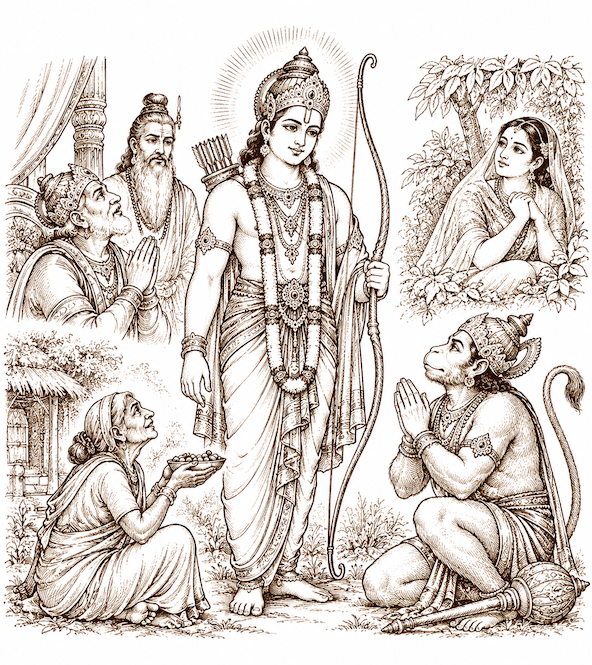
(1) When Śrī Viśvāmitra commanded Daśaratha to send Rāma with him, Daśaratha referred to Rāma’s eyes, saying, ”ūnaṣoḍaśavarṣo me rāmo rājīvalocana:” (My Rāma is less than sixteen years old and is lotus-eyed), indicating that Rāma is very young and has eyes like the lotus.
(2) Śabarī, looking at Rāma, says:
Cakṣuṣā tava saumyana
Pūtāsmi raghunandana |
Gamiṣyāmyakṣayān lokān
Tvatprasādād arindama ||
Referring to the beauty of Emperumān’s divine eyes, she says that she has been purified by that gracious kaṭākṣam and that, by His prasāda, she is proceeding to the eternal, imperishable worlds from which there is no return.
(3) When Sītā Pirāṭṭi looked at Māruti and inquired about the majestic form and beauty of Śrī Rāma’s divine body, beginning with ”kathamurukathaṃ bāhu:” (How are His thighs, how are His arms?),
he begins his description with ”rāma: kamalapatrākṣa:” (Rāma has eyes like lotus petals). First and foremost, Āñjaneyan mentions His eyes. He joyously praises those eyes, saying that those very eyes completely captivated and took possession of him, a member of the race of monkeys that leaps from palm to palm.
Why, Sītā Pirāṭṭi herself, while in the Aśokavanam, melts with devotion thinking of Śrī Rāma in this way:
Taṃ padmadalapatrākṣaṃ
Siṃhavikrāntagāminam |
Dhanyā: paśyanti me nāthaṃ
Kṛtajñaṃ priyavādinam ||
Before recounting any other glories of Śrī Rāma, she first speaks of His eyes, saying, ”taṃ padmadalapatrākṣaṃ” (Him, whose eyes are like lotus petals).
When Hiraṇyākṣa abducted Bhūmi Pirāṭṭi and hid in the ocean, Śrī Bhūmi Pirāṭṭi cried out from there:
”Namaste puṇḍarīkākṣa śaṅkha cakra gadādhara |”
Thus, she mentions Emperumān’s eyes first and foremost.
When Kaṇṇan (Kṛṣṇan) went as a messenger to Hastināpuram, He accepted hospitality at Śrī Vidura’s residence, contrary to everyone’s expectations. At that time, Duryodhana, filled with arrogance, mockingly insulted Bhagavān. Yet even while speaking insultingly, he was captivated by His divine eyes (netras), and addressed Him as such:
Bhīṣma droṇāvatikramya
Māṃ caiva madhusūdana |
Kimarthaṃ puṇḍarīkākṣa
Bhuktaṃ vṛṣalabhojanam ||
He calls out to Him, “Oh Lotus-eyed One!”
In the grand assembly, Draupadī cries out in distress:
Saṅkhacakragadāpāṇe
Dvārakānilayācyuta |
Govinda puṇḍarīkākṣa
Rakṣa māṃ śaraṇāgatām ||
Thus, she pleads, “Oh Lotus-eyed One!” Nammāzhwār too marvels, saying, ”paṅgayakkaṇṇaṉeṉko! pavaḷac cevvāyaṉeṉko” (Shall I call Him the Lotus-eyed One! Shall I call Him the coral red-lipped One).
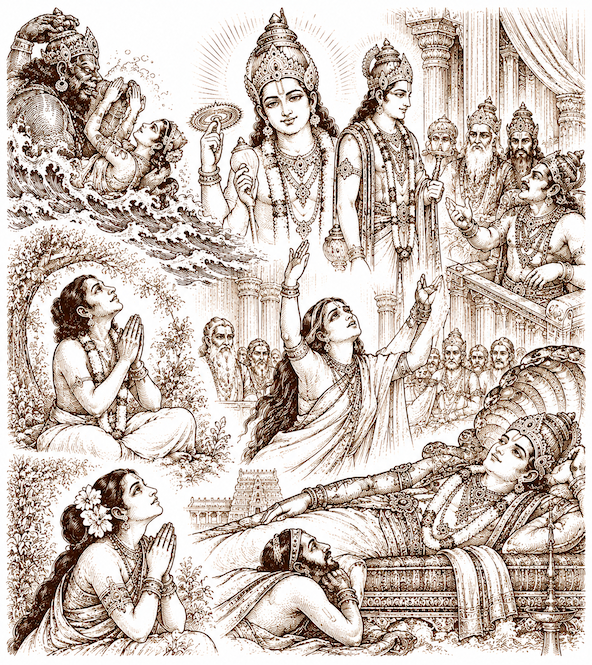
Sūḍikkoḍutta Nācciyār (Āṇḍāḷ) also mercifully speaks of the greatness of Emperumān’s gracious glance (kaṭākṣa-vīkṣaṇam), saying, ”aṅgaṇiraṇḍuṅgoṇḍeṅgaḷ mel nokkudiyel eṅgaḷ mel sābam iḻindelorembāvāy” (If You look upon us with both Your beautiful eyes, the curse upon us will be lifted, Elōr Empāvāy).
Thiruppāṇāzhwār, standing in the divine courtyard of Lord Arangan (Ranganatha), becomes immersed in the beauty of each of Arangan’s divine limbs in sequence, describing them as: ”kāṭṭave kaṇḍa pādakamala nallāḍaiyundi, teṭṭarumudarpandam thirumārbu kaṇḍa cevvāy, vāṭṭamil kaṇgaḷ meni” (The lotus feet shown to me, the fine garment, the navel, the waist band hard to seek, the divine chest, the red lips seen, the unfading eyes, and the body).
In this, he deeply experiences and describes the glory of those unfading eyes:
Pariyanāki vanda
avuṇanuḍal kīṇḍa
Amararkku ariyavādippirān
araṅgattamaḷan mugattuk
Kariyavāgip puḍaiparandu
miḷirndu cevariyoḍi
Nīṇḍavap periyavāya kaṇgaḷ
ennaip pedamai ceydanave.
Thus, he speaks with profound immersion and anubhavam.
Compared to the eyes of all other avatāras, the eyes of the Śrī Nṛsiṃhāvatāra possess a unique distinction. Thinking again and again about the special features of these eyes, he melts with devotion.
(1) He experiences and describes the divine netras of Śrī Nṛsiṃhan, which, from a divine face radiating the blazing fire of wrath, coolly bestowed grace upon the parama bhakta, the child Prahlāda. In the Śrī Nṛsiṃhāvatāra, on the terrifying divine face roaring like a lion, there are mane hairs blazing like fire on the upper side, fiercely knit eyebrows, a highly terrifying and ghastly gaping mouth on the lower side, and lion’s fangs. Surrounded by the terrifying lion’s roar capable of tearing apart the fourteen worlds, His divine eyes are nevertheless filled entirely with compassion. They coolly cast their glance upon the parama bhakta, Śrī Prahlādāzhwān, shining with intense vātsalyam and tenderness, just as a mother lovingly feeds milk to her little one. What beauty—beauty beyond compare! The Āzhwār’s anubhavam is that he is ”cīṟṟattoḍaruḷ peṟṟavaṉ” (the one who received grace amidst wrath).
(2) Can one see this wondrous union of man and lion anywhere else? What can be said of the brilliance of those divine eyes, which shower mercy from a divine face blazing with the fire of wrath, like a lotus blooming within a blazing ember!
(3) The divine face and the divine eyes that conquer even a freshly blossomed red lotus.
Karumugil tāmaraikkāḍu pūttu
nīḍu irucuḍar irupuṟat tēntiyēntalarn
Tiruuvuḍaṉ poliya ōr
ceṉpoṟkuṉṟiṉmēl varuvapōl
kaluḻaṉmēl vandu thōṉṟiṉāṉ
This is the anubhavam of the great poet Kamban.
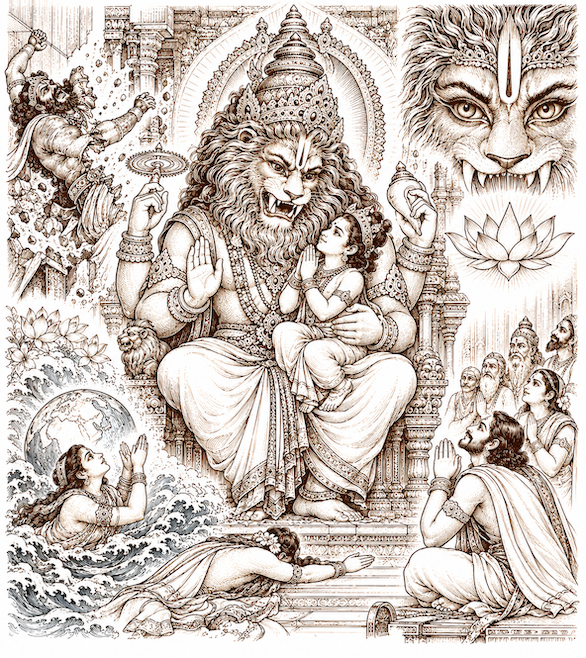
The very moment they see the devotees bowing at His feet, those divine eyes conquer the beauty of a freshly blossomed red lotus. It is this that Śrī Īśvara refers to as ”vṛttotphulla viśālākṣaṃ”. Bhagavān is an ocean of mercy.
Within that ocean, His eyes are another little ocean. As it is said, ”kaḍalaittaṭāgamākkiṉāṟ pōlē iḍamuḍaittāyirukkai” (being expansive as if an ocean were made into a pond). Even upon a supremely lowly person like me, that ocean of grace falls and drinks me in entirely. Is it not said, ”locanābhyāṃ pibanniva” (as if drinking with the eyes)? Such is the elegance of His divine eyes.
(4) ”vṛttotphullaviśālākṣaṃ” Those large eyes ”ceviyaḷavum alaiyeṟigai” (waves splashing up to the ears). Because they are viśālanetra (broad eyes), their kaṭākṣam extends and falls even upon ordinary people. Thus, he marvels, “It has captivated even an ordinary person like me.” ‘bṛhatvāt‘ (Because of being great), He is Brahmam. The Veda also says, ”bṛhate viṣṇo”. By using the word ”viśālākṣaṃ”, one must relish and realize that His netras shine forth as being even greater than Brahmam itself.
”kaṇgaḷiṉ kṛubai veḷḷattāl uḍambellām kaṇṇāgac ceyyappārkiṉṟaṉa” (With the flood of grace from His eyes, they seek to make the entire body into an eye.) — this is the anubhavam of Bhattar.
While adiyen was seated on the banks of the Śrī Kṛṣṇā river in the Śrī Maṭṭapalli Mahākṣetram, writing this, the Paraman graciously bestowed upon adiyen a special experience. Prominent persons associated with the Śrī Maṭṭapalli Śrī Lakṣmī Nṛsiṃha Devasthānam came to adiyen and requested, ”You should kindly write a Maṅgalāṣṭakam regarding the Śrī Maṭṭapalli Lakṣmī Nṛsiṃha Swāmi.” I was immediately perplexed: “I have to write eight ślokas—what should I do?” After completing my evening Sandhyāvandanam in the Śrī Kṛṣṇā river, I sat opposite Mālolān who resides at Śrī Maṭṭapalli and chanted the Śrī Mantrarāja Pada Stotram 32 times. What a wonder! All eight ślokas came to adiyen of their own accord! I was filled with joy at the thought of the immediate fruits bestowed by the Śrī Mantrarāja Pada Stotram. Adiyen’s heart melted.
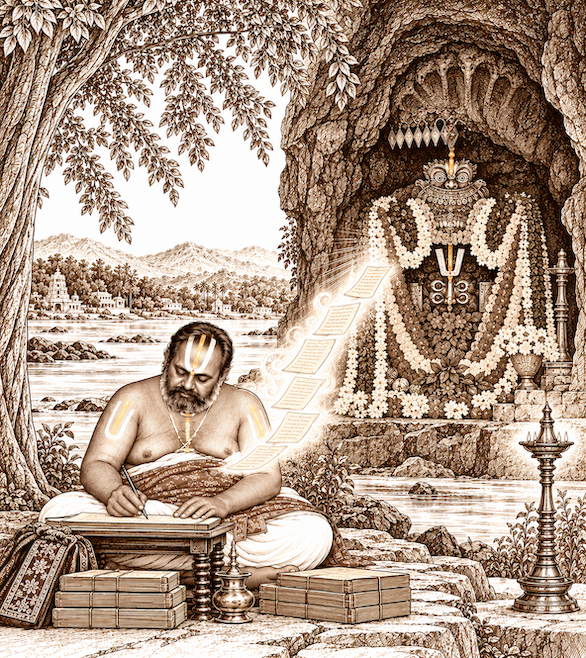
For the joy and anugraham of the esteemed readers, adiyen presents here, exactly as received, the Śrī Maṭṭapalli Maṅgalāṣṭakam that was bestowed upon adiyen by His grace.
Śrī Maṭṭapalli Maṅgalāṣṭakam
(1)
Maṭṭapallinivāsāya
Mathurānandarūpiṇe |
Mahāyajñasvarūpāya
Srīnṛsiṃhāya maṅgalam ||
(2)
Kṛṣṇaveṇītaṭasthāya
Sarvābhīṣṭapradāyine |
Prahlādapriyarūpāya
Srīnṛsiṃhāya maṅgalam ||
(3)
Gartasthitāya dhīrāya
Gambhīrāya mahātmane |
Sarvāriṣṭavināśāya
Srīnṛsiṃhāya maṅgalam ||
(4)
Rgyaju:sāmarūpāya
Mantrārūḍhāya dhīmate |
Sritānāṃ kalpavṛkṣāya
Srīnṛsiṃhāya maṅgalam ||
(5)
Guhāśayāya guhyāya
Guhyavidyāsvarūpiṇe |
Guharānte vihārāya
Srīnṛsiṃhāya maṅgalam ||
(6)
Srī pallyadrimadhyasthāya
Mathurāya mahānidhe* |
Sukhapradāya devāya
Srīnṛsiṃhāya maṅgalam ||
(* Nidhaye mathurāya ca |)
(7)
Tāpanīyarahasyāya
Tāpatrayavināśine |
Natānāṃ pārijātāya
Srīnṛsiṃhāya maṅgalam ||
(8)
Rājyalakṣmyā sametāya
Rāgadveṣa vināśine |
Maṭṭapalli nivāsāya
Srīnṛsiṃhāya maṅgalam ||
Phalaśruti:
Mukkūr nṛsiṃhadāsena
Proktaṃ maṅgala madbhutam |
Ya: paṭhet śraddhayā bhaktyā
Sarvapāpai: pramucyate ||
(To be continued)