
Sri:
Srimathe Sri Lakshminrusimha Parabrahmanae Nama:
Guidelines ordained by the Vedas to lead a contented life
( 1 ) Um
(Divine nectar from Sri U.Ve Mukkur Lakshminarasimha Chariyar upanyasams)
(Compiled by: Sri.U.Ve. Mukkur Srinivasan)
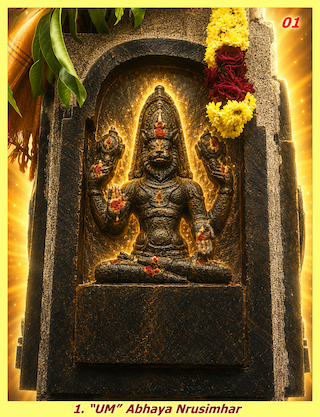
1. For those who can chant mantras and stotras with their mind constantly fixed upon the divine feet of Lord Vishnu, their dwelling place becomes Sri Vaikuntha.
2. If Vishnu is uttered, it is a divine name. If it is chanted as “Om Vishnave nama:”, it becomes a mantra. It is a noble mantra with six syllables. The Supreme Lord is greatly pleased if a flower or tulsi leaf is offered at His divine feet chanting “Om Vishnave nama:”.
3. Tulsi leaf should be plucked very carefully without the nail touching the leaf. The verse, ”Tulsi ! Amritha Janmasi ! Sadha Thvam Kesava Priye!” should be chanted while thus collecting.
4. The flower or tulsi leaf should be placed in front of our heart and it should be offered at His divine feet saying, ‘This heart of mine is nectarous. I am surrendering this heart. I am surrendering my whole self at your divine feet’.
5. While thus offering the flower, the meaning of the following verse should be thought of and recalled.
Ahimsa Prathamam Pushpam
Pushpam indriya nigraha:
Sarva bhootha daya pushpam
Kshama Pushpam Viseshatha:
Santhi: pushpam thapa: pushpam
Gnanam pushpam thathaivacha
Sathyam ashtavitham pushpam
VishNo: preethi karambhaveth.
6. Truthfulness is the most preferred flower to offer to the Lord. Manusmrithi says “Let truthfulness be your voice always. Let it be a pleasant truthfulness. While speaking truth, you should not hurt anybody. At the same time a lie should not be uttered to please somebody. Let this be your Dharma”.
7. While doing archana chanting “Vishnave nama:”, we have to see whether we possess the above mentioned eight. If we perform archana with this feeling, we would automatically get these eight flowers – i.e. gunas.
8. We are offering a flower. We chant a divine name. He returns it eight fold. He is so compassionate. We do the archana with the knowledge of the result. If we do not receive the desired result, it means that our nishtai is not enough. We have to continue doing that again and again with nishtai till we achieve the desired result.
9. The great sage Vyasa refers to the terrible kaliyuga as docile. Why? Because, it is possible to receive the result of performing one Ashwametha yagna by just listening with concentrated devotion to the chanting of the mantras, in this Kaliyuga. There is a catch in this easy way. That is “with concentrated devotion”
10. We must possess the power of pranayama if we aim to get the concentrated devotion. Pranayama can easily be described as an exercise through which we inhale and exhale our breath. But the period for which we are able to hold our breath inside is most important. That time period should increase gradually. Then we can control our mind.
11. The mind which is swaying like a jasmine creeper should be steadied by pranayama and should be wound around a support – i.e. Emperuman’s divine feet. Then the mind would prosper having that as a hold.
12. Pranayama can be performed by ladies also. It can be practiced chanting slokas without uttering mantras. The mother of Sri. Ramaa, Kousalyadevi had practiced pranayama . She reaped a divine result.
13. Thus if we make an effort to reach Him with the strength of pranayama, every thing would become easily reachable. There is nothing that cannot be achieved if we attempt with the strength of pranayama.
14. Eight represents the divine name of the Lord ‘Om Namo NarayaNaya‘. What are the things that is bestowed by that?
Kulam tharum selvam thanthidum
Adiyar paduthuyar ayinaellam
Nilam tharam seyyum neeLvisumbarulum
Arulodu perunilamaLikkum
Valam tharum matrum thanthidum
Petrathaayinum aayina seyyum
Nalam tharum sollai naan kandu konden
Narayana ennum naamam
(Peria Thirumozhi 1-1-9)
Meaning: The tirunamam Narayana gives a good life, of wealth and family, and rages to ground all travails, facing devotees, then grants the rule of the Sky and Earth with benign grace. It gives a man strength, and all that there is, with love that exceeds a mother’s. It gives the pure good, I know the Mantra, Narayana the Divine name.
15. The divine name Narayana is capable of getting us Moksha.
16. We should not have a desire for this body. We should imprint in our minds Adhi Sankara’s words – ” who is eligible for Moksha?” ” That one who considers his physical body as dead while being alive, is eligible for Moksha”.
17. Paramatma resides inside us. We have to understand and realize what the noble scripture says – that the paramatma who can pervade everything, resides both inside us and also inside insentients (achetanas – lifeless objects).
18. We can see the one who resides inside us through the mantras taught by the Acharyas.
19. We should not memorise a mantra reading it from a book. It would never bestow the desired result if it is chanted after getting it memorised from a book. We have to prostrate at the feet of Acharya, learn it from him, and then only we can bring it into practice.
20. We should have similar/equal devotion towards the mantra, the Demi-god represented by the mantra and the acharya who taught us the mantra. Only then, it would be fulfilled. i.e. It would bestow the desired result.
21. The Gayathri mantra protects those who chant it very regularly. The Ashtakshara also protects thus. The gents should recite the Ashtakshara after chanting Gayathri mantra.
22. The Pranava should never be separately chanted. It should be chanted along with the mantra in three syllables. The ladies should pronounce Pranava as ‘um’.
23. If some deed is performed by a person according to his own wishes and desires against the sastras or scriptures, he would not attain fulfillment. This is Bhagavan’s own saying.
24. We have to live according to sastras or scriptures without making the Supreme Lord angry.
25. The affection showered on us by the sastras or scriptures is greater than thousand parents.
26. All auspicious things and good results flow towards the one who lives according to the sastras or scriptures. He would be praised wherever he goes.
27. Our sampradaya glorifies Aacharam and anushtanam ( rituals and practices) more than gnana (knowledge)
28. Only if the one who preaches, follow the rituals and practices, others would practice. Otherwise they would start asking, ‘why we should do it when he himself is not practicing?’
29. Gazing at the sun is a very important practice. Those who see the sun as their first action (anushtaanam) or when Sun comes out in the horizon are considered great people. Hence we have to get up before the sun rises and prostrate expecting his arrival.
30. The Lord incarnated as Sri RAmA in the clan of sun. When He incarnated as Sri Krishna he took birth in the clan who saw the sun first everyday.
31. Sri Lakshmi Nrisimha has such a Sun as His right eye.
32. The one who is the ‘Akaara‘ in the Pranava (the first letter), who has Surya as His eye, who resides in the ‘Um‘ akshara, who blesses those who take refuge in His divine feet, is our Mattapalli Lakshmi Nrisimhan. Let us praise His glory and derive happiness on this auspicious day.
|| Sakalam Bhadramashnuthae! ||
Sri:
Srimathe Sri Lakshminrusimha Parabrahmane Namaha:
GUIDELINES ORDAINED BY THE VEDAS TO LEAD A CONTENTED LIFE
( 2 ) Gram
(Sri U.Ve Mukkur Lakshminarasimha Chariyar)
(Compiled by: Sri U.Ve Mukkur Srinivasan)
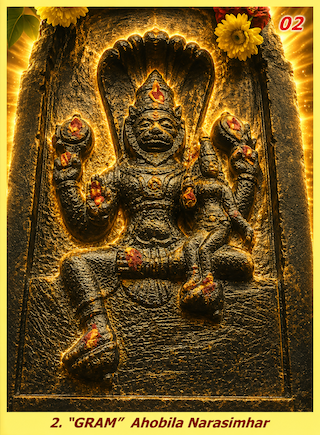
1. One should fully realize that The Lord (Paramathma) dwells in the letters (aksharams) “A – अ” and “Gram”. He is the reason behind all that is happening in the world and also for all those for which we are not able to infer. He is the one behind all actions and inactions. The letter “A – अ” denotes “the person who is the reason” and “the person to whom it belongs”.
2. In order to make a pot, we need mud, human effort, batten (stick) and wheel. In this scenario, the mud is the basic raw material. Hence in the making of the pot, mud is the Upadhana kaaranam. The potter’s efforts result in the making of the pot and hence the potter becomes the creator and is called Nimittha kaaranam. The batten and the wheel are the instruments used in the process and are referred to as Sahakaari kaaranam or the medium. Hence in this material world, for any creation, we would require a creator, raw material and instrument and for us all these three are different entities.
3. In the case of the Supreme Lord, He is all-in-one. He is the only one who drives the entire process. If this Universe is considered as similar to the making of the pot, then the Lord is the source or material cause (Upaadhaana kaaranam), the creator (Nimittha kaaranam) and the medium or instrument in its making (Sahakaari kaaranam). Nothing else could be the reason beyond Him.
4. He is omnipresent (Vyapya roopan) and all-pervading (Vyapaka roopan) and is the sole reason for the existence of everything. This realization results in “Paramatma Gnanam” or enlightment about the Lord. He is the Universe and He is the creator of this Universe. He is all pervasive in this Universe. At his desire, He manifests Himself in various forms and is omnipresent. This is amply evidenced in the incarnation of LORD NRUSIMHA.
5. We are all blessed to have taken birth as human beings with the invaluable six senses. Hence, we need to productively devote our thoughts on the Lord (Brahma Vicharam) to realize Paramatma Gnanam as stated above. In other words, we should meditate upon the Paramathma Swaroopam. We need to focus on the manifestation of the Lord. We ought to realize the one who is the origin of this Universe, the one who manages the entire functioning of this Universe and the one who is the final destination for each and every aspect of this Universe.
6. Meditation is the modus operandi for this realization. This can be done by:
a. engrossing ourselves on the sacred names of the Lord which enunciate His divine qualities (or)
b. meditate upon His divine names (or)
c. recite His divine names in group.
In all these things, utmost devotion is essential.
7. Any meditation carried out without fully engrossing ourselves will not result in the realization of the Lord. In order to control our wavering mind and to realize HIM, we ought to purify our five states or sheaths in our body.
8. There are five states or sheaths in our body. They are Annamaya Kosam (digestive sheath), Pranamaya kosam (respiratory sheath), Manomaya kosam (Mental sheath), Vignanamaya kosam (intellectual sheath) and Aanandhamaya kosam (blissful sheath). Only when there is sanctity in these states, we can understand the divine aspects of the Lord. Otherwise our knowledge would be limited to normal worldly aspects.
9. Fasting (upavaas) and performing devotional rites (vrath) with reduced intake of daily food would help in purifying our digestive sheath. The Supreme Soul (Parabrahmam) is the divine food to relish and to nurture us.
10. Pranayamam (breath control or deep systematic breathing) helps in the purification of the respiratory sheath. A minimum of ten pranayamam is mandatory to be performed during Sandhyavandhanam. The purification of respiratory sheath leads to streamlining of the five types of air in our body. This further enhances the functioning of hands and legs, elevates gait beauty, sharpness of sight and eloquence of speech.
11. To purify the Mental sheath, we have to focus on the divine feet of the Lord. Every act of ours should be carried out with the realization that it is He who is behind every act in the world. In order to cleanse the mental sheath, it is advisable to recite Swami Desikan’s “Paramartha Stuthi” eleven times daily.
12. The discretion to differentiate between what is right and what is wrong and adoption of the right ones culminates in the cleansing of the intellectual sheath.
13. Purification of blissful sheath results in the realization of God. To attain this purification, one has to understand the divine qualities of the God. Amongst the innumerable divine qualities of the Lord, we need to specifically realize the forthcoming nine main divine qualities of the Supreme Lord. Once such realization dawns upon us, we shall be able to get every thing.
14. The first and the foremost amongst the nine divine qualities is Sarveshwarathvam (Supremacy of the Lord}. HE is supreme because HE is Omnipresent; All pervading and Sole controller of the entire Universe. It is this divine quality that exhibits that HE is the creator and HE is the God who controls the entire Universe.
15. The second divine quality of the Lord is “Shriyapathitvam” being the divine consort of Goddess Mahalakshmi. Alongwith the Supreme Lord, Goddess Mahalakshmi is also all pervading and omnipresent. Hence whenever we say that Lord Narayana has descended, it is always implied that HE is accompanied by Goddess Mahalakshmi.
16. Apahathapāpmathvam (Being Blemishless) is the third important divine quality of the Lord. The Supreme Soul (Paramathma) is blemishless.
17. The fourth divine quality of the Lord is Vimruthyathvam (Eternal). HE does not experience the fear of death. HE is the Mruthyu for aal mruthyus.
18. The fifth divine quality of the Lord is “Vijwarathvam”. He is never infected by fever or any other diseases.
19. The sixth divine quality of the Lord is “Sathyakāmathvam” wherein “Kamam” refers to thoughts. The state in which the thoughts are always blemishless is referred to as “Sathyakamathvam” The God transforms all HIS thoughts into action. HIS thoughts can never be annihilated and they are blemishless.
20. The seventh divine quality is “Sathyasankalpathvam” which means that HE is the one who fulfils HIS will or desire. HE by HIS own will administers the entire Universe. HE takes various incarnations like Rama and Krishna. HE dwells in temples in the Archa state (in the form of statue). On HIS own accord, HE dwells in all movable and immovable beings.
21. HIS eighth divine quality is “Being the Controller within” of all aspects of this Universe. This quality is referred to as “Sarvaantharyaamithvam”. HE dwells in our hearts as Controller within (Antharyami). HE relishes everything (Bhogtha) and HE is also the one who is being relished (Bhogyam). HE is the one who administers everything (Prerakan).
22. The ninth divine quality of the Lord is “Sarvajñyathvam”. The Lord comprehends everything as it happens. HE is seeing everything. We cannot do any act without HIS knowledge.
23. Lord Shiva extols the glory of Lord Nrusimha with reverence in nine padams in “Eshwara Samhita”. Lord Shiva surrenders himself by doing Athma Samarpanam through Manthraraja Padha Stothra to the Lord Lakshmi Nrusimha who alone can grant salvation as Mumukshu (moksha) Upasya Devatha. This Manthraraja Padha Sthothra is sacred sthothra and it is considered as supreme authority by the preceptors of all the three sects (viz. Advaitha, Vishishtadvaitha and Dvaitha).
24. The aforesaid nine qualities of the Lord are elucidated in the nine padams of “Manthraraja Padha Stothra”. Each padam depicts the nine divine qualities of the Lord.
25. The Nine Nrusimhas dwelling in the divine Ahobila Mahakshetram personify these nine qualities of the Lord both individually as well as collectively.
26. We can shower praise on the glory of Jwala, Ahobila, Malola, Kroda, Karanja, Bhargava, Yogananda, Chathravata and Pavana Nrusimhas who are the repository of these nine divine and auspicious qualities.
27. Kroda Nrusimha who dwells in Ahobilam is the same Lord who dwells as Varaha Nrusimha in Simhachalam.
28. The Lord Nrusimha of Ahobila dwells in the letter (aksharam) “GRaM”. He takes us forward as “Agram”. Aho means great or big; Bilam means Cave.
29. The Lord who dwells in Ahobilam as “Yoganandha Nrusimha” is the same God who dwells in the divine place Mattapalli Mahashetram with HIS consorts Goddess Rajalakshmi and Goddess Chenchulakshmi as “Rajyalakshmi Chenchulakshmi Naayikaa Sametha Baktha Prahladha Yoganandha Lakshmi Nrusimha” in the holy cave (which is sacred lore or vedha Guha) sheltered by Adisesha.
30. The Lord of Mattapalli is in meditative state to protect those who surrender themselves to HIM. HE infallibly protects all those who surrender to HIS Lotus feet. HIS thoughts are always blemishless (Sathyakaman) and HE can fulfil all that HE desires (Sathyasankalpan).
31. Lord of Mattapalli is an epitome of bliss. We should worship the Lord with the realization that HE is the embodiment of these nine divine qualities:
a. Sarveshwarathvam (Being Supreme)
b. Shriyapathithvam (Being consort of Goddess Mahalakshmi)
c. Apahathapapmathvam (Being blemishless)
d. Vimruthyathvam (Being Eternal)
e. Vijwarathvam (Being free from diseases)
f. Sathyakamathvam (One whose thoughts cannot be annihilated and who is blemishless)
g. Sathyasankalpathvam (One who fulfils all His desires)
h. Sarvantharyamithvam (One who is the controller from within)
i. Sarvajyathvam (One who comprehends everything as it happens)
This realization results in purification of blissful sheath.
32. “Bilam” refers to cave. In this auspicious day let us surrender ourselves to the Lotus feet of the Lord who dwells in the holy cave of the sacred lore (Vedha guha) in Mattapalli as Yoganandha Nrusimha to bestow Brahmaanandam by residing in our hrudaya guha.
|| Sakalam Bhadramashnuthe! ||
Sri:
Srimathe Sri Lakshminrusimha Parabrahmane Namaha:
GUIDELINES ORDAINED BY THE VEDAS TO LEAD A CONTENTED LIFE
( 3 ) Veem
(Sri U.Ve Mukkur Lakshminarasimha Chariyar)
(Compiled by: Sri U.Ve Mukkur Srinivasan)
1. The Supreme Lord, the consort of Sri (Mahalakshmi), during His incarnation as Sri Krishna, sucked His big toe with His delicate lips. Why? He was actually testing what the Vedas proclaim. The Vedas declare, “Let everything around be as sweet as honey; let the cows yield milk as sweet as honey; let the plants yield fruits and vegetables as sweet as honey; let the entire world become as sweet as honey. For all this to happen, meditate on the honey oozing from the divine feet of the Lord.” Not only that, by solemnly declaring, “Let honey eternally flow on My tongue, and let it always be bestowed with the ability to speak words as sweet as honey,” He tested the fruits and the divine power of His own feet as enunciated by the Vedas.
2. Vaasudeva is another divine name of Lord Sri Krishna. The Lord dwells precisely within the divine name ‘Vaasudeva’. “सर्वत्र वसति वासुदेव: – Sarvatra vasati iti Vaasudevaha“—this divine name is attributed to Him because He is omnipresent in this universe, residing within all beings, both animate and inanimate.
3. The Vedas describe this Lord Vaasudeva as both one and many. They acclaim Him using both odd and even numbers, praising Him as “He who resides in one, three, five, seven, and nine,” and also as “He who dwells in four, eight, and twelve.” When they say He who is one is also three, it means, “He took the forms of Brahma, Vishnu, and Shiva, and dwells within them as their Antaratma (inner soul).” When they say He became five, it means “He Himself became the Pancha Bhoothas (five elements).“
4. In order to realize that the Supreme Lord is present as both one and many, Bhakti (devotion) is essential. Jnana (knowledge), Bhakti (devotion), and Vairagya (detachment) are the three key tenets. Notice that Jnana is mentioned first, Vairagya is mentioned last, and Bhakti is placed right in the middle. This signifies that once Bhakti blossoms within us, Jnana and Vairagya will automatically follow. Without Bhakti, one cannot acquire Jnana. Without Bhakti, Vairagya will never arise.
5. In Thiruppavai, Andal meditates on Lord Vaasudeva and sings, “Melaiyar seyvanagal venduvan ketiyel,” meaning we ought to follow what our noble ancestors practiced. We may not be able to replicate entirely everything our ancestors did, but whatever is within our capacity, we must certainly do.
6. Lord Krishna states in Bhagavad Gita that “You leave all those acts that you cannot perform”. Whilst saying so,, he immediately adds “while you leave those acts, hold on to My divine feet”. It is astounding to note how much He has simplified the path for us.
7. Therefore, we must reduce our involvement in Laukika (worldly) matters and engage ourselves deeply in Bhagavad Vishayam (spiritual matters). If we indulge in worldly affairs, spiritual pursuits will slip away from us. But if we immerse ourselves in Bhagavad Vishayam, all these worldly attachments will naturally fall away. “He Himself will be attained” is the ultimate fruit of holding onto His divine feet.
8. Realizing that Lord Vaasudeva/Govinda, who is omnipresent, completely fills our hearts as well, we must offer our food (Annam) with devotion to the Lord residing within us, and ultimately offer our very soul to Him. The Upanishads refer to this internal offering to the Antaryami (indweller) as a “Yajñam“. In an external Yajñam, we offer Havis (oblations) into the Homa Kundam in the outside world. But this—is the Yajñam performed internally to the Antaratma.
9. To develop supreme devotion towards the Lord, we must have absolute faith in Him. It is the Paramatma who orchestrates everything; He is the root cause of all. If we truly understand that not even an atom moves without Him, sorrow and worry will never afflict our minds. The mind will not get the chance to capriciously jump around. Therefore, we must place complete trust in Him and not cling to anything else.
10. To cultivate such absolute faith, we must immerse ourselves in the divine histories (Bhagavad Charitrams). In the Vishnu Purana, Sage Maitreya asks Parashara Maharishi: “From where did this world originate? By whom is it protected? Who is the ultimate cause of all this?” Parashara Maharishi answers all this in a single sloka: “O Maitreya! You asked for the cause of all these things one by one. Everything originated from Vishnu. He did not bring materials from elsewhere to create this; everything manifested from within Him. The entire universe resides within Him alone. Vishnu is the sole cause of the universe!” Realizing this ultimate truth dispels fear and gives rise to pure devotion.
11. We must perform Saranagati (absolute surrender) to the Lord with complete faith. When we do so, the Lord blesses us with Dakshina (offerings) from the Yajñam He performs. The Yajñam performed by the Lord is called ‘Saranagata Rakshanam‘ (Protecting the surrendered). No one other than Him can perform this Yajñam of Saranagata Rakshanam. Who does the Lord protect? Everyone—He protects all who come seeking surrender. Even great scholars and intellects would perish in vain without His protection.
12. Our internal (Antharika) enemies are our own Indriyas (senses). To control and master these senses, Lord Vishnu is the sole recourse. He removes the sins that lurk far outside us, and He also destroys our internal enemies, the senses. He stops our minds from wandering toward trivial matters. What does the Lord do to achieve this? He always stays with us and protects us—He protects everyone who has grasped His divine feet. Since coming from afar would take time, He resides right beside us to offer His protection.
13. The Vedas declare that the Lord is free from death, fever, and diseases. “Prathamo daivyo bhishak,” proclaims the Veda. Who is the first physician? The Veda answers: The Lord. In the Sahasranamam, He is celebrated as “Bheshajam bhishak.” Bheshajam means medicine, and Bhishak means physician. Who is the physician? The Lord. He is the medicine as well. He stands as the physician, and He Himself becomes the medicine.
14. The Lord demonstrated that He Himself is the medicine in the history of Prahlada. Hiranyakashipu ordered the venom of the Karkotaka serpent to be given to Prahlada. If the wind merely brushes against the Karkotaka serpent’s venom and touches us, it is fatal; the snake doesn’t even need to bite. It is that deadly! Yet, in the holy kshetram of Namakkal, the Lord reclines precisely upon this very Karkotaka serpent (Karkotaka Sayanam). Prahlada was made to drink this Karkotaka venom. Thinking, “Will not this poison become my medicine?“, the child took it, chanted “Narayana“, and gulped it down swiftly. The Paramatma protected that child simply through the nectar of His divine name (Namamrutham). The child stood perfectly unharmed. The Lord’s Namamrutham conquers even the deadliest poison. Hence, He is both the medicine and the physician!
15. To protect us, the Lord points out, “This is good; this is evil.” For a brief moment, He grants free will to the soul. Yet, since not an atom moves without Him, He is ultimately the cause of even this. This is His divine play (Leela). If we grasp the good, He guides us along the right path and protects us. If we grasp the evil, He lets us travel that path for a while, but ultimately grants us the highest salvation.
16. For the Jivatma, the Paramatma is the ultimate refuge (Gathi). The Paramatma was never created; therefore, He has no destruction. Similarly, the Jivatma was never created, so it too has no destruction. However, whatever is created is subject to destruction. If it is said, “someone is born,” it guarantees that “he will die.” Here, birth and death apply only to the physical body (Sarira), not to the soul (Atma).
17. To protect us, the Lord Himself imparts profound Vedantic truths, and He also speaks them through various Mahaans (great sages). He Himself selects the right sages, choosing perfectly who should speak, at what time, and in what place to make it happen.
18. Mahaans praise the Lord as Satyakāman. If we hold a request in our hearts and say, “Vishnu is Satyakāman,” Lord Vishnu will fulfill our true desire. You can even test this if you wish. You should pray: “O Prabhu! I am only asking for a materialistic desire from You. I cannot survive right now without this request. I have the responsibility to protect my family. Truly, You are the one who protects them… but in my ignorance, I think I am the protector. Therefore, You must fulfill what I am thinking of right now…” Then, repeat the two divine names, “Om Vishnave Namah, Om Satyakaamaaya Namah,” 1008 times. If you think of a desire while chanting this, it will certainly happen.
19. Because the Lord is Satyakāman, He fulfills the desires not only of us but also of Brahma and the Devas. In ancient times, Lord Brahma performed a supreme Yajñam! He did it so that everyone in the world would receive Annam (food). He performed it so no one would ever suffer for Prasadam (food). For this, he conducted the Ashwamedha Maha Yajñam. The one who emerged from that Ashwamedha is the Lord Devaathirajan, who resides in Kanchipuram, the Satyavrata Kshetram. He fulfilled Brahma’s request. Even today, He stands as Satyakāman and continues to fulfill our desires.
20. Thus, the Lord is present as the Archa-rupam (deity form) in many Kshetrams. The Upanishad states that the Paramatma experiences no joy in being utterly alone. When does the Paramatma rejoice? He rejoices when His Bhakthas and Bhagavathothamas immerse themselves in singing His glories! He gets delighted when His sanctum sanctorum becomes muddy because of the tears of the overjoyed devotees.
21. The Lord relishes such devotees. The Upanishads urge us to understand: Who is the Bhoktha? What is the Bhokyam? Who is the Prerakan? Bhoktha is the one who experiences/enjoys. Bhokyam is the object being experienced. Prerakan is the one who induces or facilitates the experience. In our worldly matters, these three are entirely different. But in Bhagavad Vishayam, all three—the Bhoktha, the Bhokyam, and the Prerakan—are the Lord Himself.
22. The Lord Himself attains those who are dear to Him, and He makes them attain Him. To become worthy of His love, we must perform the Karmas prescribed by Him, and we must surrender this soul as His property in a manner acceptable to Him. It is precisely to facilitate such a supreme Atma Samrpanam (soul surrender) that He resides within us as the Sarvāntaryāmi.
23. The Azhwars praise the Lord in various ways as Amalan, Vimalan, and Nirmalan. Malam means dirt or impurity. The Paramatma is the exact opposite of that. He possesses countless auspicious qualities. In one place, the Veda describes Him as “Nirgunah Niranjanah,” seemingly stating He has no qualities. The Acharyas have clarified this: “Being Nirguna does not mean He is devoid of all qualities. It means He has absolutely no bad qualities. All His attributes are Sugunas (auspicious qualities).“
24. The Lord, fully brimming with Sugunas, blesses us in magnificent ways across various Divya Desams. By manifesting in all these Divya Desams, He captivates and rules over us. He resides in Vaikuntham… He is in the Divya Desams… He takes incarnations like Rama and Krishna… Above that, He reclines on the Milky Ocean (Thirupparkadal). And beyond all this, the Upanishad reveals that He exists within everything as the Antaryami.
25. The Lord graciously manifests in the Bimbas (idols) and Vigrahas that are consecrated according to the Agamas. When Mahaans perform Aarādhanam (worship), they do so with immense humility and extreme care because the Lord resolves, ‘I am entirely present in this Bimba,’ and comes to reside there. The Lord takes residence in the Bimbas in four ways: Daivam, Maanusham, Aarsham, and above all, Swayam Vyaktham. Daivam means consecrated by the Devas through their prayers. Aarsham means He became visibly manifest to the Maharishis and, upon their prayers, remained in those Kshetrams in that very form. Those consecrated by humans according to Agamic rules are Maanusham. Swayam Vyaktham means He manifested at certain places entirely of His own volition.
26. The Veda declares that Yajñam is the most superior way to worship the Lord: “Yajñohi sreshthatamam karma.” The Veda prescribes a specific Yajñam to be performed on the day of Rohini Nakshatram. This Yajñam, known as Odhana Savam, is performed with the prayer that all living beings in the world should receive Annam (food). This Yajñam must be commenced right at sunrise.
27. To the Yajamanas who perform such a Yajñam, the blemishless Lord (Amalan) grants a pure, unblemished intellect, fulfilling the prayer “Sumathim bhajaamahe.” Our intellect must be absolutely pure. The intellect is prone to flaws like Anyatha Jnanam, Vipareetha Jnanam, and Samsayam. Misunderstanding one thing for another is Anyatha Jnanam. Grasping the exact opposite of what is told is Vipareetha Jnanam. Doubting everything and being confused about ‘is it this or that?’ is Samsayam. The spotless Lord (Amalan) removes all these impurities and grants the ultimate fruit of the Yajñam.
28. The Lord who grants the fruits of the Yajñam is an Aashritha Vatsalan. He stays close beside us so that He can come running the moment we call Him. Just as a calf runs behind the cow, and if the calf is led in front, the cow follows, the Paramatma never leaves our side. That is His quality of Vaatsalyam. He does not separate from us even for a moment… out of His fear of what might happen to us!
29. When the Paramatma is an Aashritha Vatsalan toward us, full of profound, special love, we must approach Him and say, “Hey Prabhu! The love You have for me is immense! What I have for You is so little.” He Himself has stated this in the Bhagavad Gita. Therefore, we should never ask, “Is it better for the Lord to love us, or for us to love the Lord?” Instead, we must rephrase the question: “Is the love you have for the Lord greater? Or is the love the Lord has for you greater?“
30. At the same time, if karmas like Yajñam are performed for Khyathi—for fame, for profit, or for Pooja (so that others will praise and celebrate us)—the Lord will never accept that karma or act.
31. Therefore, we must always remember what the Lord taught Arjuna by staying right beside him. “This physical body of ours is a chariot. The Indriyas (senses) are all horses; the mind is the reins; the intellect is the charioteer. The Paramatma enters our intellect and drives the action. He stays right beside us and protects us.“
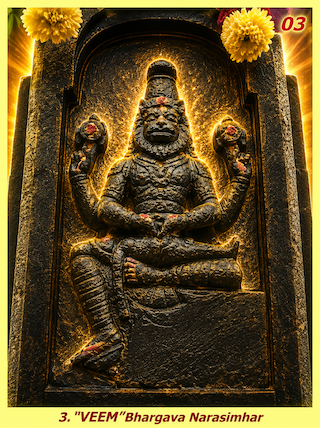
32. Thus, the Lord who protects us in all places and at all times resides in the Ahobila Kshetram as “Bhārgava Narasimhan,” manifesting as the majestic Periya Perumal who granted His divine service (darshan) to Parasurama. It is He who also resides in the Yajñavaatika of the Mattapalli Maha Kshetram, within the pillar of the third syllable “Veem“. For those who meditate upon Him on this auspicious day, He will cure bodily ailments, eradicate the Rajo and Tamo gunas, bless them with Sattva guna, and protect them. There is absolutely no shortcoming! (Kuraiyondrumillai!)
|| Sakalam Bhadramasnuthe! ||
Sri:
Srimathe Sri Lakshminrusimha Parabrahmane Namaha:
GUIDELINES ORDAINED BY THE VEDAS TO LEAD A CONTENTED LIFE
( 4 ) Ram
(Sri U.Ve Mukkur Lakshminarasimha Chariyar)
(Compiled by: Sri U.Ve Mukkur Srinivasan)
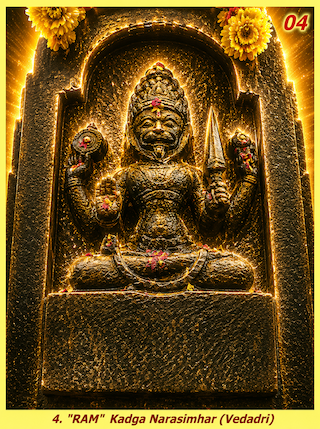
1. Bhagavan Sri Lakshmi Nrusimhan dwells in the fourth aksharam (syllable), “Ram”.
2. “Ram” signifies the One who enchants us—the One who captivates and magnetically attracts us towards Him.
3. Emperuman, possessing a uniquely resplendent Divya Mangala Swaroopam (divine auspicious form), attracts and captivates everyone through the following 9 kalyana gunas (auspicious qualities). They are Amalathvam (Blemishlessness), Ashrita Vatsalyathvam (Boundless affection towards surrendered souls), Upayathvam (Being the Supreme Means), Upeyathvam (Being the Ultimate Goal), Bhogyathvam (Being the Object of Enjoyment), Bhokthruthvam (Being the Supreme Enjoyer), Niyanthruthvam (Being the Supreme Controller), Shubhashrayathvam (Being the Auspicious Refuge), and Sarvathomukhathvam (Being accessible from all directions/Omnipresence).
4. The first attribute is “Amalathvam”. ‘Malam’ means blemish or impurity. ‘Amalam’ means that which is absolutely blemishless. It denotes that Paramatma is completely free from any impurities.
5. Establishing that Bhagavan is immaculate, Swamy Desikan extols Him as “Amalan, aviyaatha sudar, alavilla aaramudham” (The Blemishless One, the unextinguishable flame, the boundless insatiable nectar). Thiruppaanazhwar sings in Amalanadhipiran, “Amalanaadhipiraan; adiyaarkku ennai aatpadutha vimalan” (The Blemishless Primordial Lord; the Pure One who made me a servant to His devotees).
6. Just as Bhagavan possesses an immaculate Thirumeni (divine physical form), He is equally endowed with flawless attributes. All that resides within Him are solely Sugunas (auspicious qualities)!
7. Adi Sankara Bhagavatpada speaks of Sagunopasana (worshipping the Lord with attributes) and, beyond that, Nirgunopasana. Sagunopasana is universally captivating. It has the supreme power to magnetically draw the hearts of anyone, regardless of their nature.
8. He states, “Jivan muktopi leelaya, vigraham kruthva bhajanthe”. Even Jivan Muktas (liberated souls) who have renounced everything, upon beholding Vigraha Aradhana (worship of the deity form)—the enchanting beauty of Bhagavan’s Divya Roopam (divine form)—feel a profound, irresistible yearning to perform Aradhana (worship) themselves!
9. Therefore, only those who deeply immerse themselves in His divine form and perform Kainkaryam (devoted service) at His Lotus Feet truly lead a fulfilled existence.
10. We may think we are living beautifully. However, the Upanishads term us as “Vaazhaavetti” (a destitute/separated wife). He is the Lord of all the worlds; He is the Supreme Consort. If we stand separated from Him, are we not a Vaazhaavetti? Hence, only when we remain eternally united with Bhagavan do we truly live.
11. It is said that even those who ascend to Sri Vaikuntham and experience the Supreme Bliss of Bhagavan there, upon beholding Thiruvenkatam (Tirumala), yearn: “Can we not be born again on Bhooloka? ‘Govinda, Govinda’ chanting, can we not go on a yatra (pilgrimage) to Thiruvenkatam?” Such is the captivating manifestation of the blemishless Lord of Thiruvenkatam (Thiruvenkatamudaiyan)!
12. At Thiruneermalai, Bhagavan enchants us by manifesting in four distinct divine postures: walking (Nadanthaan), reclining (Kidanthaan), standing (Ninraan), and sitting (Amarnthaan).
13. Bhagavan acts purely based on the facial cues of Mahalakshmi (Thayar). A mere movement of Her eyebrows is enough for Him to bestow everything upon us.
14. Mahalakshmi possesses immense Vaallabhyam (influence and dominion) over Emperuman. Driven by Her Vatsalyam (boundless motherly affection) towards us, She uses this influence to secure His anugraham (grace) for us.
15. Whether Bhagavan resides in Sri Vaikuntham, in the Arca Vigrahas (deity forms), or dwells within us as the Antaryami (indweller), no matter how many forms or incarnations He assumes, He remains eternally Amalan—absolutely blemishless.
16. Among these, Sri Vaikuntham represents the supreme state of experiencing Bhagavan without any sorrows or hindrances. This is referred to as Anubhava Bhogyam.
17. The Mukta Purushas (liberated souls) who ascend from here experience Bhagavan, and He, in turn, experiences them. The Vedas describe this exalted state as Sayujyam.
18. How can one experience that Vaikuntha Bhogyam right here? Experiencing Paramatma in the form of Arca (deity) in the temples grants us that Mokshanubhavam (the experience of liberation) right here in this world!
19. Bhagavan manifests in the Arca form in four ways: Daivam (consecrated by the Devas); Aarsham (where He appeared before Maharishis, was prayed to by them, and remained in those Kshetras); Swayam Vyaktham (manifesting of His own supreme volition in certain places); and Maanusham (consecrated by human beings according to Agamic tenets).
20. Sri Yogananda Lakshmi Nrusimhan, who majestically presides at the Mattapalli Mahakshetram, is a Swayam Vyaktham (self-manifested).
21. During the Sandhya Kaalams—at sunrise and sunset—one must remain awake and engage in Bhagavad Dhyanam (meditation on the Lord) without sleeping.
22. Those who sleep during the Sandhya Kaalams will attract even the heinous sins committed by others. This is heavily illustrated in the ‘Bharatha Pratijna’ (Bharata’s vows in the Ramayana).
23. During Sandhyavandanam, we must welcome Surya, who appears as the Pratyaksha Devata (visible deity) to bless us. We must offer Arghyam (water oblation) just before his sunrise and just before his sunset.
24. The Vedas declare that the Sun is like our very eye. Furthermore, it states, “Brahmavaadino Vadanthi”—It is not just I who say this; the Brahma Vids and Veda Vids (the realized sages and knowers of the Vedas) also celebrate this truth.
25. Just as the Sun is Amalan (blemishless) and remains untainted by any flaws or doshas, Emperuman Sri Vishnu resides as the Antarvarthi (indweller) within the Agni Mandalam (solar orb) and shines brilliantly as Surya Narayanan.
26. In the Jyothir Adhikaranam of the Brahma Sutras, it is declared: “Paramatma is the one who pervades everything as the Jyothi Swaroopi (embodiment of supreme light)… I perform Upasana to that Jyothi.”
27. At the Wadapalli Kshetram, the Lord, who is glorified in the Nrusimha Mantra as “Jvalathe! Jvalathe! Jvalathe!”, manifested directly (Pratyaksham) before Sage Agastya.
28. Jvalathe means “Swayam Prakasam (self-effulgent)—Bhagavan is the self-luminous Supreme Flame”.
29. It is this very Lord, shining resplendently as Surya Narayanan (“Jvalathe”), whom we worship through the Gayatri Mantra. By realizing that Paramatma Vishnu is the one who protects us by embodying the forms of Gayatri, Savitri, and Saraswati, it becomes evident that He is Amalan (Blemishless)!
30. He is Amalan because He removes our impurities; He is Amalan because He Himself is completely devoid of any impurities!
31. How do we attain this Amalathvam? This foul-smelling physical body is covered by skin; without this skin, flies would swarm it. This impure body becomes free of blemish purely through its association (Sambandham) with Emperuman. He eventually grants us a resplendent, luminous Thirumeni akin to His own.
32. Bhagavan, who shines enchantingly and blemishlessly in the Aksharam “Ram”, graces us at the fourth pillar of the Mattapalli Mahakshetram as “Khadga Nrusimhan (with a sword in His hand), the same Lord who dwells in the Vedadri Kshetram”. Let us pray on this highly auspicious day that He vanquishes our impurities with that Khadgam (sword) and renders us Amalan (blemishless) too. There is indeed no lack whatsoever (Kurai Ondrum Illai)!!
|| Sakalam Bhadramashnuthe! ||
Sri:
Srimathe Sri Lakshminrusimha Parabrahmane Namaha:
GUIDELINES ORDAINED BY THE VEDAS TO LEAD A CONTENTED LIFE
( 5 ) Mam
(Sri U.Ve Mukkur Lakshminarasimha Chariyar)
(Compiled by: Sri U.Ve Mukkur Srinivasan)
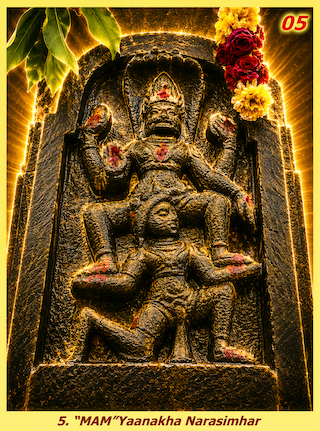
1. Bhagavan Sri Lakshmi Nrusimhan dwells in the fifth aksharam (syllable), “Mam”. By doing so, He reveals that He belongs universally to all ‘Jivaraasis’ (living beings) and possesses boundless, supreme affection for them.
2. In “Mam”, the letter “Ma” denotes the Jivatma. The Supreme Paramatma who owns and supports that Jivatma resides within the Bijaaksharam, “Mam”!
3. The aksharam “Mam” illustrates Bhagavan’s profound Kalyana Guna known as “Ashrita Vatsalyathvam”—His infinite, tender affection towards the Jivatmas who surrender unto Him.
4. Endowed with the immaculate quality of Amalathvam (blemishlessness), Bhagavan eternally remains an Ashrita Vatsalan (one who is boundlessly affectionate to those who surrender).
5. Bhagavan is famously known as ‘Vatsalan’. He declares that He will protect anyone who is a ‘Samashrita’. “Ashrita means those who have sought refuge in Bhagavan—those who have surrendered.” He is incredibly accessible (Sulabhan) to those who bow down to Him. Those who refuse to surrender can never comprehend or attain Him.
6. In the Paduka Sahasram, Swamy Desikan states, “Rama’s Paduka (sandals), which was worshipped by Bharata, brings down those who think highly of themselves and elevates those who humbly consider themselves lowly.” How does this happen?
7. In this cruel Kali Yuga, Bhagavan stands majestically on Thirumalai (Tirumala) as Srinivasan. He stands there in response to the prayers of the Devas. He makes all the celestials from the higher realms descend, and He calls upon us (the mortals) to ascend. Bringing them down, raising us up… He graciously unites both groups, letting them stand together in one glorious ‘Goshti’ (assembly) to shower His ‘Anugraham’ (grace).
8. If those who are high and mighty fail to bow down to Him, they inevitably fall. If those who are lowly and humbly surrender, they are elevated! What does Bhagavan truly desire from us? Only our humble surrender (Namaskaram)! When we bow, He showers His grace. To those who seek His refuge (Ashritās), He is indeed a Vatsalan!
9. The deep, instinctive love a cow has for its calf is called Vatsalyam. A cow will refuse to touch its food if it emanates a foul smell. However, if its calf comes rolling in mud, reeking of a foul odour, the mother cow will lovingly lick it clean and shower it with her milk. What is this phenomenon? It is Vatsalyam!
10. Bhagavan bestows this exact same ‘Vatsalyam’ upon those who surrender to Him. Consider a cow that has a calf. The calf grows older. Later, the cow gives birth to another calf. When this second, newborn calf comes bounding joyfully to drink milk, if the older calf stands as an obstacle, the mother cow—despite it being her own offspring—will gently but firmly push the older calf away with her horns to make room for the younger one. Bhagavan acts in the exact same manner… He declares, “No matter how many come seeking refuge, I shall protect them all.” He does not limit His protection to just one person!
11. When Sugriva objected to accepting Vibhishana, Rama replied: “In Kishkindha, at the foothills of Rishyamukha Parvata, you came to me… you performed ‘Saranagati’ (surrender). I protected you. You are my first calf. Now, here on the shores of the ocean, Vibhishana has come to surrender. I shall protect him too. If you stand as an obstacle to protecting this second calf, I will have to push you away!”
12. In the Bharadwaja Samhita, Sage Bharadwaja beautifully illustrates this: “Who else possesses such Kalyana Gunas (auspicious qualities) like Bhagavan? Once someone tightly grasps His Lotus Feet, whether they belong to the Rakshasa race, whether it is a plant, a bird, or an animal—no matter what they are, He showers His ‘Anugraham’ with an equal, compassionate vision.“
13. If one asks how we know Bhagavan is an ‘Ashrita Vatsalan’, the proof lies in the fact that He pervades all entities, and whenever we call out to Him, He comes rushing to us immediately!
14. Just as a calf instinctively runs behind its mother cow, and just as it faithfully follows when led forward, Paramatma never leaves our side; He remains eternally with us.
15. Bhagavan is the one who lost us in this ‘Prakruti Mandalam’ (material realm). He is constantly making immense efforts to reclaim us and unite us with Himself.
16. Just as ghee is poured into the sacred fire in an unbroken, continuous stream (Santhatha dharai), our remembrance (Smaranai) of Him must be uninterrupted. We must attain a state where, even if His thought leaves us for a mere fraction of a second, we feel completely lost and paralysed, unable to do anything else.
17. The time we spend living with such Bhagavad Smaranai (remembrance of the Lord) is the only time truly “lived.” He constantly holds us in His remembrance… We too must unceasingly remember Him!
18. We all face a final journey, do we not… a journey from which there is no return! We must keep Him in our thoughts until that very journey. Only those who live until their last breath with Emperuman’s Smaranai have truly lived a fulfilled life.
19. It does not matter how many years a person lived. What truly matters is whether they lived with ‘Bhagavad Smaranai’. All other days must be discarded, just as one sifts and throws away dust and stones while cleaning rice. Those days simply do not count as days lived.
20. Sage Markandeya looked at Parasara and said, “Even though I have lived through seven lifetimes, the time I truly ‘lived’ is only five years… You, who are only seven years old—because you have spent these entire seven years continuously in ‘Bhagavad Smaranai’, you are two years senior to me. Therefore, I bow to you.”
21. The determination of one’s age and maturity is based purely on their ‘Bhagavad Smaranai’, not merely on their physical age. If someone is a ‘Mahan’ (a great realized soul), even if they are a young boy, they are worthy of our reverence and prostration!
22. When two ‘Bhagavatothamas’ (exalted devotees of the Lord) prostrate to one another, that prostration directly reaches Lord Vishnu, who stands invisibly between them. Because He accepts that reverence, no ‘dosham’ (fault) incurs to the devotees; instead, the greatness of those ‘Bhagavatothamas’ only increases.
23. The very reason Bhagavan manifests as Arca (deity form) in temples is solely due to this magnificent quality of ‘Ashrita Vatsalyam’. In His ‘Arcavatara’ alone, He has graciously revealed this specific quality to us on numerous occasions.
24. In Jeeyapuram, when a mother affectionately called out to her child, “Ranga! Ranga!“, Lord Ranganatha, who reclines in Srirangam, disguised Himself as that child and lovingly ate the ‘Keerai Saadham’ (spinach rice) she fed him. To commemorate this divine event, even today, Lord Ranganatha makes a procession to Jeeyapuram and accepts the offering of ‘Sundiya Keerai’ (spinach). It is then distributed to everyone. How profound is His compassion towards us? What boundless ‘Vatsalyam’!
25. In the Yaksha Prashna, the Yaksha asked Dharmaputra, “Who in this world is truly the most joyous?” Dharmaputra replied, “He who lives in his own village, in his own home, entirely free of debt, and eats simple spinach—he is the one who is truly joyous.” Bhagavan demonstrates and lives this very truth in Srirangam to this day..! This is the magnificent ‘Vatsalyam’ of Lord Ranganatha in His ‘Arca’ form.
26. Thiruvenkatamudaiyan (Lord Srinivasa) is known as Mukkurumbarutha Nambi—the one who eradicates the three ‘Khyathi’ (fame), ‘Labha’ (profit), and ‘Pooja’ (desire to be honored). If someone performs an act for ‘Khyathi’ (to gain fame), or for ‘Pooja’ (so others will praise and celebrate them), or for personal ‘Labha’ (profit), He absolutely refuses to accept it.
27. Emperor Thondaiman offered one thousand golden flowers daily in his ‘archana’ to Thiruvenkatamudaiyan (Srinivasa). However, the Lord pushed all of them aside and joyfully accepted a simple flower made of clay, offered with pure devotion by a poor potter. What is this..? That is ‘Ashrita Vatsalyam’.
28. Therefore, He becomes a ‘Vatsalan’ (affectionate protector) only to those who possess pure, supreme ‘Bhakti’ (devotion).
29. Sri Lakshmi Nrusimhan, who presides at the Mattapalli Mahakshetram, is the ultimate “Ashrita Vatsalan“. He has personally intervened to alleviate the profound sufferings of countless poor and destitute devotees.
30. Residing there as the “Ashrita Vatsalan“, solely to bless the ‘Jivatmas’ (denoted by “Ma“) and wipe away their sorrows, He has prescribed a very simple ‘Karma’ (action) that anyone can easily follow. What is it? He simply asks us to stay at the Mattapalli Kshetram for eleven days and perform ‘Pradakshinam’ (circumambulation) around Him. He declares, “I shall eradicate all the sins of those who do so, and I shall elevate them to greatness..!” Behold His immense ‘Vatsalyam..!’ Can everyone perform grand ‘Yajnas’ and ‘Yagas?’ No! But the exact same supreme benefits obtained from performing those ‘Yajnas’ can be easily attained just by circumambulating Him..! That is precisely “Ashrita Vatsalyathvam“.
31. To facilitate devotees staying and performing ‘Pradakshinam’ for 11 days at the Mattapalli Mahakshetram, He Himself, out of His grace, established a 32-room choultry (guest house) under Adiyen’s very name as the “Sri Mukkur Nruhari Nivasam“. To quench our ‘Thapathrayams’ (the three-fold miseries) and wash away our sins, He facilitates the Pradakshinam. It is like, He dug the well, tied the bucket, drew the water, and poured it directly into our hands. Our only effort is to simply drink that purifying water..!
32. Bhagavan, who shines brilliantly as the ‘Ashrita Vatsalan’ in the ‘Aksharam’ “Mam“, manifests at the fifth pillar in the ‘Yajnavatika’ of Mattapalli Mahakshetram as “Yaanaka Nrusimhan“—in the magnificent ‘Yajna Vahana Thirukkolam’ (posture). He appears as the auspicious ‘Mangala Murthy,’ holding the ‘Sankha’ and ‘Chakra’, showing the ‘Abhaya Mudra’ (gesture of protection) with His four divine hands. With Garuda (the embodiment of the Vedas) as His vehicle, Adisesha as His umbrella, He is seen vanquishing His enemies while simultaneously protecting His devotees. He eagerly waits to grant ‘Abhayam’ (freedom from fear) to all devotees who visit that Kshetram, dispelling their terrors and blessing them with the supreme ‘Gnanam’ (knowledge) of ‘Bhagavad Smaranai’. On this highly auspicious day, let us pray to Him and prosper through His boundless ‘Vatsalyam’ (affection)..! There is indeed no lack whatsoever (Kurai Ondrum Illai)!!
|| Sakalam Bhadramashnuthe! ||
Sri:
Srimathe Sri Lakshminrusimha Parabrahmane Namaha:
GUIDELINES ORDAINED BY THE VEDAS TO LEAD A CONTENTED LIFE
( 6 ) Haam
(Sri U.Ve Mukkur Lakshminarasimha Chariyar)
(Compiled by: Sri U.Ve Mukkur Srinivasan)
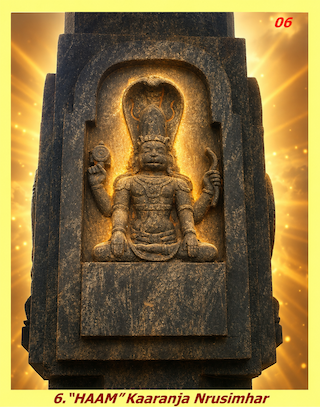
1. Bhagavan Sri Lakshmi Nrusimhan dwells in the sixth aksharam (syllable), “Haam”. By doing so, He reveals that He Himself is the path (Upāyam) and the ultimate destination (Upeyam) attained by traversing that path.
2. In “Haam”, the aksharam “Haa” signifies the ultimate bliss experienced by the Muktas (liberated souls) in Sri Vaikuntham, as they sing the Sama Veda chant, “Haavu, Haavu”.
3. The aksharam “Haam” illustrates that to reach Bhagavan, He alone is the Upayam (means), and after reaching Him, He alone is the Upeyam (the ultimate goal/object of enjoyment).
4. Endowed with the immaculate qualities of Amalathvam and Ashrita Vatsalyathvam, Bhagavan also possesses the profound attributes of being the Upayam and Upeyam.
5. What are Upayam and Upeyam? ‘Upeyam’ is the goal to be attained; ‘Upayam’ is the means or instrument used to attain it.
6. In worldly matters, we observe that the means (Upayam) is one thing, and the destination (Upeyam) is entirely different.
7. However, in Bhagavad Vishayam (matters concerning the Supreme Lord), the One who takes us there is Him, and the One we reach is also Him—He is both Upayam and Upeyam. He is the means and the fruit. He alone is the path to reach Him!
8. One of His divine names is Nayah:. “Nayathi” means ‘to lead or guide’. He is the one who leads us by the hand to Himself.
9. In the Varaha Charama Sloka, Bhagavan explains to Bhoomadevi whom He protects and whom He calls to Himself. ‘Charamam’ means the ultimate or final instruction.
10. “When the mind is still in a good, steady state—before it begins to wander—while the body still possesses health, strength, and vitality, while the pulse is steady, while the intellect remains sharp and unwavering, and while the nerves are firm and robust… whoever loudly chants My divine names at that prime time, they shall be immediately protected by Me!” declares Bhagavan in the Charama Sloka.
11. Therefore, one must chant the divine names of Bhagavan from a young age. One must offer flowers and perform ‘archana’ at His Lotus Feet. One must perform ‘Atma Samarpanam’ (surrender) in their youth itself. All these are the Upayam (means) to reach Him.
12. During the ‘Antima Kaalam’ (final moments of life), in old age, one might be physically incapable of doing all these things. Hence, Bhagavan urges us to do them in our youth itself.
13. The final moments (Antima Kaalam) are arduous. If a child performs ‘Sushrusha’ (loving service) to their parents during their final days, the hearts of both the mother and father will bless that child. Their blessings will extend to all the child’s descendants. Such a person will live a highly prosperous and fulfilled life. Does a life where one fails to serve their parents even count as a life? So questions the Manu Smriti.
14. For those who firmly grasp His Lotus Feet, Bhagavan declares, “I Myself shall come directly during their final moments and escort them to My abode.“
15. During Bhishmacharya’s final moments, did Paramatma come to him directly or not? Did Bhishma expect it? No, Bhagavan came of His own accord. He arrived and granted His divine vision. This gave birth to the Bhishma Stuti. Bhishma chanted this grand ‘Stotram’ and then attained the Lotus Feet of Bhagavan.
16. Those who practice ‘Bhakti Yoga’ must, through their own strenuous self-effort, invoke the ‘Smruthi’ (remembrance) of Bhagavan during their final moments. But for those who perform Saranagati (surrender), Bhagavan Himself grants them that Antima Smruthi (final remembrance) and personally leads them to His abode.
17. For ‘Paapathmas’ (sinners), the two messengers of Yama (Yama Kinkaras) arrive. For ‘Punyatmas’ (virtuous souls), Yama himself arrives! But for those who attain Moksha – the realm from which there is no return – Bhagavan Himself arrives!!
18. The Upeyam—the ultimate fruit—is Him. He is also the instrument that leads us there (Upayam). How do we know that He is both the means and the fruit? We know this because He is the one who entirely eradicates all the severe obstacles that reside within us.
19. Bhagavan destroys the enemies that are far away. He also destroys the enemies that lurk very close to us.
20. Who are these enemies that are far away? They are the sins (Paapam) we committed, unbeknownst to us, across countless past lifetimes! These sins continuously act as our adversaries. They paralyze us, preventing us from engaging in auspicious deeds. They stand as a massive barricade. But the moment we grasp the Lotus Feet of Bhagavan, He ensures that even those accumulated, unknown sins cannot come anywhere near us!
21. We often see someone who continuously commits sins living very comfortably… whereas those who tirelessly perform ‘Punya Karma’ (virtuous deeds) seem to constantly suffer. We might naturally wonder, “What is the use of doing Punya Karma?” However, we must remember that this is not our first birth. We have already gone through countless lifetimes.
22. If a person committing sins is currently living comfortably, they will inevitably face the consequences of those sins in the future. If they are comfortable now, it simply means they are currently enjoying the fruits of the Punyam (virtue) they accumulated in their past lives.
23. One must not lament, “I am performing Punya now, yet I am suffering.” Think of it this way: if you relish a delicious bowl of Mysore Rasam, even after you wash your hands, if you bring your hand near your nose half an hour later, the lingering aroma of the Rasam will still be there. Similarly, this ‘Jivatma’ has been committing sins lifetime after lifetime! The lingering trace (Vaasanai) of those sins will not vanish instantly.
24. Who are the enemies that are close to us? They are our very own ‘Indriyas’ (senses)! It is Bhagavan alone who blesses us with the power to conquer these tyrannical senses—the formidable enemies residing within us!!
25. One might ask, “Can we not just perform Prayaschittams (atonements) for our sins?” Imagine scrubbing an elephant thoroughly until it shines, giving it a good bath, and tying it under a tree… What does that elephant do? It immediately scoops up the dirt and dust from the ground and throws it over its own head, dirtying itself again. The sins we commit are exactly like this. Mere ‘Prayaschittam’ is of no absolute use!
25. Consider a bamboo forest that suddenly caught fire and was reduced to ashes. What a wonder! If you look at it six months later, the exact spot where charred remains lay will be sprouting fresh, lush green shoots. The fire only burned the parts above the ground; it did not possess the power to penetrate deep into the earth and destroy the roots. ‘Prayaschitta Karmas’ are exactly like that. These Karmas do not possess the power to eradicate the deep-rooted, wicked Vaasanai (latent tendencies) that incite us to commit sins.
26. To truly refrain from committing sins, we must tightly grasp the Lotus Feet of Bhagavan. He alone is capable of completely annihilating the wicked Vaasanai that provokes us to sin..!
27. Because we continuously commit sins, and because they persistently follow us across lifetimes, it is He who eradicates all the sufferings that arise from them. He completely wipes out our sins, leaving not even a trace behind.
28. The Emperuman of the Mattapalli Mahakshetram declares, “Raaga-Dwesha Vinaasine“—He proclaims that He destroys the desires (Raaga) and aversions/anger (Dwesha) that incite His devotees to commit sins!
29. Furthermore, He is “Sarvaarishta Vinaasine“—meaning He eradicates all ‘Arishtams’ (calamities and evil forces).
30. Beyond that, He is “Sarvaabheeshta Pradhaayine“—declaring that He fulfils all the ‘Abheeshtams’ (righteous desires and prayers) of His devotees.
31. Sri Lakshmi Nrusimhan, who majestically resides at the Mattapalli Mahakshetram, is our ultimate “Upayam – Upeyam“. He is the path. He is the destination!
32. Emperuman, who shines as both our ‘Upayam’ and ‘Upeyam’, graciously manifests at the sixth pillar in the ‘Yajnavatika’ of Mattapalli Mahakshetram within the aksharam “Haam“, as “Sri Karanja Nrusimhan“. This divine name arises from His manifestation under the Karanja tree (Indian Beech tree) in the Ahobila Mahakshetram. He is seated in ‘Padmasana’, with Adisesha serving as His umbrella, displaying His four divine hands. Holding the ‘Chakra’ (discus) in His right hand and a bow in His left, He is the Supreme Moorthy who gave darshan to Lord Hanuman as Lord Rama Himself. Let us grasp His Lotus Feet, realizing that He is both the means (Upayam) and the goal (Upeyam). For those who do so, there will forever be nothing lacking in our lives! (Kurai Ondrum Illai)..!
|| Sakalam Bhadramashnuthe! ||
Sri:
Srimathe Sri Lakshminrusimha Parabrahmane Namaha:
GUIDELINES ORDAINED BY THE VEDAS TO LEAD A CONTENTED LIFE
( 7 ) Vim
(Sri U.Ve Mukkur Lakshminarasimha Chariyar)
(Compiled by: Sri U.Ve Mukkur Srinivasan)
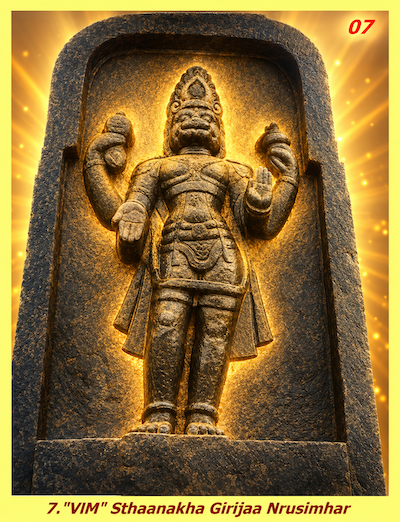
1. Bhagavan Sri Lakshmi Nrusimhan dwells in the seventh aksharam (syllable), “Vim”. He is the experiencer, the object of experience, and the supreme controller.
2. In “Vim”, the aksharam “Vi” denotes Bhagavan Vishnu. The divine name ‘Vishnu’ signifies the One who permeates and resides within everything.
3. The aksharam “Vim” illustrates the profound truth that Bhagavan Vishnu ‘creates the objects of enjoyment, commands us to enjoy them, and ultimately, He Himself is the true enjoyer.’
4. Bhagavan, who possesses the immaculate qualities of Amalathvam and Ashrita Vatsalyathvam, and who is Himself the Upayam (means) and Upeyam (goal), is also endowed with the divine attributes of Bhogyathvam, Bhokthruthvam, and Niyanthruthvam.
5. What do Bhogyathvam, Bhokthruthvam, and Niyanthruthvam mean? Bhoktha is the experiencer or enjoyer; Bhogyam is the object to be experienced or enjoyed; Niyanthruthvam or Preritha signifies the Supreme Controller or the one who impels the experience.
6. Bhagavan is known as the Niyamakan (the Supreme Controller). Lord Vishnu is the one who commands, who actuates, and who orchestrates everything from within.
7. Who is the Bhoktha? It is the Jivatma! In the external world, there are innumerable objects meant for the eyes, the ears, and the sense of taste. The Jivatma is the Bhoktha who experiences them.
8. The Jivatma possesses consciousness. It is termed as ‘Chethanam’. It is the experiencer!
9. The objects that are meant to be experienced are called Bhogyam. If we ask, “How was the ‘Thaligai’ (sacred food offering) today?”, we say, “It was very Bhogyam.” It means it was thoroughly enjoyable.
10. All ‘Bhogyam’ (enjoyable) objects are ‘Achethanam’ (insentient). They lack consciousness. They do not experience; rather, they are the objects to be experienced.
11. Therefore, all these objects exist as ‘Bhogyam’ to be experienced by the Jivatma, who is the ‘Bhoktha’. Who makes this experience possible? It is the Preritha—the Niyamakan—Bhagavan, the Supreme Lord (Iswara).
12. What is the underlying Tattvam (philosophical truth) here? The Sastras declare the three fundamental realities: Chith, Achith, and Iswaran. ‘Chith’ denotes Chethanam—the conscious entity (Jivatma). ‘Achith’ denotes Achethanam—the insentient, ordinary matter found in this universe. Paramatma is the one who actuates both of them. Residing as the Antaryami (indweller), He controls and orchestrates both!
13. We can witness this Tattvam on Arjuna’s chariot. Arjuna is seated; he is the ‘Chith‘. The horses possess consciousness; they too belong to the category of Chethanam. The chariot itself is the ‘Achith‘. Who is the one controlling and actuating both? It is Krishna, who drives the chariot—the Iswaran!
14. If we take the Narasimha Avataram, Prahlada is the Chith; the pillar (Sthambam) is the Achith. Who controlled and orchestrated both? It is Lord Nrusimhan who emerged from the pillar!
15. We must always meditate upon the great Acharya, Sri Alavandar, chanting “Namo Namo Yamunaya, Yamunaya Namo Namaha.” He composed the magnificent hymns known as the Stotra Ratnam. If we deeply understand its profound meanings, it will instil ‘Vairagyam’ (detachment) in us. It will kindle deep Bhakti towards Bhagavan. It will bestow upon us the supreme knowledge (Gnanam) concerning Bhagavad Vishayam.
16. Adi Sankara Bhagavatpada urges us to chant the Rama Nama four times: “Bhajeham Bhajeham Bhajeham Bhajeham.” Because the Rama Nama offers such immense refuge! It is said that Iswara (Paramasivan), who is enamoured by Katyayani (Parvati), hurries to the right ear of every dying soul in the holy city of Kashi during their final moments and chants “Rama, Rama, Rama” three times!
17. That is precisely why Bhagavatpada declares four times: “I worship that Supreme Brahman, the One who sustains us all, the Peerless One, through His matchless divine name!”
18. Similarly, in “Namo Namo Yamunaya…” repeating the same reverence intensifies Bhakti, making it soar to exalted heights!
19. Sri Alavandar, originally named Yamunacharya, defeated the arrogant royal court poet ‘Aakki Azhvan’ in a philosophical debate while he was just a young boy.
20. During that debate, he challenged the arrogant scholar: “Whatever I state as ‘existing’, you must prove it as ‘non-existent’! Whatever I state as ‘non-existent’, you must establish it as ‘existing’. If you fail to prove it, it means you have accepted defeat.” The scholar agreed, and the debate commenced.
21. The young boy Yamunacharya put forth three statements. First, he said, “Your mother is not barren.” The scholar had to argue that his mother was barren. How could he possibly say that? Secondly, the child said, “This King is a Sarvabhouman.” (Sarvabhouman means an emperor whose kingdom spans all directions). The scholar had to argue that the King was not a Sarvabhouman. If he did, the King would immediately banish him. Thus, he stood speechless again. Thirdly, he stated, “The Queen is a Maha Pativrata” (a supremely chaste woman). This was a highly dangerous proposition. The scholar now had to argue that the Queen was not a Pativrata. If he dared to utter those words, he would be instantly beheaded. Left with no choice, he accepted his defeat!
22. Yamunacharya himself then provided the answers based on the Sastras. “A crow lays only one egg. A banana tree yields only one bunch. A single tree does not make an orchard. You are the only child to your mother. Just as we consider the crow and the banana tree barren (after their single yield), according to the Sastras, your mother is also barren,” he explained.
23. Next was about the Sarvabhouman. According to the Sastras, a Sarvabhouman must rule over all the seven Dvipas (continents). The sun must never set on his empire; meaning, the entire earth must be under his dominion. Since this King lacks such vast dominion, he cannot be termed a Sarvabhouman.
24. Next, when a woman is born in this world, according to Vedic tradition, her soul is first under the protection of Soma (Chandra). Then she comes under the protection of the Gandharvas… The Gandharvas then entrust her to Agni. The Vivaha Mantra (wedding chant) states that Agni is now bestowing this bride (who was previously under the care of these three) to the human groom on earth. Since this is a universal Vedic truth applicable to all women, there is absolutely no dosham (blemish) in it. However, from this strict Sastric perspective, the child argued that the Queen cannot be termed a Pativrata. Upon hearing this brilliant exposition, the Queen was astounded and exclaimed, “Emmai Aalavandeero!” (Have you come to rule over me/us!). Hence, Yamunacharya came to be celebrated by the glorious name ‘Alavandar’!
25. Sri Alavandar, who perceives everything through the profound lens of the Sastras, has elaborately explained the concepts of Bhoktha, Bhogyam, and Preritha in his ‘Stotra Ratnam’. If we meditate upon him, we will attain all three: Gnanam (knowledge), Bhakti (devotion), and Vairagyam (detachment)!
26. In the Vishnu Puranam, Sage Parasara has provided an extensive exposition on Chith, Achith, Anandam, Bhoktha, Bhogyam, and Preritha.
27. The most crucial truth we must realize is this: “If we wish to experience anything, we simply cannot do so without His grace. No matter how meticulously we plan and prepare to enjoy something, if there is no Bhagavad Sankalpam (divine will), it will just slip away from our grasp.”
28. Swamy Desikan distils the very essence of Saranagati (surrender) into ten slokas (the Nyasa Dasakam)… In one of those slokas, he pleads, “Oh Varada! Devadiraja! You Yourself must accept this.” What must He accept? “I offer myself and everything I possess, acknowledging that they entirely belong to You. You must graciously accept this offering and bless me,” he prays.
29. There is a mantra in the Third Kanda of the Vedas. Its profound meaning is: “This lifespan of mine is for the sake of Yajna… the Prana (life-breath) is for the sake of Yajna… the Apana Vayu is for the sake of Yajna… the power of hearing is for the sake of Yajna… the mind is for the sake of Yajna… speech is for the sake of Yajna… the Atma is for the sake of Yajna… my wife, cows, home, and all wealth are entirely for the sake of Yajna…”
30. Someone once asked, “If everything is for the sake of Yajna, then what is left for you?” Even when we surrender everything saying it is for Yajna, Bhagavan multiplies it manifold and returns it to us. To those who perform the Yajna, He returns their offerings magnified in abundance!
31. Therefore, we must dedicate everything to Sri Mattapalli Yogananda Lakshmi Nrusimhan, who is glorified as “Maha Yajna Swaroopaya“. We must surrender, declaring, “Everything that belongs to me is solely for Your sake.” He constantly observes whether we are making such a true surrender.
32. Emperuman Lakshmi Nrusimhan, who is the Bhoktha, Bhogyam, and Prerakan, graciously manifests in the seventh pillar of the Mattapalli Yajnavatika, within the aksharam “Vim“, as “Girija Nrusimhan” in a magnificent standing posture with four divine hands. He stands majestically, holding the Chakra (discus) in His right hand while displaying the Varada Mudra (gesture of bestowing boons), and holding a lotus in His left hand while displaying the Abhaya Mudra (gesture of protection). If we meditate upon Him, we will be firmly established in Para Bhakti, Para Gnanam, and Parama Bhakti. There will forever be nothing lacking in our lives (Kurai Ondrum Illai)..!!
|| Sakalam Bhadramashnuthe! ||