
The Roar of Laughter of Narasimha in Kamban’s Poetry
[Sri. U. Ve. Vidwan Mukkur Lakshminarasimhacharya Swami, Vijayawada]
(Article published in the 1971 Karthikai issue of Sri Nrisimhapriya magazine)
Kambar is renowned by the saying, ‘Even the loom in Kamban’s house sings poetry‘. His verses delight the minds of the learned. The reason for him attaining such greatness is his supreme devotion.
The Yuddha Kandam commences. This section describes how the hero, Lord Rama, conquered and slew his enemy Ravana in battle. Before beginning the Yuddha Kandam, Kambar offers his invocatory prayer (Kappu) to Sri Nrusimha:—
Ondrē ennil ondrēyām,
Palaven ṟuraikkir palavēyām,
Andrē ennil andrēyām,
Āmen ṟuraikkin āmeyām,
Indrē ennil indrēyām,
Uladhen ṟuraikkin uladhēyām,
Nandrē Nambi kudivāzhkkai,
Namakk ingēnnō pizhaippammā!
If said to be One, He is One;
If said to be many, He is many;
If said ‘He is not’, He is not;
If said ‘He is’, He is;
If said ‘He is not today’, He is not today;
If said ‘He exists’, He exists;
Placing complete trust in Him is the only good way of life,
What other livelihood is there for us here!
Although this verse speaks of Bhagavan’s nature in general, among His incarnations, it exceptionally highlights the Sri Nrusimhavatara as the Ultimate Truth (Meypporul).
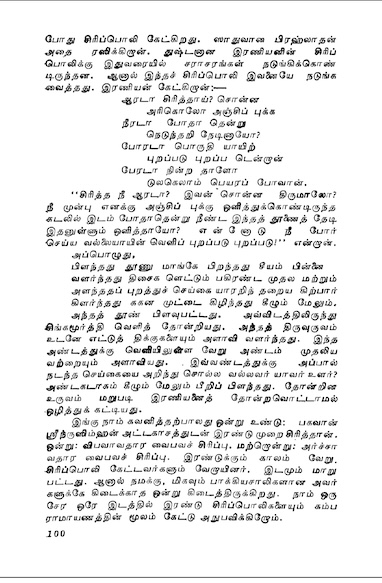
Bhagavan, who is ‘Eka‘ (One), transformed into ‘Bahu‘ (Many). In the first two lines, the Upanishadic declaration ‘Bahu syām prajāyeyeti’ is affirmed. Parankusha’s (Nammalvar’s) divine utterance is “Udal misai uyirena karandhengum parandhulan” (He pervades everywhere, hidden like the soul within the body). When Jnanis like him observe with their inner vision, they realize ‘Nirkinrathellam Nedumal’ (All that stands is the Supreme Lord). However, in order for even the dull-witted to realize this greatness of His, Bhagavan manifested everywhere during the era of the Sri Nrusimhavatara.
We cannot simply brush aside the glory of this avatar as something belonging to the past. Our Thuppul Kulamani (Swami Desikan) proclaimed, “Aho nâbhi garjath! Nūnam trailokyam etad akhilam narasimha garbham” (Oh, the roar from the navel! Indeed, all these three worlds are pregnant with Narasimha). Even now, and forever, He is seen pervading the infinite universes. The Lord will be seen. There is no doubt about it. The child said, ‘He is everywhere’. Bhagavan, wondering ‘Where will the child point to show Me?’, became omnipresent. However, He emerged only from a pillar. Bhagavan firmly established Himself in the form of Nrusimha in all other moving and non-moving entities (characharas). Kambar describes this. Thus, there is a profound reason for him to praise Lord Narasimha.
In this very Kandam, prior to the ‘Veedanan Adaikkala Padalam’ (The Chapter on Vibhishana’s Surrender), Kambar places the ‘Iraniyan Vadhai Padalam’ (The Chapter on the Slaying of Hiranya) to have Vibhishana preach the glory of Sri Nrusimhavatara to the wicked (duratma) Ravana. The details regarding this chapter, handed down through oral tradition (Karna-paramparai), are as follows:—
When Kambar was premiering his Ramayana in the thousand-pillared hall in Srirangam, and read the ‘Iraniyan Vadhai Padalam’, some vidwans present there objected in a unified voice, saying, “The slaying of Hiranya is not mentioned in the original epic (adi kavya), the Valmiki Ramayana! What is this modern addition? Unless it demonstrates some divine proof, it will not be accepted.” Sriman Nathamunigal remained silent on this matter. Later, Kambar, resolving ‘Let it be according to the divine will (Bhagavat Sankalpa)’, read this chapter in the sanctum of Lord Mettazhagiyasingar. At that moment, that Supreme Lord extended His divine hands, shook His divine head, opened His mouth, and roared with a loud laugh (perunchirippu). Seeing that, everyone was astonished. Furthermore, some highly praised the work, saying, “When a child of the Muvayiravar in Thiruchitrakoodam recited some verses from the Nagapasa Padalam of this Kamba Ramayana, a dead person came back to life. Here, when the Iraniyan Vadhai Padalam was read, Lord Mettazhagiyasingar, who has mercifully manifested as an Archa-vigraha, became immensely pleased and, to make that joy visible to everyone, performed a roaring laugh (aṭṭahāsa) along with a nod of His head (sirakampam). Therefore, this great epic possesses divine nature,” and highly praised the work.
Upon reading the Iraniyan Vadhai Padalam, even more beautiful than the laughing roar of the Archavatara murthi is the beauty of Kamban’s poetry laughing! The great sinner (mahapapi) Hiranya tortures the young boy Prahlada in many ways. Enraged, Hiranya yells at the child and asks: “You say your Hari is ‘everywhere’; if so, will He be in this pillar? If He is, show Him!” The supreme Bhagavata (Parama Bhagavatottama), the child, joins his palms and speaks thus:—
Sāṇinu muḷanōr taṉmai
Yaṇuvinaic catakū ṟiṭṭa
Kōṇinu muḷaṉmā Mēruk
Kuṉṟinu muḷaṉ inninṟa
Tūṇinu muḷaṉ nī sonna
Sollinu muḷaṉ ittaṉmai
Kāṇuti viraivi ṉeṉṟāṉ
Naṉṟeṉak Kanakaṉ nakkāṉ.
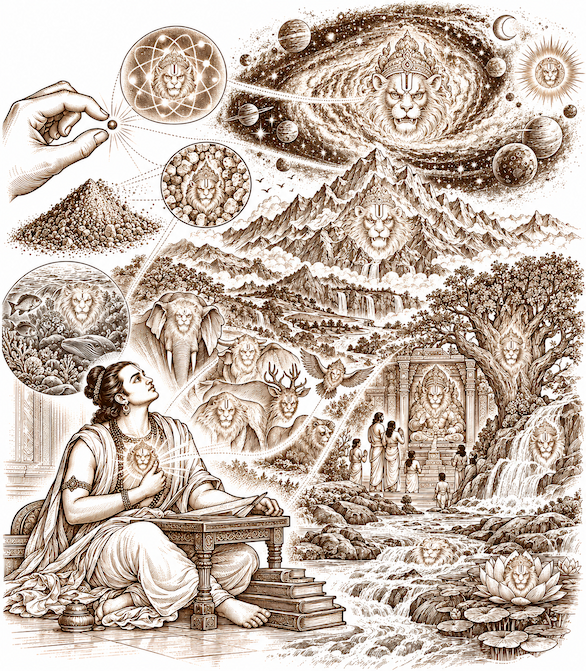
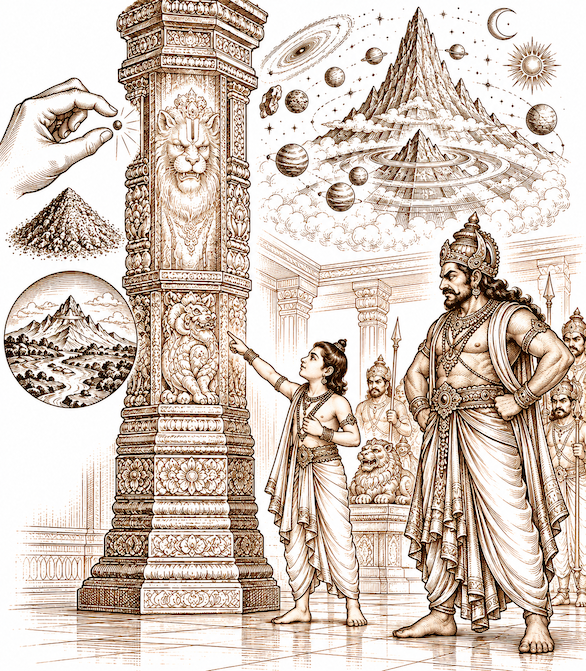
He exists in a hand-span,
His nature is such that
He exists in a fraction of an atom split into a hundred parts;
He exists in the great Meru mountain;
He exists in this standing pillar,
He exists in the word you just spoke;
You will see this truth very soon, he said.
‘Good!’ said the golden one (Hiranya) and laughed.
“That Emperuman I spoke of exists in a hand-span. He exists in the fraction of a tiny atom divided into a hundred parts. He exists in the great Meru mountain. He exists right here in this pillar. He exists even in the mocking word you spoke about Him. You shall quickly test and realize this truth,” said Prahlada.
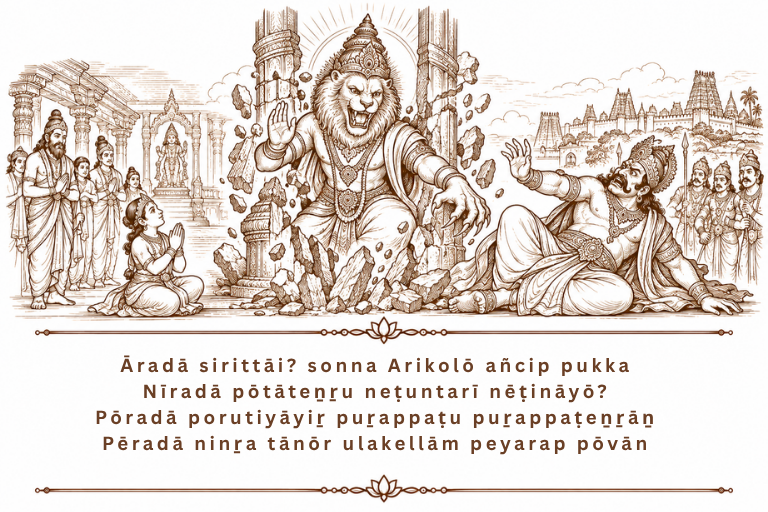
Hearing this, Hiranya, with extreme fury, struck the pillar with his fist. Right there and then, Bhagavan appeared with an astonishingly loud laugh and a highly wondrous Narasimha form. The resounding laugh of this Vibhava-murthi was a source of bliss for His dependents (ashritas) and, at the same time, instilled trembling fear in the hearts of the wicked. As a supreme Sadhu (Prahlada) and a supreme wicked one (Hiranya) stood near the pillar, the roar of laughter was heard. The gentle Prahlada relished it. Until now, all moving and non-moving things had trembled at the mocking laugh of the wicked Hiranya. But this laugh made him (Hiranya) himself tremble. Hiranya asks:—
Āradā sirittāy? sonna
Arikolō añcip pukka
Nīradā pōtāteṉṟu
neṭuntarī nēṭināyō?
Pōradā porutiyāyiṟ
puṟappaṭu puṟappaṭeṉṟāṉ
Pēradā ninṟa tānōr
ulakellām peyarap pōvān
Who are you that laughed?
Is it the Hari he spoke of? Out of fear of me,
Did you find the ocean insufficient,
And seek out this tall pillar?
If you can fight,
Come out, come out, he said!
Are you just going to stand there,
One who is about to lose all the worlds.
“Who are you that laughed? Are you the Thirumal he spoke of? Fearing me, you previously went and hid in the ocean; finding the space there insufficient, did you seek out this tall pillar and hide inside this too? If you possess the might to fight with me, come out, come out!” he said.
At that moment,
Pilaṉtatu tūṇu māṅkē
Piṟantatu cīyam pinnai
Vaḷaṉtatu ticaikaḷ eṭṭum
Pakiraṇṭa mutalā maṟṟum
Aḷantatap puṟattuc ceykai
Yāṟaṟin taṟaiya kiṟpār
Kiḷarntatu kakanam uṭṭai
Kiḻintatu kīḻum mēlum.
The pillar split apart; and there a Lion was born;
It then grew; the eight directions,
The universe, and all else it encompassed;
Who can know and describe His actions beyond that?
The cosmic egg of the sky burst, tearing apart top and bottom.
That pillar split apart. From it, Singamurthi (Lord Narasimha) emerged. That divine form immediately grew, encompassing all eight directions. It encompassed the other universes existing outside this universe. Who is there capable of knowing and describing the deeds that happened beyond this universe? The cosmic sphere (anda-katakam) tore open at the bottom and top. The manifested form annihilated Hiranya, ensuring he would never appear again.
There is one thing we must note here: Bhagavan Sri Nrusimhan laughed with a roaring aṭṭahāsa twice. One: The laugh of the Vibhavavatara’s glory. The other: The laugh of the Archavatara’s glory. The time for both was different. The people who heard the laugh were also different. The place was also different. But to us, something unavailable even to those highly blessed souls has been given. Through Kamba Ramayana, we hear and experience both roars of laughter together in one place.