
Sri:
Sri Lakshminrusimha Parabrahmane Namah
Acharya Vandhanam
(Sri U. Ve. Mukkur Srinivasan)
Swami Nammazhwar, at the very beginning of the prabandham called ‘Thiruviruththam’, speaks about the nature of the jivas (souls) to Bhagavan, the consort of Sri, in the following manner:
Poy ninra gnanamum - polla ozhukkum azhukkudambum *
In ninra neermai - ini yaam uraamai uyiralippaan |
En ninra yoniyumaayp pirandhaay - Imaiyor thalaivaa! *
Meyn ninru kettarulaay - adiyen seyyum vinnappame ||
He appeals to the Lord saying, “Please stand true and listen to my plea.”
He, who is the foremost in the assembly of both the Azhwars and the Acharyas, states that the knowledge of the jivas is false (flawed)—it is not true. However, the Acharyas transform such jivas who possess limited knowledge into immensely wise beings. How..? Through the quality of Bhagavan known as ‘Sauhardham’.
What does ‘Sauhardham’ mean?
Kulasekhara Azhwar says, “Asodhai thollai inbathiruthi kandaale,” meaning that the joy Yasodha experienced upon seeing the divine leelas (playful acts) of Lord Krishna was the ultimate limit of bliss.
Inbathiruthi (The ultimate limit of bliss) – Here, great scholars inquire whether one can actually see the boundary of bliss. Because, all the Upanishads wander in search of Bhagavan. Bhagavan is beyond the reach of the mind and words.
Yatho vacho nivarthanthe | Aprapya manasa saha |
Anandam Brahmano vidvan | Na bibheti kadhachanethi ||
states the Taittiriya Upanishad.
It says Parabrahman cannot be reached by the mind and words. That same Upanishad also says Parabrahman is Anandhamayan (embodiment of bliss). Furthermore, just as Parabrahman cannot be fully comprehended, His bliss cannot be fully measured either. But Kulasekhara Azhwar says, ‘Asodhai thollai inbathiruthi kandaale‘.
The Vedas, however, say that the limit of bliss cannot be seen.
Which of these is true..?
Both are true!!
If we try to achieve it on our own or through our own efforts, we cannot see it. But what if He resolves (Sankalpa) to show it..?
That is Bhagavan’s ‘Sauhardham’; He Himself bestowed that supreme Brahmanandam upon Yasodha!!
Bhagavat Sankalpam
When will Bhagavan make such a resolve..?
If there is a connection with a good Acharya, Bhagavan’s grace can be obtained easily.
What should we do to attain the connection of a good Acharya..?
Kavitharkika Simham Swami Desikan states six reasons for attaining the connection of a great Acharya.
Ishvarasya cha sauhardham yadruccha sukrutham thatha
Vishno: katakshamadvesham abhimukyam cha saathvikai:
Sambhashanam shadetani hi Acharya prapthihetava:
He states.
Ishvarasya cha sauhardham | Bhagavan’s intention/desire that the jivas should fare well |
| Yadruccha sukrutham thatha | The result of accidental or unintentional good deeds performed by the jiva |
| Vishno: kataksham | The jiva receiving the graceful glance of the Lord |
| Adhvesham | The removal of the hatred the jiva had towards the Lord |
| Abhimukyam | The jiva developing a deep interest in learning about the auspicious qualities of the Lord |
| Saathvikai: Sambhashanam | The jiva developing friendship and conversing with those who possess the Sattva guna (quality of goodness) |
These six factors will lead a person to a most excellent Acharya.
Who is a great Acharya?
The gem of the Thooppul clan (Swami Desikan) portrays who a great Acharya is in his work ” Nyasa Vimsathi “.
Siddham satsampradaye sthiradhiyamanagham
srotriyam brahma nishtam |
Satthvastham satyavacham samaya niyataya
sadhu vrutthya sametham |
Dambhasuyadi muktham jitha vishayi ganam
deergha bandhum dayalum |
Skhalithye sasitharam sva para hitha param
desikam bhooshnuripheth ||
Thus, Swami Desikan lists fourteen qualities that a great Acharya should possess. Only one who is completely endowed with all these fourteen qualities is a great Acharya.
We should approach such an Acharya, understand the dharma he cherishes, and bring it into our own daily practice (anushtana).
The Fourteen Qualities
The 14 qualities mentioned in this sloka are:
(1) Having thoroughly understood one’s Sampradaya (tradition) and possessing complete steadfastness in it;
(2) Not losing mental resolve in any situation;
(3) Being flawless (without blemishes);
(4) Being well-versed in the Vedas and Vedantas; having sat beside an Acharya, performed service to him, studied, recited, listened, realized, and put it into practice;
(5) Being deeply devoted to Bhagavan;
(6) Possessing Sattva guna (the quality of goodness); being a Sattvic person;
(7) Being a speaker of truth;
(8) Performing the required anushtanas (duties) at their respective prescribed times;
(9) Not being boastful about oneself, and not being jealous of others;
(10) Having conquered the senses;
(11) Being capable of doing good for the disciples in this world and the next. That is, being a ‘Viswacharya’, a long-lasting relative (Deergha Bandhu) who unites us with Bhagavan;
(12) Possessing the quality of compassion (Dayai);
(13) Being capable of correcting and disciplining a disciple if they make a mistake, and reforming them to engage in service;
(14) Being an Acharya who can instruct what is beneficial for oneself and for others, as stated by “sva para hitha param”
One who is filled with these fourteen qualities should be accepted as “Desikan“, a great Acharya.
For what..?
To attain complete and perfect knowledge.
Namswami
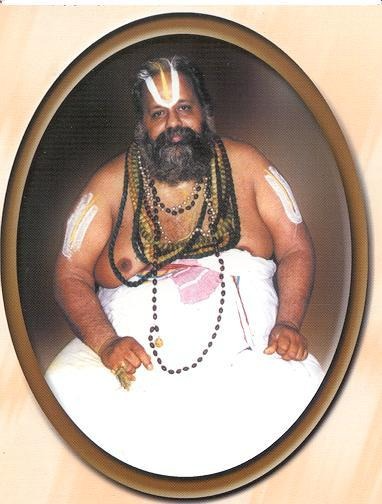
One who is completely filled with the above-mentioned fourteen qualities is Namswami Sri U. Ve. Mukkur Lakshminarasimhachariyar.
If we daily meditate upon that great Acharya (Mahadesikan) and his Thaniyans, we can attain complete knowledge and achieve all prosperity.
Acharya Vandhanam
The Vedas and Sastras emphasize that Acharya Vandhanam (salutation) or Dhyanam (meditation) is not just a Nithya Karma (daily mandatory duty) but also a Naimitthika Karma (occasional duty to be performed at specific times).
The Gautama Dharma Sutra states “Sambhashya punyakrutho manasa dhyayeth”.
We meet countless people in our daily lives, and we are compelled to speak with them. When speaking so, if the person speaking has any dosha (flaws/impurity), we incur sin.
What kind of flaws..?
The Sastras declare the abandonment of daily rituals like Sandhyavandhanam as an impurity. The Sastras call those who have given up the rituals prescribed according to their respective dharma as ‘impure’. Therefore, not only is one who hasn’t bathed considered impure, but also one who has abandoned daily rituals.
If we speak with those who are impure in this way, we incur sin.
Similarly, there is a category called ‘Adharmikas’ (unrighteous people)—those who have earned wealth through unrighteous means rather than righteous ones. Speaking with them also brings sin.
A doubt may arise: “How can we remain without speaking? What if there is a compulsion to speak?”
If asked, “What should be done to get rid of these sins..?”
The sutra answers: “Sambhashya punyakrutho manasa dhyayeth”. If we mentally meditate upon the highly meritorious Acharyas at that moment, that sin will not attach to us.
According to this sutra, Acharya Dhyanam or Guru Vandhanam becomes not only a Nithya Karmanushtanam but also a Naimitthika Karma—a duty to be performed at those specific instances.
Therefore, if we daily meditate upon Namswami—who is completely filled with the aforementioned fourteen qualities—through his Thaniyans, it is certain that, as the saying goes “Sarvapapai: pramuchyathe” (freed from all sins), all our sins will be destroyed, and we will attain complete knowledge.
The Yagyēsa Taniyan
In the lineage of our great preceptors, a Taniyan (invocation verse) is more than just a poetic tribute; it serves as a capsule containing the very spiritual essence of the Acharya. When I set out to compose this verse dedicated to Sri Mukkur Lakshmi Narasimhachariar (Mukkur Sri Nruhari), the intention was to combine technical metrical precision with the deep Puranic insights that defined his divine life.
I. The Verse
श्री यज्ञेश कृपापात्रम्
वात्सल्यादि गुणोद्भवम् ।
वाधूल वंश तिलकम्
मुक्कुर् श्री नृहरिम् भजे ॥
ஸ்ரீ யஜ்ஞேஸ க்ருபாபாத்ரம்
வாத்ஸல்யாதி குணோத்பவம் |
வாதூல வம்ஸ திலகம்
முக்கூர் ஸ்ரீ ந்ருஹரிம் பஜே ||
Sri Yagyēsa krupāpāthram
Vāthsalyādi gunōthbhavam |
Vādhoola vamsha tilakham
Mukkūr Sri Nruharim bhajaē ||
“I offer my salutations to Sri Mukkur Nruhari, the recipient of the grace of Lord Yagyēsa, the repository of virtues beginning with affection (Vatsalya), and the shining jewel of the Vadhoola lineage.”
II. The Secret of “Yagyēsa”
The opening phrase, Sri Yagyēsa krupāpāthram, was a deliberate choice to directly link our Acharya to the Prishnigarbha Avatara of the Lord.
During the Swayambhuva Manvantara, when the matriarch Prishni and her husband Suthapas performed intense penance, she addressed Sriman Narayana not by a common name, but specifically as “Yagyēsa” (The Lord of Yajna). The Scriptures tell us that the Lord was so charmed by this specific address—which acknowledged Him as the direct fruit of their sacrificial penance—that He granted her a unique boon: He would be born as her son not once, but three times.
- As Prishnigarbha (to Prishini and Suthapas)
- As Vamana (to Athithi and Kashyapa Prajapathi)
- As Krishna (to Devaki and Vasudeva)
In all three Avataras, the parents remained the same. Invoking this specific name suggests a profound parallel: just as Prishni pleased the Lord by calling Him Yagyēsa, Sri Mukkur Swamy became the true vessel of His grace (Krupāpāthram) because he, too, worshipped the Lord through the fire of massive Yagnas.
III. The Definition of Compassion: Vatse Dhenuriva Vātsalyam
The second line, Vāthsalyādi gunōthbhavam, describes the Acharya as the origin of virtues, starting with Vatsalya. This is not merely “affection,” but a reference to the specific theological concept of “Vatse Dhenuriva Vatsalyam”—the unique love a cow bears for its calf.
The Paradox of Purity: A cow is naturally fastidious; it refuses to graze on contaminated grass or eat impure food, maintaining a strict standard of personal purity. However, the moment its own calf approaches—even if that calf has just rolled in mud and dust—the cow does not reject it.
Instead, the cow uses its tongue to lick the filth off the calf’s body. It willingly ingests the “impurity” of the calf to make the calf clean. This is the true definition of Vatsalya..!
The Acharya as the Cow This powerful metaphor perfectly defines Sri Mukkur Swamy. Though he was a scholar of the highest order and a rigorous practitioner of orthodox rituals (possessing the purity of the cow), his compassion for his devotees knew no bounds.
When devotees approached him, laden with the “mud and dust” of their worldly sins (Karma), he never rejected them for being impure. Instead, with the tongue of his wisdom and grace, he cleansed them. He absorbed their burdens to purify them, treating every devotee with the same unconditional instinct that a mother cow has for her calf. Thus, he is rightly called the Gunōthbhavam—the very birthplace of such compassion.
IV. The Jewel of the Lineage: Vādhoola Vamsha Tilakham
In the third line, addresses his lineage: Vādhoola vamsha tilakham.
While Vadhoola Vamsha refers to his specific Gotra (lineage descending from the great sage Vadhoola), the word “Tilakham” holds the weight of the metaphor.
By calling him the Tilaka of his clan, the verse implies that while the Vadhoola lineage is historically illustrious, it finds its crowning glory and most visible mark of auspiciousness in Sri Mukkur Swamy. He is the ornament that makes the entire lineage shine.
V. The Final Salutation: Mukkūr Sri Nruharim Bhajaē
The final line, Mukkūr Sri Nruharim bhajaē, is the culmination of the verse—the act of surrender.
The Significance of “Nruhari”: the Sanskrit name “Nruhari” (Nru = Man, Hari = Lion/God) instead of the common “Narasimha.” serves a dual purpose:
- The Name: It refers to his given name, Sri Lakshmi Narasimhachariar.
- The Identity: It establishes a non-difference between the Acharya and the Deity he worshipped. For us devotees, the fierce yet compassionate Lord Narasimha (Nruhari) is not found in distant Vaikuntha, but is visibly present right here in the form of our Acharya from Mukkūr.
The Meaning of “Bhajaē” Finally, the verb Bhajaē is significant. It does not merely mean “I bow” or “I praise.” It stems from the root Bhaj, which implies service, adoration, and constant meditation. This verse isn’t just about outward respect. It is an act of devotion where I meditate on Sri Mukkur Nruhari within my heart.
The Sadāchāra Taniyan
I. The Verse
सदाचार अनुष्ठान
सौशील्यादि सुभूषितम्।
श्रीनृसिंह कृपापात्रं
मुक्कुर् श्री नृहरिं भजे ||
ஸதாசார அனுஷ்டான
சௌசீல்யாதி சுபூஷிதம் |
ஶ்ரீந்ருஸிம்ஹ க்ருபாபாத்ரம்
முக்கூர் ஸ்ரீ ந்ருஹரிம் பஜே ||
Sadāchāra anushṭhāna
sausīlyādi subhūṣitam |
Śrīnṛsiṃha kṛpāpātraṃ
Mukkūr Śrī Nṛhariṃ bhajē ||
“I worship Sri Mukkur Nruhari, who is well-adorned with virtues beginning with Right Conduct (Sadāchāra), Rigorous Practice (Anushṭhāna), and Affectionate Accessibility (Sauseelya), and who is the true vessel of the grace of Lord Sri Nrusimha.”
II. Commentary
This verse focuses on the practical and interpersonal greatness of the Acharya. While the first Taniyan (Sri Yagyēsa…) focused on his divine lineage and compassion (Vatsalya), this Taniyan focuses on his orthodox purity and his accessibility (Sauseelya). This thaniyan emphasizes that these virtues are not just internal qualities but are visible ornaments that decorate the Acharya’s personality, making him shine.
1. Sadāchāra (Righteous Conduct)
- Meaning: Sat (Truth/Good/Soul) + Āchāra (Conduct). This refers to conduct that elevates the soul (Sat) and adheres strictly to the Shastras.
- The Ornament of Purity: Just as one wears jewels to look beautiful, the Acharya wears Sadāchāra (Sat + Āchāra) as his primary ornament. This conduct is Sathvik—aimed entirely at the upliftment of the Soul (Sat).
- Even as a young boy, Sri Mukkur Swamy exhibited such fierce adherence to purity and scriptural injunctions that he was conferred the title “Sadāchāra Bālasūrya” (The Young Sun of Righteous Conduct).
- Note on the Title ‘Sadāchāra Bālasūrya’: Just as the sun dispels darkness, the Acharya’s Sadāchāra dispelled the darkness of ignorance and laziness in his disciples. He did not just teach the rules; he lived them from childhood, shining brightly like a young sun.
2. Anushṭhānan (Rigorous Observance)
- Meaning: This refers to the blemishless execution of duties (Karma) ordained by the Vedas.
- As per the Swami Desika, a true Acharya must be Srotriyam (versed in Vedas) and Brahma Nishtam (fixed in God). The saastras explicitly state that neglecting Nitya Karmanushtanam (like Sandhyavandanam) makes a person “impure”.
- Commentary: Sri Mukkur Swamy was the embodiment of perfect Anushṭhāna. He never compromised on his ablutions, prayers, or Yagnas, regardless of time, place, or health. His life was a testament that Anushṭhāna is the foundation of spiritual authority.
3. Sauseelyādi (Accessibility & Humility)
- Meaning: Sauseelya is the quality of a superior person mingling freely with an inferior person without showing any sign of superiority.
- The Milk Analogy:Sauseelya is like Milk mixing with Water.
- The Milk (Acharya): Pure, white, nutritious, and superior.
- The Water (Devotee): Colorless, tasteless, and often lacking in substance.
- The Union: When milk mixes with water, it grants the water its own whiteness and value. It does not separate itself. Similarly, Sri Mukkur Swamy, despite his intimidating orthodox stature (Sadāchāra), mingled effortlessly with the simplest of devotees. He granted them his own “color” (grace) and made them valid and valuable, just as milk validates water.
4. Śrīnṛsiṃha Kṛpāpātraṃ (Vessel of Nrusimha’s Grace)
- Meaning: One who has fully received the mercy of Lord Nrusimha.
- The Two Lords: This specifically refers to the grace he received from the two forms of the Lord he served all his life:
- Sri Yagnamurthy: The Lord of the Sacrifice (referencing his massive Yagnas to the small silver idol of Sri Lakshminrusimha).
- Sri Mattapalli Yoagananda Lakshminrusimha: The Lord residing in the caves of Mattapalli.
- By constantly worshipping these forms, the Acharya became a Pātraṃ (vessel)—he didn’t just hold the grace for himself, but carried it to distribute to others.
5. Mukkūr Sri Nruharim bhajaē: I meditate on Sri Mukkur Nruhari within my heart.
The Madhvapuri Taniyan
I. The Verse
मध्वपुराधिप प्रियम्
उत्तमादि गुणोद्भवम् ।
विश्वात्म प्रियमात्मानं
मुक्कुर् श्री नृहरिं भजे ॥
மத்வபுராதிப ப்ரியம்
உத்தமாதி குணோத்பவம் |
விஸ்வாத்மா ப்ரியமாத்மானம்
முக்கூர் ஸ்ரீ ந்ருஹரிம் பஜே ||
Madhvapurādhipa priyam
Uttamādi guṇōdbhavam |
Viśvātma priyamātmānaṃ
Mukkūr Śrī Nṛhariṃ bhajē ||
“I worship Sri Mukkur Nruhari, who is dear to the Lord of Madhvapuri (Mattapalli), who is the origin of virtues beginning with the highest selflessness (Uttama), and who is the beloved soul of the Universal Soul (Lord Varaha/Simhachalam).“
II. Commentary
1. Madhvapurādhipa Priyam (Dear to the Lord of Mattapalli)
- Madhvapuri: As revealed by God Himself, the ancient name for Mattapalli is Madhupuri or Madhvapuri (The City of Honey/Sweetness).
- Adhipa: The Lord/Ruler of this city is Sri Mattapalli Lakshmi Nrusimha.
- Priyam: Sri Mukkur Swamy is described as being uniquely dear to this Lord. Just as a close friend or a beloved child has special access to the King, the Acharya had direct access to the Lord of Mattapalli.
2. Uttamādi Guṇōdbhavam (The Origin of the ‘Uttama’ Quality)
Here, the word “Uttama” is not used in the casual sense of “good,” but in the strict Shastraic definition of character classification.
The Four Categories of People: The Shastras classify human beings into four levels based on how they treat themselves versus others:
- Adhamādhama (Lowest of the Low): One who destroys himself and destroys others.
- Adhama (Low): One who lives well (selfishly) but prevents others from living well.
- Madhyama (Middle/Average): One who lives well and allows others to live well (“Live and let live”).
- Uttama (The Highest): One who is willing to spoil himself (undergo suffering or humiliation) to ensure that others live well.
The Vamana Example: the classic example is of Vamana Avatara. The Lord, who owns the entire Cosmos (Aiswarya), reduced Himself to a beggar. He humbled Himself (spoiling His own status) to beg from Mahabali, purely to restore the welfare of the Devas and the Universe. This self-sacrifice is the mark of the Uttama.
The Acharya as Uttama: Sri Mukkur Swamy fits this definition perfectly. He performed massive Yagnas lasting many days. During these times, he would often undergo severe physical hardship—fasting without food or water, standing for hours in the heat or smoke—”spoiling” his own physical comfort to ensure the spiritual and material welfare of the society.
3. Viśvātma Priyamātmānaṃ (The Beloved Soul of the Universal Lord)
- Viswātma (The Soul of the Universe): This term refers to the Varaha Avatara. Lord Varaha is called Viswātma because He physically lifted the Viswam (Universe/Earth) from the ocean, proving He is the supporter of all existence.
- The Simhachalam Connection: Simhachalam is the abode of Sri Varaha Lakshmi Nrusimha (a dual form). Sri Mukkur Swamy performed a grand Mahayagna at this Kshetram.
- Priyamātmānaṃ: By satisfying the Lord through this Yagna, the Acharya became the Priyamātmā (the beloved soul) of that Universal Lord.
4. Mukkūr Sri Nruharim bhajaē: I meditate on Sri Mukkur Nruhari within my heart.
The Viswambaram Taniyan
I. The Verse
विश्वंभरं महात्मानं
विश्वमूर्ति गुणोद्भवम् ।
उग्रसिंहं गुणभद्रं
मुक्कुर् श्री नृहरिं भजे ॥
விஸ்வம்பரம் மஹாத்மானம்
விஸ்வமூர்த்தி குணோத்பவம்
உக்ரஸிம்ஹம் குணபத்ரம்
முக்கூர் ஸ்ரீ ந்ருஹரிம் பஜே ||
Viśvaṃbharaṃ mahātmānaṃ
Viśvamūrti guṇōdbhavam |
Ugrasiṃhaṃ guṇabhadraṃ
Mukkūr Śrī Nṛhariṃ bhajē ||
“I worship Sri Mukkur Nruhari, who is known as Viswambhara and a Mahatma (the Great Soul), who originates from the attributes of Viswamurthy (Lord Narasimha), and who is celebrated as Ugrasimha and Gunabhadra.”
II. Commentary
This verse is unique because it acts as a historical record of the revelation given by Lord Simhachala Varaha Lakshmi Nrusimha Himself regarding the Acharya’s soul journey across Yugas.
1. The Yagna Rahasya (The Secret of the Sacrifice)
The names used in this verse—Viswambhara, Ugrasimha, Gunabhadra—are not merely poetic titles. They are specific identities revealed during the 106th Mahayagna at Simhachalam.
- The Revelation: The Lord revealed that He had a Sankalpa (Divine Will) to have 32,000 Mahayagnas performed across the ages. The Advaryu (Chief Priest) chosen for this task is the same soul appearing in different forms:
- Kruta Yuga: He was Viswambhara.
- Treta Yuga: He was Ugrasimha.
- Dwapara Yuga: He was Gunabhadra.
- Kali Yuga: He is Lakshmi Narasimhan (Sri Mukkur Swamy).
- Conclusion: By chanting this verse, one is not just praising a Guru, but reciting the Nama Sankeertanam of a divine soul divinely appointed for Loka Kshemam (World Welfare).
2. Mahātmānaṃ (The Great Soul)
- Trikarana Suddhi: The Shastras define a Mahatma not by power, but by the purity of Thought, Word, and Deed (Manas, Vak, Kayam).
- Contrast: A Duratma thinks one thing, says another, and does a third. Sri Mukkur Swamy is a Mahatma because his inner meditation on the Lord, his preaching of the Vedas, and his physical performance of Yagnas were perfectly aligned.
3. Viśvamūrti Guṇōdbhavam (Born of the Attributes of the Universal Form)
- Viswamurthy: Refers to Lord Narasimha/Varaha.
- Satya Kama & Satya Sankalpa: The Lord’s primary attributes are that His desires (Kama) and His resolves (Sankalpa) always come true and are always for the truth.
- The Acharya’s Reflection: Sri Mukkur Swamy mirrors this. He took a Sankalpa to perform 108 Swathi Yagnas. Despite the immense physical and financial difficulty, he completed them. His resolve became Satya Sankalpa because it was rooted in the Lord’s command.
4. Mukkūr Sri Nruharim bhajaē: I meditate on Sri Mukkur Nruhari within my heart.
*** Sri Viswambara Ugrasimha Gunabhadra Lakshminarasimhaya Nama: ***
Nammudai Namperuman
நம்முடை நம்பெருமான் நம்மட்டபல்லிநாதனை
நம்பி நம்பி நம்பி நம்பி – நம்பியென்று
நவின்றுரைத்த நம்ஸ்வாமியே நமவென்றால்
நம்வினை தீருமே ||
Nammudai Namperumān Nam Mattapallināthanai
Nambi Nambi Nambi Nambi – Nambiyendru
Navindruraittha Namswāmiyaē Namavendrāl
Namvinai theerumaē ||
The presiding deity of the foremost Kshetram (holy shrine), Srirangam, bears the divine name ‘Namperumal’. When Thirumangai Alvar visited Ahobilam, moved by the Saulabhyam (infinite compassion and easy accessibility) of the Narasimhan residing there, he glorified Him in his hymns as ‘Nammudai Namperuman’ (Our very own Namperumal).
To make us realize that Sri Mattapalli Nathan is a deity of such immense Saulabhyam, Namswāmi refers to Him as ‘Nammudai Namperuman Nam Mattapalli Nathan’. The profound meaning derived from this is that He is the Lord who is most intimately close to us.
Namswāmi explains that it is this very Sri Mattapalli Sri Yogananda Lakshmi Narasimhan who resides in other sacred Kshetras as well. That is, the Panaka Narasimhan presiding in Mangalagiri, the Yogananda Narasimhan in Vedadri, the Lakshmi Narasimhan in Kethavaram, the Deepa Narasimhan in Wadapally, and the Yogananda Narasimhan (one of the Nava Murthis) in Ahobilam—all these five deities are indeed none other than Sri Mattapalli Nathan Himself. Through the phrase ‘Nambi Nambi Nambi Nambi – Nambi’, the established meaning is that one can receive the grace and have the Darshanam of all these forms right here.
Thus, having deeply researched, meditated, and performed Yagyams over a long period, the one who expressly declared (‘Navindruraitha’) and made us realize the boundless glories of Sri Mattapalli Nathan is Namswāmi.
If we offer our salutations to that great Acharya—if we say ‘Namswāmiye Namavendral’ (meaning, if we meditate upon or chant ‘Namswāmiye Namaha’)—then ‘Nam vinai theerume’: all our accumulated karmas and sins will be completely destroyed..!!
Mukkuril pirantha
முக்கூரில் பிறந்த முக்கூர் ஸ்வாமி தன்மையை
முக்காலமும் தம்மனதில் நிருத்தி
மிக்கான் மட்டபல்லிநாதனைத் தொழுவோர்க்கு
எக்காலமும் பொற்காலமே ||
Mukkūril pirantha Mukkūrsvāmi thanmaiyai
Mukkālamum thammanathil nirutthi
Mikkān Mattapallināthanaith thozhuvōrkku
Ekkālamum porkālamaē ||
Namswāmi incarnated in the great Kshetram of Mukkur itself. Because He shone as an illustrious Acharya, He is revered by all as Mukkur Swami.
If we worship Sri Mattapalli Nathan while constantly meditating in our hearts during all three Sandhyas of the day (dawn, noon, and dusk—that is, always) upon His auspicious qualities (Kalyana Gunas) such as Vatsalyam (unconditional affection), Souseelyam (easy accessibility and mingling with all), Karunyam (compassion), and Uthamam (supreme nobility), then every moment of our lives will become a golden era.