
Sri:
Sri Lakshminrusimha Parabrahmanae Nama:
Mūri Nimirndu Muḻangip Puṛappaṭṭu
(Sri U.Ve. Mukkur Srinivasan)
( 1 )
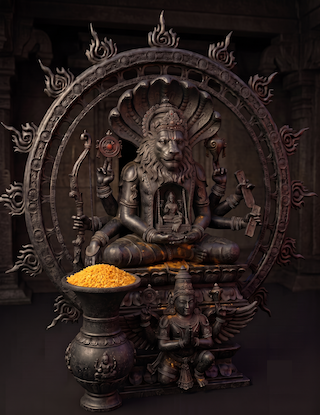
The Vedas, which are verily the breath of the Supreme Lord, declare in the Śrī Nṛsiṁha Tāpanīya Upaniṣad the majestic beauty and grandeur of Lord Nṛsiṁha:
Stuhi śrutam
kṛtasatam yuvānam
mṛgam na bhīmam
upahatnu mukram |
mṛḍā jaritre
siṁhas tavāno
anyante asmin
nivapantu senāḥ ||
Here, kṛtasatam means “He who dwells in the cave”;
yuvānam – “the ever-youthful one”;
mṛgam na – “He is not merely a Lion”;
He is the wondrous union of man and lion.
That Narasimha rose up, stretching His mighty form and roaring aloud.
Just as a lion breaks its slumber, extends its body and thunders forth, so did He. At that cosmic roar, countless beings in all directions trembled in awe.
Why did He manifest?
Was it to protect Prahlāda? – No.
Was it to slay Hiraṇyakaśipu? – Not merely that.
Then why?
It was to uphold the truthful word of Prahlāda!
Kamban sings:
Cāṇinum uḷanor taṉmai
aṇuvinaic catakūṛiṭṭa
Kōṇinum uḷan
mā Mēruk kuṉṟinum uḷan
in niṉṟa Tūṇinum uḷan
mun colla nin collinum uḷan
ittaṉmai Kāṇudi viraivil eṉṟān ||
When Hiraṇya asked, “Where is your Lord?”,
Prahlāda replied: “He dwells in every word you utter. Is there any place where He is not? He is in me, He is in you.”
“Tvayi asti, mayy asti ca” – He is within you, He is within me.
The little child proclaimed the supreme truth: the Lord is sarva-vyāpi, the all-pervading One. To protect the word of that innocent devotee, He burst forth as Narasimha, the wondrous union of man and lion, pervading all existence.
Thus, it is to this mighty Lion of the Lord, who ever stands ready, roaring and poised to rise in defense of His devotees’ words, that we must present our most sacred prayer.
And what is that prayer…?
That, we shall behold in the next chapter!
Mūri Nimirndu Muḻangip Puṛappaṭṭu
(Sri U.Ve. Mukkur Srinivasan)
( 2 )
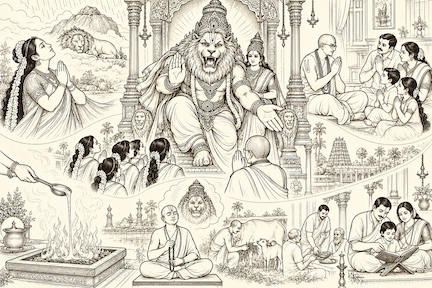
To uphold the word of the Bhagavathothamas, Bhagavan Sri Lakshmi Narasimha is ever waiting, ready to rise majestically, roar, and set forth at a moment’s notice. From Him, we must ask for only one thing. We should seek nothing else whatsoever.
Sri Andal graciously shows us exactly what we should ask of Bhagavan in the 23rd Pasuram of Sri Thiruppavai:
māri malaimuḻañcil
maṉṉik kiṭantuṟaṅkum
cīriya ciṅkam
aṟivuṟṟut tīviḻittu
vēri mayir poṅka
eppāṭum pērntutaṟi
mūri nimirntu
muḻaṅkip puṟappaṭṭup
pōtarumā pōlē
nī pūvaippū vaṇṇā! uṉ
kōyil niṉṟiṅṅaṉē
pōntaruḷik – kōppuṭaiya
cīriya ciṅkācaṉattiruntu
yām vanta kāriyam
ārāyntaruḷ ēlōr empāvāy.
What we must ask of that majestic Lion is simply this: “Graciously consider the purpose for which we have come and bestow Your grace upon us.” We should seek absolutely nothing else.
And what is the purpose for which we have come? To remain engaged in Bhagavad Dhyanam (meditation) and to perform Kainkaryam (Service) to Bhagavan.
Just as ghee is poured in an uninterrupted stream during the Vasordhara homam of a Yajna, constantly contemplating His Kalyana Gunas and rendering Kainkaryam for His sake will bestow upon us the highest rewards.
At this point, someone might lament, “Swamin! If one remains engaged in Bhagavad Dhyanam and Bhagavad Kainkaryam, must one not also carry on with one’s worldly life? Must one not take care of one’s wife and children? Do we not have the great responsibility of running our family and household?”
That is indeed true. For this very reason, our Poorvacharyas have thoughtfully provided us with simple ways within our very daily lives.
What are they? We shall explore them further…
Mūri Nimirndu Muḻangip Puṛappaṭṭu
(Sri U.Ve. Mukkur Srinivasan)
( 3 )
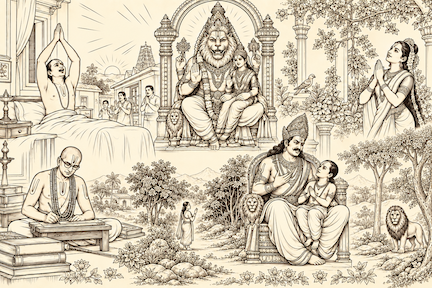
Bhagavad Dhyanam — the contemplation of Bhagavan must remain uninterrupted. For this very reason, our Poorvacharyas who deeply understood the Sastras have embedded the chanting of Bhagavan’s divine names and meditating upon Him into our very daily routines. How is that?
When we wake up in the morning, we must rise chanting loudly, ‘Hari Hari Hari Hari… Hari Hari Hari‘.
Sri Andal in Thiruppavai says,
mella eḻuntu ariyeṉṟa pēraravam
uḷḷam pukuntu kuḷirntēlōr empāvāy
Thus, she instructs that when waking up in the morning, one must rise to the loud, resounding chant of the name ‘Hari‘.
Why should we chant it aloud? Can we not meditate upon it silently within our minds? It is for Paropakaram (the benefit of others). When we chant ‘Hari Hari’ in a loud voice, even those sleeping nearby should be startled awake! When that divine name of Hari falls upon their ears, they too reap the supreme benefit of having chanted it!
Why specifically chant it seven times?
Swami Desikan, at the very beginning of his prabandham, Sri Vaishnava Dinasari, instructs:
vari iruḷ aḻi vaḻi
maṉam varum uṇarvoṭu
karikiri maruviya
kariyavaṉ aṭi iṇai |
parivoṭu paravu nal
aṭiyavar paḻa urai
ari ari ari ari
ari ari ariyē ||
By singing “ari ari ari ari ari ari ariyē“, he explicitly mentions ‘Hari’ seven times to establish that it must be chanted exactly seven times.
The true meaning is: ‘The ideal daily practice is to wake up at dawn as the darkness dispels, and with a clear mind, meditate upon the grief-dispelling, radiant lotus feet of Kanchi Varadaraja Perumal, lovingly chanting the name of Hari seven times.’
We meditate seven times upon Hari, who transcends the Sapta Vyahritis (the seven planes/utterances).
In the Sri Narasimha Tattvam, the one hailed as ‘Hari‘ is none other than Bhagavan Sri Lakshmi Narasimha!
When the child Prahlada returned to the palace during his school holidays, Hiranyakashipu lifted him and placed him on his lap.
He asked, ‘My child, Prahlada! What is the greatest thing in this world?’ Hiranyakashipu had strictly ordered the school to teach only his own glories. Therefore, he fully expected the child to declare that Hiranyakashipu alone is the greatest of all!
But the child replied:
tat sādhu manye ‘sura-varya dehināṁ
sadā samudvigna-dhiyām asad-grahāt |
hitvātma-pātaṁ gṛham andha-kūpaṁ
vanaṁ gato yad harim āśrayeta ||
(Srimad Bhagavatam)
“O best of the Asuras! The human mind is constantly tormented by anxiety due to clinging to temporary worldly desires and familial attachments. This superficial life, which causes the fall of the soul, is like a ‘dark, ruined well.’ Therefore, I consider it best for one to completely abandon it, go to the forest, and take refuge at the lotus feet of Sri Hari,” said Prahlada.
In Sanskrit, ‘Hari‘ means ‘Lion’. Therefore, Prahlada’s profound intent is that the greatest pursuit of all is to go to the forest and meditate upon Sri Narasimha, who is waiting, ready to “majestically rise, roar, and set forth“. Taking this to heart, Bhagavan incarnated with the magnificent face of a Lion.
Thus, when we chant “Hari Hari Hari Hari… Hari Hari Hari” seven times in the morning, we are meditating directly upon Sri Narasimha Himself. By doing so, we ensure that the entire day will pass smoothly, safely, and without any obstacles.
“Alright… You said one must meditate continuously without interruption. Is it enough to just chant this in the morning?” one might ask. There is an answer for that too. We shall explore it further…
Mūri Nimirndu Muḻangip Puṛappaṭṭu
(Majestically Rising, Roaring, and Setting Forth)
(Sri U.Ve. Mukkur Srinivasan)
( 4 )
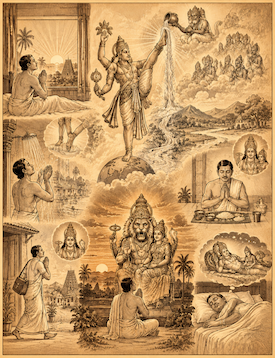
The contemplation of Bhagavan (Bhagavad Dhyanam) must remain uninterrupted. For this very reason, our Poorvacharyas have embedded the chanting of Bhagavan’s divine names and the meditation upon His Kalyana Gunas (auspicious attributes) into the very routines of our daily lives.
One must wake up before sunrise. We have already seen the simple duty of waking up while loudly chanting “Hari Hari Hari Hari… Hari Hari Hari” seven times.
Next, when we perform ‘Snanam’ (bathing), if we meditate upon Sri Trivikrama while bathing, it yields the exact same merit as performing ‘Ganga Snanam‘. Bhagavan incarnated as Vamana and grew into Trivikrama. Having grown thus, He measured the three worlds with His divine lotus feet.
His divine foot extended and reached all the way to Satyaloka, where Brahma resides. Immediately, Brahma washed Bhagavan’s lotus foot with the sacred water from his ‘Kamandalu’. That very sacred water flowed down to this earth as the river Ganga.
Sri Andal specifically meditates upon this Trivikrama when she sings, “ōṅki ulakaḷanta uttamaṉ pēr pāṭi“.
The Vedas specially celebrate this by declaring, “idaṁ viṣṇur vi cakrame tredhā nidadhe padam” — meaning, “Bhagavan Sri Maha Vishnu measured these three worlds with His three steps, planting His divine feet and pervading the universe.”
Therefore, if we meditate upon Trivikrama during our daily routine of Snanam, it becomes equivalent to a Ganga Snanam, and our Bhagavad Dhyanam also continues uninterrupted!
Next, before partaking in food (Aharam), one must meditate upon “Govinda“. If we chant “Govinda Govinda Govinda” three times and then partake in our meal, it grants us good digestion and thereby excellent health.!
Similarly, when we set out from our homes for any work, if we meditate upon Kesava and chant “Kesava Kesava Kesava Kesava” four times—remembering the phrase “keṭuviṭarāyavellām kēcavāveṉṉa“—all obstacles will be destroyed. The task for which we set out will be successfully accomplished.
Most importantly, in the evening, during sunset, one must meditate upon Sri Narasimha.
Periyalvar sings Pallandu to the Lord who incarnated during that twilight hour: “antiyampōtil ariyuruvāki ariyai aḻittavaṉai | pantaṉai tīrap pallāṇṭu pāṭutumē“.
In Sri Narasimha Tattvam, it is stated that with the Anugraham (grace) of Bhagavan Narasimha, one can conquer that twilight period (Sandhya time), which naturally tends to drag our senses toward wicked paths.
The twilight hour is highly dangerous. It instigates one to commit various evil deeds. The cruel Hiranyakashipu committed many atrocities. Bhagavan incarnated as Narasimha during that very twilight hour and put an end to him. Therefore, to prevent our minds from straying into worldly distractions, it is highly auspicious to meditate upon Bhagavan Narasimha during that evening hour.
Sri Parameshwara, in the Sri Mantraraja Pada Stotram, says:
sarvendriyair api vinā
sarvaṁ sarvatra sarvadā |
yo jānāti namāmy ādyaṁ
tam ahaṁ sarvato-mukham ||
Meaning: “Bhagavan Sri Lakshmi Narasimha rules over all our senses. He can perfectly see everything, everywhere, at all times, even without the use of senses. He is the one who controls and rules our mind. I bow down (namami aham) to such a Sarvatomukha—the primordial One who faces everywhere.”
Therefore, if we meditate upon Sri Narasimha during the very time of His incarnation, He Himself will stand as the cause to direct our minds safely toward His divine lotus feet.
Next, before going to sleep, if we chant “Madhava Madhava Madhava Madhava” four times and meditate upon that Sri Lakshmi Narayana, Bhagavan Himself will protect us (Rakshanam) during our slumber.
Thus, by chanting Bhagavan’s divine names throughout our daily activities, Bhagavad Dhyanam continues for us without any interruption.
Alright, how can one remain in Bhagavad Dhyanam even while sleeping..?