
Sri Swathi Nakshathra Sri Maha Narasimha Maha Manthra
Japa Homa Maha Yagya Vivaranam
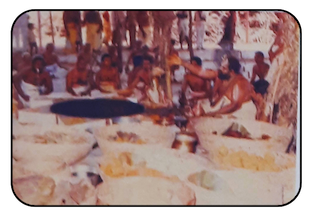
Sri U Ve Mukkur Lakshmi Narasimhachariyar Swami, guided by Divine Ordinance performed over 120 Swati Maha Yagyams in several places. The Yagyam is performed on the asterism Swati, when the fourth Avatar of Lord Vishnu, Lord Lakshmi Narasimha occured. The first of these Yagyams was performed in June 1981 at Asthika Samajam, Alwarpet, Chennai. Thereafter most of the Yagyams were performed in different parts of Andhra Pradesh, Karnataka, Tamilnadu and Kerala. The 90th Yagyam was performed in New Delhi. From the 97th Yagyam onwards they were performed in Kshetras (mostly Lakshmi Narasimha Kshetras) like Mangalagiri, Vedadri, Gatikachalam, Antharvedi, Hrishikesh, Yadagiri, Sobhanadri, Naimisaranyam, Vadapalli, Simhachalam, Brindavan, Srirangam etc.
Sri Swami performed ALL the Yagyams for LOKA KSHEMAM (on the concept of SARVE JANAHA: SUKHINO. BHAVANTHU) and not for fulfilling any KAMYAM (desire). Anybody who has atleast seen a picture of His Yagyam let alone the whole Yagyam would appreciate the devotion, perfection, and love he had for the ‘Sthambak Kuzhandhai’ Lord Sri Lakshminrusimha. There are Thirty two bheejaksharams in the Nrusimha Maha Mantram. It is not a coincidence that there are typically Thirty two distinct events in every Swati Maha Yagyams of Sri Mukkur Swami.
The 32 Events of the Maha Yagnam
.
1. Venue selection
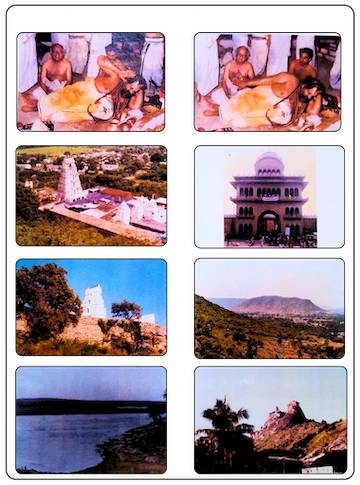
All the Swati Maha Yagnams are conducted only on Divine order. In certain cases, the venue for the forthcoming Maha Yag nam would be revealed to Sri Swamy either through a dream or through Perumal Aavirbhaavam (trans). For example, the venue of the 106th Maha Yag~nam was revealed to the devotees during the 105th Maha Yagn am at Sri Naimishaaranya Maha Kshetram. Perumal hinted that the forthcoming Yagn am should be performed at a place where there is a Svayam Vyaktha (self manifest) Sri Yogaananda Narasimha temple flanked on either side by two rivers that flow and unite to form a garland for the Lord. It took a lot of time to locate the venue- Sri Vaadapalli Maha Kshetram that is situated at the confluence of two rivers Krishna and Moosi near Miryalguda in Andhra Pradesh. Sometimes, Perumal shows interesting body language to give clues.
2. Yagna Vatica site selection
Once the Lord reveals the yagya Kshetram, Sri Swamy takes a preliminary tour to the Kshetram and decides the exact yagya vatica site. It is necessary to have a spacious and high raised structure for the Yagya Vatica, Homakundam etc., and also for seating the numerous devotees visiting from various places. Another factor to be taken into account is the need to arrange for dwelling accommodation for partaking deekshakas and rithwiks nearby and adjacent to the Yagya Vatica. Invariably there would be a river flowing nearby providing essential sacred water for the yagya. Sri Swamy himself or his main assistants make frequent visits to the site to ensure that all requirements are kept ready. The erection of the Yagya Vatica commences a couple of months before the start of the yagyam with the work of leveling the terrain. Some terrain were forests, some valleys, some fields and some were hillocks. In the Simhachala yagyam after leveling the ground, it was contemplated to clean the surroundings with water; but providentially, as always, an unusual downpour occurred as if HE was doing the site purification. At Vadapalli Maha Kshetram the place near the Lakshmi Narasimhaswamy temple was so barren and uneven that Sri Swamy had to commission a bulldozer to level the land where a huge shamiana was set up to envelope the entire Yagya Vatica!
3. Yagna Vatica Construction
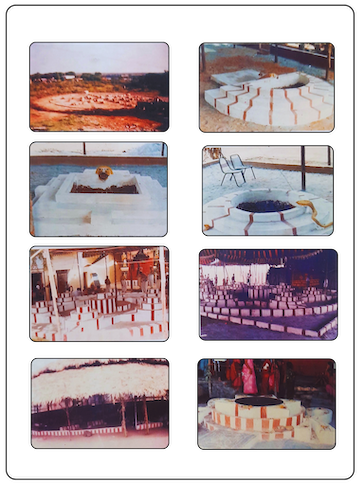
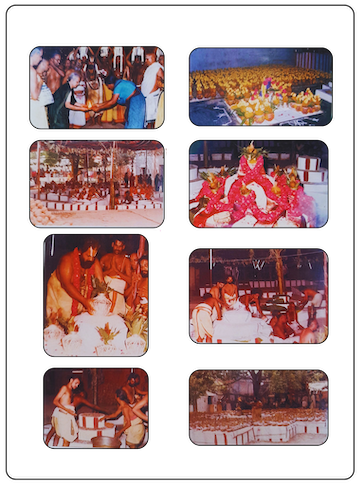
The Yagna Vatica extends into a huge site and usually comprises of Sannidhi (sanctum sanctorum), Kalasa mandapam, Homa salai, Pedestals and Madapalli (kitchen). The sannidhi is raised on a 15 square plot wherein Sri Swamy’s Divya Kshetra Deities, Sri Yagna moorthy, Alwars, Ahobila Mutt Yatheeswaras (Sri Swamy’s Acharyas) are housed in a mandapam. The Kalasa Mandapam is erected in front of the sanctum sanctorum on a 120 square feet area with a height of around 80 feet. This Mandapam consists of a Pradhaana Bindusthaanam surrounded by Sudarshana Shat Chakram and engulfed by four concentric circles for accommodating the kalasams. The 1008, the 108 and 10 Pradhana Kalasas are kept in seperate specially constructed pedestals. The Kalasa Mandapam also accommodates a Grahamandapam, accommodating Yagnya Purusha, Navagrahas and Pradhaana Devaas to whom havis (oblations) is offered. As ordained by the Lord, one/three/five/thirtytwo Homa Kundas are constructed. The main Homa Kunda is at least eight feet deep. The Akaras (Sudarshana chakra, triangle, square, circle, semi circle etc.) are sketched by Sri Swamy. In the front side of the Homa Kundas, figurines of koorma (tortoise), simham (lion), sarpam (snake), and matsyam (fish) are selectively sketched. Special pedestal for placing paligai is constructed. Separate kitchens for preparing the prasadams for the Lord and for preparing food for devotees are also set up. Sri Swamy would stay in a very small 10 by 10 enclosure within the Yagna Vatica throughout the entire Yagnam.
4. Swagatham
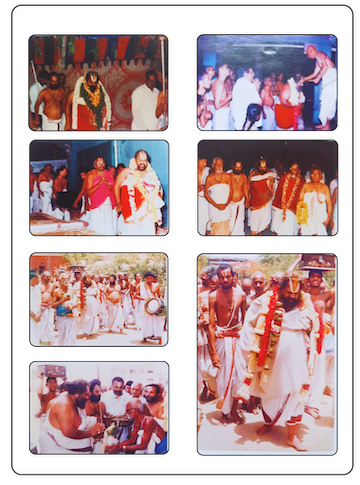
Sri Yagna Moorthy, Sri Swamy’s idols and Sri Swamy are first received with poorna kumbham at the Yagna Vatica on their arrival. This is done by the temple priest and/or vedic scholars amidst auspicious chants. Poorna Kumbham is offered since theertham (water) is the abode of entire Devas and also since it is said to be the Lord’s first creation!. Harathi is done by sumangali sthrees to the Lords and Sri Swami.
5. Sankalpam
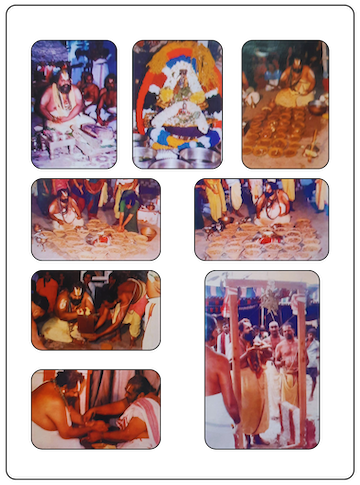
On the first day of the Yagna, Sri Swamy performs the sankalpam and Vishwaksena aradhanam, invoking the blessings of the Lord for completion of the Yag-nam without any hindrance. This is followed by Punyavachanam, sanctification of the entire Yag-na Vatica with the mantra enriched holy water. It should be noted that ALL the 107D Swati yagnas were conducted by Sri Swamy as per Perumal’s sankalpam SOLELY for loka kshemam and NOT for fulfilling any kamyam (desire).
6. Ankurarpanam
Ankurarpanam or Mrut Sangrahanam is performed after the Sankalpam. This marks the beginning of the Yagna. Mrut Sangrahanam involves collecting the mud from an anthill which is sanctified with Mantras invoking Lord Bhoovarahan, Soma devan etc., Seeking their blessings for the successful completion of the Yagna, navadhaanyam is soaked in water and sowed in 32 earthernware bowls filled with the sanctified mud. The sowing of the Navadanyas is done by Sri Swamy, rithviks, temple priests and devotees. The bowls are then traditionally taken around the Yag na Vatica and placed in the specially constructed pedestal. The navadanyams sown are watered daily and they sprout and grow rapidly into plants within days. This is referred to as Paligai.
7. Raksha Bandhanam
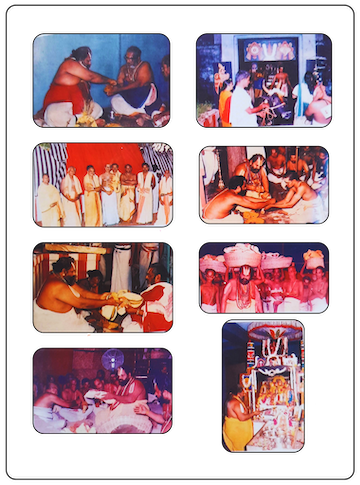
Raksha bandhanam is done to seek the blessings from the Lord and to protect one and all from all evil during the Yagna. Amidst auspicious music, the sacred thread (coloured yellow with turmeric), is tied to all the Lords beginning with Yagna moorthy. The rakshai (protective band) is tied to the right wrist of the Lords and the left wrist of their consorts. Thereafter, raksha bandhanam is done to Sri Swamy, the rithviks and all the devotees present. While raksha bandhanam is done, the gothram, star and name of the participants are mentioned and sankalpam is done by the individuals partaking in the Yag nam. Although the Yag nas are done for the common good without any kamyam (desire), while taking sankalpam, devotees can seek fufilment of their specific desires if any. Sri Swamy used to give dakshinai, few Kajurkais (dried dates), betel leaves, cocoanut etc to every person while tying the rakshai.
8. Deekshai
Sri Swamy, the rithviks, the temple priests and the male devotees are then given deeksha vastrams (veshti and angavastrams soaked in turmeric water and then dried). Invariably all males wear the deeksha vastrams throughout the yag-na period. Sri Swamy desires that all those undertaking deekshai should not leave the Yagna Vatica during the entire Yagna.
9. Pānakhārādhanam & Bhagavath Arādhanam
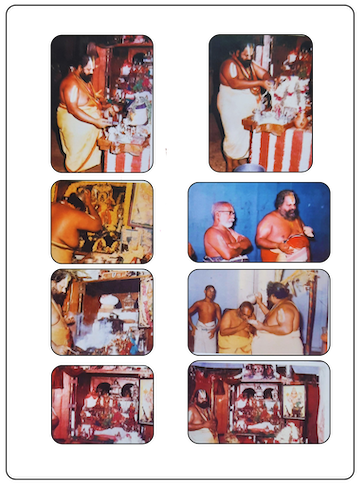
All Mahayagyams start with Pānakhārādhanam to Sri Yagyamurthy and other deities by Sri Swamy . In Kshetra Yag-nas he seeks the blessings of the Kshetra deity as well. The daily Puja during the entire Yagya consists of the early morning Viswaroopam, the morning Abhigamanam, the forenoon ljyai and the evening Panaka aradhanam.
(Click here for the video of “Mangalagiri Kshethra Mahayagyam Pānakhārādanam“)
10. Theertha Sveekaranam
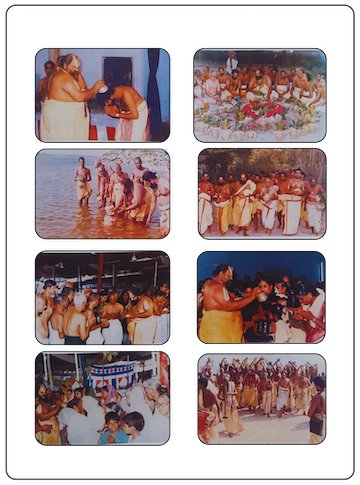
Amidst the Veda mantras and mangala vadhyam, water is collected from the holy theertham and brought in a procession led by Sri Swamy, followed by rithviks, priests and devotees. The 1008 kalasams are usually earthen pots, the 108 kalasas are made of brass while the 10 pradhana (principal) kalasas are made of silver. All the kalasas are tied with rakshai invoking their protection so that the thirtham placed therein is preserved till the conclusion of the Homams. The 1008, 108 and 10 pradhana kalasas are placed on specially constructed pedestals and kept in special formations decided by Sri Swamy for each yagna differently. The pedestals are first sanctified with kolam, on top of which layers of plantain leaves, dharbam, paddy, vastram and rice are laid out. The kalasam is placed on top of this layer and filled with the holy water from the sacred river. On each of the kalasams, hiranyam (coins) are placed along with thirtha parimalam (ground mixture of cardamom, cloves, saffron, jadikkai, jadhipatri, pachai kalpooram etc.). Top of the kalasam is covered with mango leaves, coconut, and koorcham (made of darbhai) and further adorned with special silk vastrams and flowers. The Pradhana kalasam at the central spot represents yagnya Narasimha and the nine surrounding kalasams represent the nine Narasimhas as described in the Narasimha Anushtup mantram. The pradhana kalasams are adorned with colourful silk and jari thagadis. ShatkOnam consists of six bindhusthanams comprising of 108 Upa pradhana kalasams representing the 108 divya desas. The four surrounding circular rows comprise respectively of 8,12,16 and 32 bindusthanams containing 1008 kalasams representing Ashtaaksharam, dwaadashaaksharam, purusha suuktam and Maha Narasimha mantram. The kalasams are installed after chanting a number of aavruthiis (iterations) of yagnya mantrams and through offering beejaaksharas vide mantrajalam. Fresh flowers are added to each of the kalasas every day. In Brindavan $Yag\sim na$, the 10 pradhana kalasas were surrounded by 108 kalasas which were again encircled by the 1008 kalasas. To Sri Swamy, the kalasa vatica appeared like the Lord Sri Krishna dancing with gopikas, while to mere mortals the vatica was merely a colourful sight with vastrams and flowers!. Beauty beholds the eye!!!.
11. Kalasa Prathistai and Devatha Avahanam
Sri Swamy performs avahanam (invocation) of Lord Lakshmi Narasimha and Sudarshana in each of the kalasas. This is performed with Vishnu Sahasranamam for the 1008 kalasas, Nrisimha Ashtothram for the 108 kalasas and moola mantram for the 10 pradhana kalasas.
12. Kalasa Japam
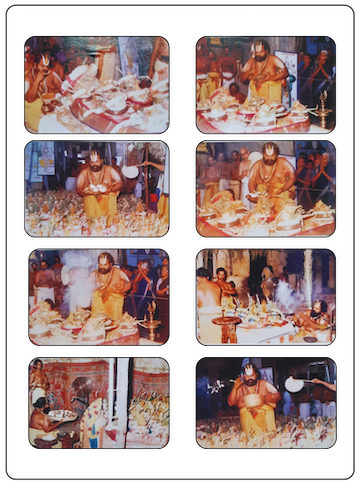
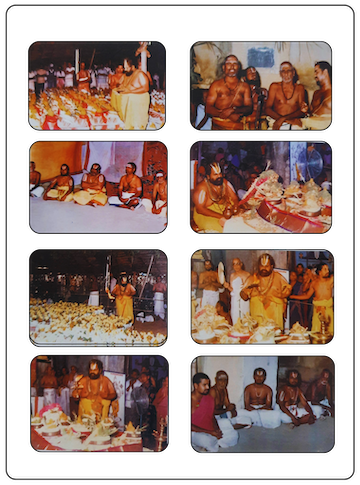
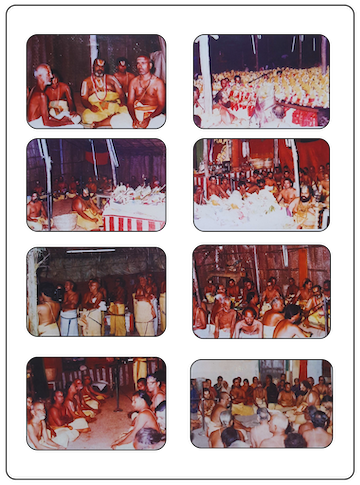
At the start of Japam for the kalasas, Sri Swamy would shower akshatai on all the kalasas. Standing at one end of the pedestal, Sri Swamy would put the akshatai on each of the 1008 kalasas and every single offering of akshatai would fall exactly on top of the coconut placed on each of the kalasa without fail. It is a treat to watch such precision revealing Sri Swamy’s devotion and bhakti. At the start of the Japam, a kalasa filled with water and adorned with mango leaves, coconut, vastram, etc is placed next to the kalasas and Lord Brahma is invoked in the same. This is done since Lord Brahma is supposed to be the prime witness for the japan to follow. Puja and offerings are done to Brahma every day. The kalasam where Lord Brahma was invoked is moved symbolically at the conclusion of the entire Japam for all the kalasas, after performing utthanam (requesting the devata to return back to their swasthanam) of Lord Brahma. Until then, care is taken not to disturb the kalasam.
Several Avrithis of Japam (including but not limited to Taittiriya Samhita prashna 1, Purusha sooktam, Sri sooktham, Bhoo sooktam, Neela sooktham, Mantrarajapada stotram, Narasimha moola mantram, Sudharshana maalaa mantram, Nrisimha ashtotrasathanaama sthothram, Sudarshana shatkam, Mantrarajapada veda mantraani, Mantraraja dvatrigumshad akshara devataa mantraani and vedic chants selected from Nrisimha Tapaneeya upanishad for Lord Lakshmi Narasimha, from Ahirbuthya samhitai for Sudarshana and from Padma samhitai for Mahalakshmi) are chanted by Sri Swami and the rithviks. Each Avrithi takes around two to three hours. Two or more Avrithi Japam is chanted for EACH of the Pradhana Kalasams. For the 108 and 1008 Kalasas, Japam is done collectively. After each Avrithi of Japam, veda ganam is recited by Rig, Yajur, Sarma, Atharvana Vedic Scholars (Sri Swamy would recite in all four) followed by rendering of divya prabhandam. After each Avrithi, upaharam (betel leaves, arecanut, coconut, fruits etc) is offered to the kalasa followed by Mangala Harathi and offerings of prasadams. After the Japam for the day is completed, bhagavath aradhanam would take place followed by distribution of prasadams to devotees. The Japam during each Yag-na would spread over several weeks.
13. Arani Madhanam & Agni Prathishtai
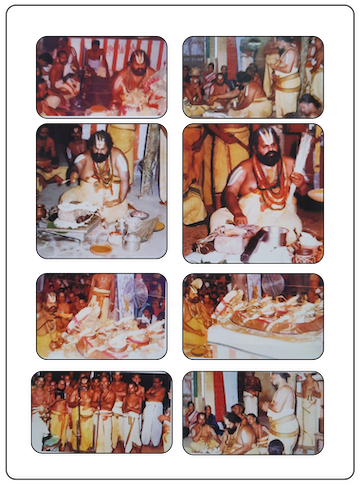
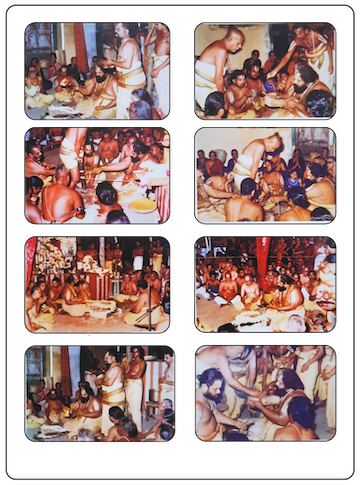
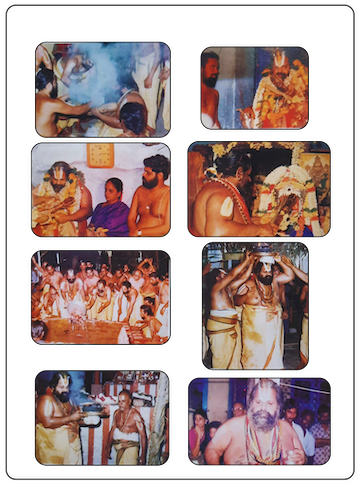
After completion of Japam for all the kalasas, the next part of Yagyam involves performing homam for which agni (fire) is a prerequisite. Agni is Pratyaksha devatha (one who can be seen with mortal eyes) while all other devathas are Paroksha devathas (one who cannot be seen with mortal eyes). As per the Taittirya Saakha of the Krishna Yajur Veda (the one that deals predominantly with the perfomance of sacrifices), in the olden days, the rithviks used to take some akshadai in their hand and just utter ‘Om bhuul’ and put it in to the empty homakundam and agni bhagavan, respecting their tejas, would spring forth. Even though we devotees feel that Sri Swamy was capable of all that and more, it is by dint of His sheer humility that Arani Madhanam ceremony is conducted. To create the vaidhika Agni, Sri Swami uses a special arani wood equipped with grooves to accomodate smaller Arani rods.
After the chanting of yagya manthra japam and invocation of the various deities upon the Arani wood, the smaller arani rods are placed into the groove and then surrounded by dry coconut fibre and camphor to act as catalysts. The small arani rods are cascaded onto a larger rod that has a set of threads for accommodating a rope. Holding either end of the ropes, Sri Swamy and another person (mostly His elder brother) would chum the arani wood like the chuming (mathanam) of the ocean. The churning creates intense heat causing sparks that are built up to a fire with coconut fibre. Most of the times, agni bhagavan reciprocates by appearing within a few seconds of churning. There were also times when he would test by postponing his appearance. In particular, at the Ayodhya mandapam yagyam, agni did not spring forth even after 8 hours of arani madhanam.
Sri Swami used to mention that getting the Agni from the Aranikattai is akin to getting a million rupees!. Sri Swamy’s face would invariably glow with happiness as soon as Agni appeared. The coconut fibre and agni are placed on an earthern bowl (madakku) in a brass plate and Sri Swamy would carry the agni on his head and go around the Vatica in Pradakshinam and then place the fire carefully in the Pradhana homa kundam. When more Homa Kundams are ordained by the Lord, the Agni from the Pradhana Kunda is taken and placed in the other Homa Kundas to start the Homam therein. A special Kesari Prasadam filled with sumptuous amounts of pure ghee and full of dry fruits -cashew, almonds, raisins is specially offered to the Lord on Arani Madhanam day and distributed to all those present.
14. Homam
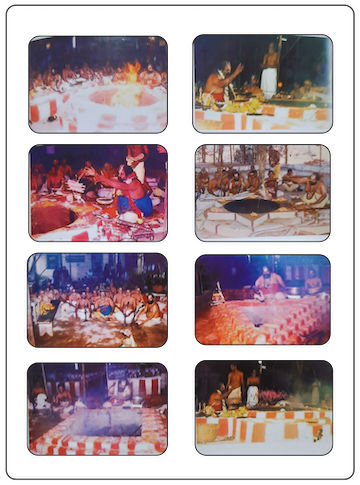
For making the offerings in the Homa Kundas, shruk and shruvam made of wood and covered with silver plating is used. Shruk and shruvam are ladels with long handles whose ends are shaped in oval and rectangular forms respectively, suitable for holding the offerings to be made to the Homa Kundam. As in the case of Japam, after each iteration of Homam, Ganam from all the four Vedas followed by Divya Prabandham is recited. This is followed by the offering of upaharam and prasadams to the Homa kundam. Before the start of homam each day, the Yag na moorthy is brought in a small palanquin (decorated beautifully and in differnt Vahanas) in the clockwise order and placed on a pedestal in front of the homa kundam.
After the completion of the homam, the Yagna moorthy is returned back to the mantapam. Sri Swamy would typically have one Homa Kundam (in Sudharshana Akara) for most of the Swati Yagnas. However, as per divine ordinance, he has performed Homams in 3, 5, 3, 32 Homa Kundas in Vadapalli, Simhaachalam, Brindavan, and Mattapally Yagyams respectively. At the start of the Homam, couple of samiths are placed on all sides of the Homa Kunda with special mantras to ensure protection during the Homam. These samiths are removed towards the conclusion of the Homam and offered to the agni. A madakku containing water is placed on the opposite side of the Homa Kundam as it is beleived that agni, respecting the presence of water, would not spread out of the Homa Kundam!. Each time Homam is started, Sri Swamy would sanctify the Kundam with Mantrakshatai, flowers etc. The mantras recited during the homams are the same with which the kalasa japans are done. The avrithis of mantras during homam is invariably one tenth of the number of avrithis done during kalasa japams and hence known as dasanga homams.
WHY DASANGA HOMAMS? As told by Bhagavan Sri Krishna in Srimadbhagavadgeeta ‘yagnyaanaam japa yagnyosmi’ (10.25), and also according to the Taittiriya Saakha of the Krishna Yajur Veda, more time has to be spent in the perfomance of the japam and a lesser amount of time for the homam as the proper perfomance of homam is not in our hands. There may be pratigraha dosham, dravya lopam, kaarya lopam, niyama lopam, anushtaana lopam and other lopams. For example, when the adhvaryu is perfoming a homa and touches his shika by mistake, he has to immediately perform achamanam and praanayaamam. If by mistake he touches his foot, there is no pardon. Aapastabha Maharshi says that the praayashchittam has to be performed by immediately having bath with the same clothes and only then continue with the ritual. Such strict controls are not within human reach especially when one is supposed to follow this repeatedly for weeks at a stretch.
Hence in accordance with our scriptures majority of the time should be spent only in the japam. Sri Swamy sits in front of the pradhana homa kunda in the deer skin spread over the koorma asana. Every offering made in the homa kunda is purified with ajyam (pure ghee). The same mantras recited during japam are suffixed by a ‘swahakara’ during homam and for each swahakara the offering is made to the agni. Depending on the mantra recited, the swahakaras appear in different time frames, but not once has Sri Swamy faulted in dropping the offering to the agni. The recitation of the mantras is done by Sri Swami and the rithviks.
The offerings in the homa kunda consists of samith, annam, ghee, bhakshanas, milk, honey, medicinal herbs, fruits, flowers etc.. At least one avirthi of Yagya mantras is recited for each of the samith, anna and aajya Homams. It is very common for Sri Swamy to sit in front of the Homa Kundam performing the homam for well over nine hours at a stretch, without even moving his legs in spite of the heat of the agni and the blazing sun. And, after the ksheeranna homam, Sri Swamy patiently distributes the homa sesham (remaining Ksheerannam after the Homam) to all the devotees. This itself takes more than two hours!. The homam, like japam, is spread over several days. When more than one Homa kundams are ordained, the same sequence of offerings are made to the remaning kundams as well successively. In all the Homa kundas it is only Sri Swamy who makes the offerings.
15. Vasordhara
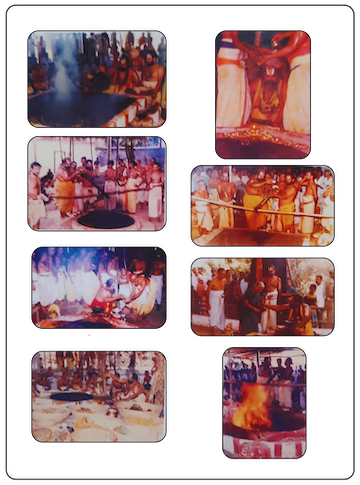
After homam, vasordhara is performed wherein ghee is poured in the special vasordhara ladel. It is a long silver plated wooden implement with a bowl like formation on one end and where the ghee is poured so as to flow through the handle into the mouth (usually in Lion form) of the implement at the other end into the Homa Kundam. This is done once again amidst the chanting of chamaka prashna and Mantras and usually performed for around two hours. Once the flow of the ghee starts falling into the Homa Kundam, the dhara (flow) continues throughout the recitation period without a single break. Almost fifteen to twenty Kgs of Ghee is required just for Vasordhara.
Before commencing the Vasordhara, Puja is done for the Vasordhara implement. Sri Swamy would pour the ghee into the implement while the Kainkaryaparas hold the implement. Since the flow of ghee continuously falls into the Homa Kundam, agni would spring up from the bottom of the Kundam to over six to seven feet above the Kundam (total of 15 feet!!). It would be a blessing to witness the agni subside and draw back into the Kundam as soon as Sri Swamy waves his hand towards the agni as though directing it to subside!. The Vasordhara is done to offset any sort of dravya, mantra, niyama lopams (shortfalls in the offerings or mantras and other activities) that may involuntarily have crept in the Yag-na proceedings. Sri Swamy used to inform that while witnessing the Vasordhara, if anyone wishes for fulfillment of any type of wish with full sincerity, it would get fulfilled without fail!.
16. Poornahuthi
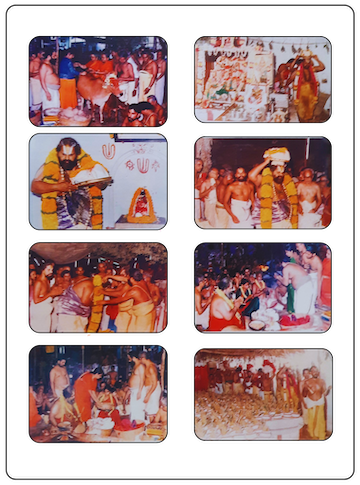
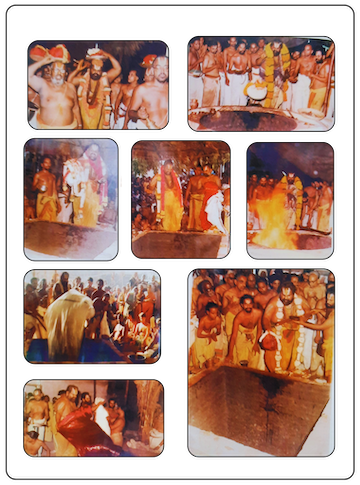
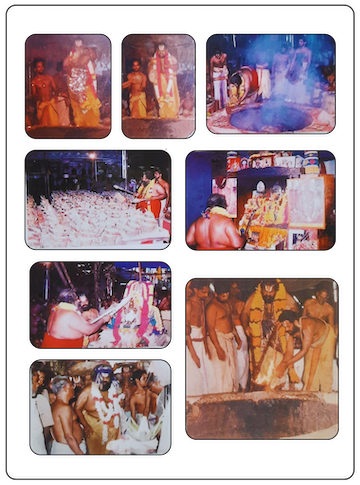
Poornaahuti marks the final offering culminating in the completion of the Homam. It is performed after special pujas in the presence of Sri Yagya moorthy. The special pujas include go puja, kanya puja and dampathi puja. At times if ordained by the lord, shukra puja and brihaspati puja are also performed. Go puja is performed for the cow and calf, with offerings of fruits, application of kumkum and turmeric, mangala harathi etc. Kanya puja is performed to one or two spinsters and dampathi puja is performed to a couple. Sambhavanai in the form of gold coin, cash and vastrams are given in each of these Pujas. These Pujas are conducted near the pradhana homa kundam just before the Poornaahuti and is done by Sri Swamy and his Devigal.
As part of poornaahuti, silk veshtis and silk sarees (9 yards), silk blouse pieces, coins in huge number, matta thengai etc are given as offerings in the Homa Kundam. These are carried by the devotees who do pradakshina of the Yag na Vatica and handover the same to Sri Swamy. The silk veshtis, silk sarees and silk blouse pieces are then soaked in ghee one by one and offered in the Yagna Kundam. Poornahuti dravyam (betel leaves, arecanut, matta thengai, sandalwood piece, little of oshadigal (medicinal herbs), vettiver, navaratnangal etc) are tied up in a white silk cloth and amidst the playing of mangala vadhyam, Sri Swamy would carry the poornaahuti bundle on his head, places the same on the divine feet of Yagya moorthy and then goes around the Yagya Vatica and finally arrives at the Homa Kundam and offers the Poornaahuti to the agni bhagawan in the Homa Kundam. Sri Swami would then prostrate in front of the Homa Kundam. He then shifts the Brahma kalasam signifying the completion of the homam. Poornahuti is performed only for the pradhana homa kundam.
17. Agni Udhvasanam
After completion of the poornaahuti, the agni bhagavan is symbolically removed from the homa kunda, by Sri Swamy with the shruk and shruvam. This agni is placed at the feet of Yagna moorthy and all the kalasas. The black soot from the homam is then taken and applied by Sri Swamy to the Lords, then himself and then to the rithviks and devotees. This is to ward off any drishti dosham (evil).
18. Kalasa Udhvasanam
Special Puja is done to all the kalasas and after paying obeisence to the devatas who had been present in the Kalasas, are requested to return back to their Sva Sthanams.
19. Tirumanjanam
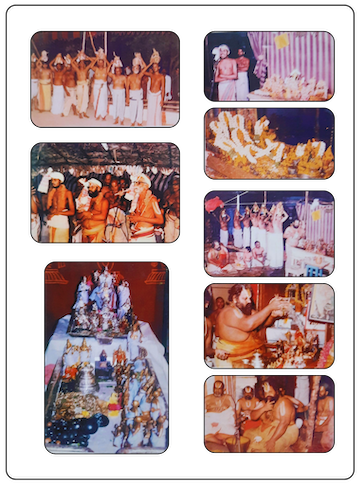
The entire Divya Desa deities of Sri Swamy, the Yagna Moorthy, Salagrama murthys, Dwaraka Silas, Alwars, Acharyas, and the Utsava Moorthys of the Kshetram are installed on the thirumanjana veedhi (special silver pedestal for doing abhishekam). The kalasams are brought by the devotees and rithviks around the Yag-na Vatica in pradakshinam. Sri Swamy performs the thirumanjam of the dieties with the sacred water in the kalasa. This water is now fully potent with the various mantras with which the japas have been done. The 1008 kalasas, the 108 kalasas are brought in a specific order and Sri Swamy would take utmost care to ensure that the correct order is maintained. Intermittantly, after a particular row of kalasas are completed, upaharam is offered to the Lords followed by harathi etc.
20. Kattiyam
After Thirumanjanam with the theertham from the 1008 and 108 Kalasas are completed, manjal kappu (turmeric paste) is placed on all the deities. Thereafter, kattiyam is recited by a few rithviks, for whom special honour is done by Sri Swamy by tying the parivattam- a silk vastram around the head of the rithviks. Kattiyam is a melodious rendering of divya prabanda pasurams and Nrisimha shlokas, inviting the Lords for ‘manjanam ada varai’ (thirumanjanam).
21. Sahasra dhara, Shanka dhara, Chakra dhara
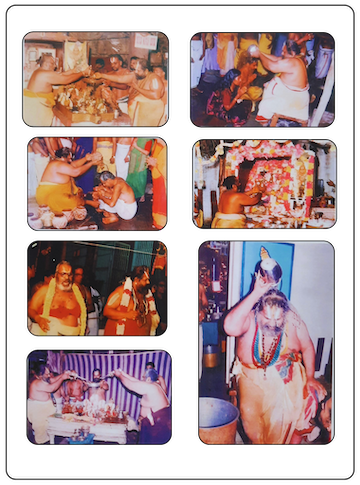
After Kattiyam is completed, the pradhana kalasams are brought around the yag na vatica by rithiviks and Swamy performs the sahasra dhara thirumanjam (silver vessel with 1008 holes) After completion of all the Pradhana kalasa tirumanjanam, the Manjal Kappu is distributed to all present. At the Naimisaranyam Yagyam in May 1992, Sri Swamy performed the entire thirumanjanam for over EIGHT hours without a break. He also performed thirumanjanam for the 43rd Jeer of Ahobila Mutt, Srivan Satakopa Sri Veeraraghava Satakopa Yatheendra Maha Desikan, whose Brindavnam is located in Naimisaranyam. After the Tirumanjanam, alankaram (decoration) is done for the deities in the Mandapam. This takes at least two hours.
22. Avabrutham
Thirumanjana theertham is collected from the Thirumanjana Veedhi and stored in huge vessels This potent theertham is sanctified further with the thirumeni sambhandam (physical touch) of all the idols and as such possess immense power. Sn Swamy would pour this sacred theertham on all the devotees one by one (in case of couples, jointly). Fresh water is added if there are large number of devotees. Sri Swamy performs the avabrutham to EVERY person untiringly irrespective of the number involved Invariably, he would pour it on himself and his devigal ONLY towards the end This is in accordance with practising what he preached: Bhagavan and BhagavatAs before self. After the avabrutha snanam is done, one is expected to take bath only on the next day. The avabrutha snanam is so refreshing that the fragrance of the theertha parimalam stays throughout the day. The avabrutha snanam is said to cure all physical ailments.
23. Theerthavari
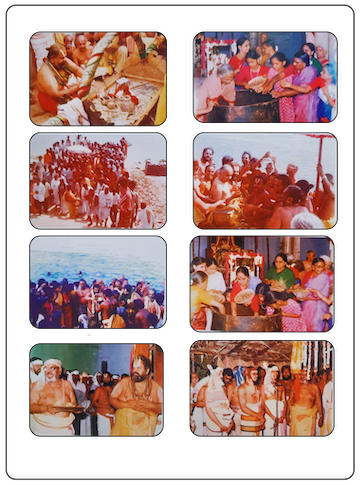
In certain Yag-nas, theerthavari is done wherein Sri satari and Sudarshana chakra are taken in a palanquin, amidst mangala vadhya gosham to the river. Sri Swami, the rithviks and the devotees together with Sri Satari and Chakkarattazwar immerse in the waters. At some yag nas, avabrutha nanam is performed simultaneously.
24. Paligai Karaithal
Amidst Mangala Vadhya gosham, sumangali sthrees led by Sri Swamy’s devigal carry the earthern bowls containing the paligai to the river and all the devotees dissolve the Paligai in the river water.
25. Satrumurai
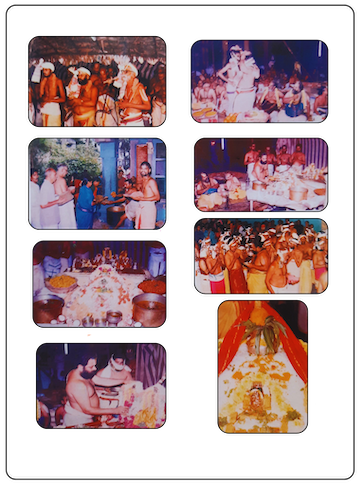
After the conclusion of the avabrutham, periya sattrumurai is done for the deities with the recitation of four Vedas, divya prabhanda pasurams etc, which takes around two hours. Offerings of countless prasadams (sundal, puliyodarai, chakkarai pongal, dosai, kesan, sweet varieties, navaneetham, curd rice etc) is offered to the Lord and later distributed to the devotees. Duning the Sattrumarai, Sri Swami ensures that kalasa vastrams are used as parivattam to adorn the heads of EVERY male member present. Sri Swamy administers Sn Satari to all of them. Note: Sri Swamy summoned and tied the parivattan personally to a beggar in Patha Sivalayam yag-no in 1988. The beggar had been watching the Yag-na throughout the night from a distance near the temple entrance Sri Swami had also performed avabrutha snanam to him. SUCH IS THE BENEVOLENCE OF SRI SWAMY WHO SAW EVERY PERSON AS PART OF GOD and not as MERE MORTALS!.
26. Annakoota Utsavam
In certain Yag nas, annakoota utsavam is also performed. Huge amounts of rice is cooked and heaped in the form of a hillock and alankaram (decoration) is done with sweets and savouries like Thenguzhal (Madhu Murali), Manoppu (Pradhana Indriya Lavanam), Pakodas, Mysorepak etc.. Sri Yag na Moorthy is placed on a small pedestal in front of anna kootam and kadamba kuzhambu (mixed vegetable kuzhambu with lots of deep fried sundaikkai) is placed in vessels around. After performing Puja, naivedyam and harathi to the annakootam, the kadambha kuzhambu and the savouries are mixed with the cooked rice and distributed to all the devotees. The prasadam which is piping hot when distributed would be very tasty and relished by one and all.
27. Kalyana Utsavam
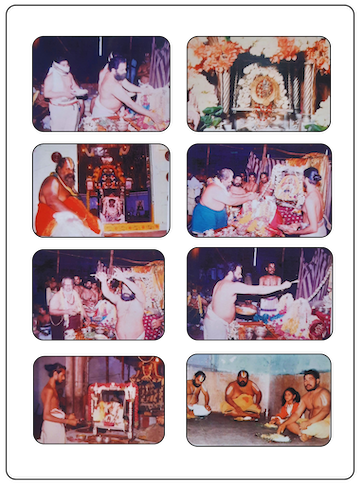
As Shanti (peace) to the Lord and his consorts, after successful completion of the yag na, kalyanotsavam is done to both Sri Swamy’s emberuman and Kshetra Utsava Moorthys. Under the Adhyaksham of Sri Swamy, kalyana utsavam is done by kainkaryaparas as elaborately as in regular (yesteryear!!!) marriages, with kankana dharanam, exchanging garlands, mangalya dharanam etc..
28. Dolotsavam
After the kalyanotsavam, the Lords and consorts are placed in dolai (swing) and the devotees rock the Lord with devotional songs. Sri Swami sits near the dolai throughout and on several occassions the singing takes place throughout the night!. The Dolotsavam is performed so that the Lords could take rest after the hectic yag na activities. Naivedyam of Prasadams is done to the Lord in dolai at the end and distributed to the devotees.
29. Thadeeyaradhanai
Thadeeyaradhanai is performed and Sri Swamy takes food along with the rithviks and devotees in the same pandhi. Sri Swamy would be on mere liquid diet since the beginning of the Yag na and partakes solid full meals only on the thadeeyaradanam day!. Sri Swamy’s face would glow with the happiness of the successful completion of the yagna and would be as ecstatic as always.
30. Vidwat Sadas & Swami’s Upanyasams
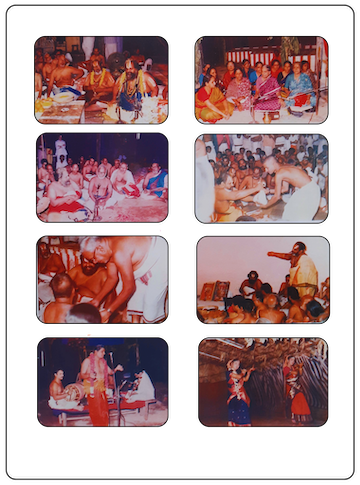
Sri Swami used to say that a yag na would attain poornathvam (completion) only when the rithviks are given sambhavanai. After the thadeeyaradhanai, under the adhyaksham of Sri Swamy, all the rithviks, kainkaryaparas, archakas, sannidhi paricharakas, temple priests, cooks, nadaswara vidwans, pookarar (who makes the flower garlands) are honoured at the sadas and sambhavanai is given to them by the poshakas of the yag-na, devotees and Sri Swami. Sri Swami then renders an upanyasam elaborating on the yagna, praising the Lord, the future venues for the ensuing Yag nas etc. The Upanyasam goes on for about two hours and is very moving and memorable every time. Sri Swamy would never fail to thank every kainkaryapara from pradhana archaka to the cook, pookarar, nadaswara vidwan, in his inimitable style. After vidwat sadas and Swami’s upanyasams devotees take leave of Sri Swami regretfully Sri Swami’s devigal would give betel leaves, turmeric, kumkum and blouse piece to the ladies and bhakshanam is also given to all the devotees.
31. Nama Sankeerthanam
Over and above the ahorAthrav veda gosham, Swami’s Yagyam is always filled with Nama sankeerthanam. The Vana Malika group led by Smt. Radha Krishnaswamy takes every opportunity to sing HIS praise.
32. Subha Mangalam
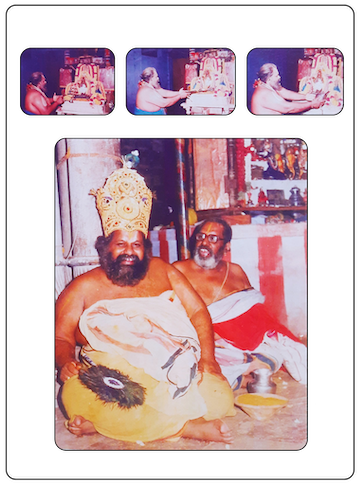
The Swati Maha Yagyam comes to an end with vidwat sadas for us. However, that is not true for Sri Mukkur Swamy. After the completion of every Swati Maha Yagyam, Sri Swamy would personally write to each and every devotee who contributed to the Yagyam. He would do this irrespective of the level or type of contribution or their social status. He would give them a report about the completed yagyam, acknowledging them for their contribution. He would also send them the meticulously packed Homa prasadham, perumal photo and Nrusimha medallions. There are many who have laminated his beautiful writings- the UNDILUTED thoughts that flows from this mahan who performed 107+++ Yagyas PURELY for loka kshemam..!!
List of Sri Swathi Maha Yagnams performed by Sri Mukkur Swami:
Sri Swami has performed more than 108++ Sri Swathi Maha Yagyams across our Bharatha desam. Below is the compiled list of Maha Yagnams along with the locations.
| Yagnam | Place Performed | Sponsored by |
| 1st | 24, Venkatesan St, Chennai – 17 | Sri Swami |
| 2nd | 24, Venkatesan St, Chennai – 17 | Sri Swami |
| 3rd | 14, Valmiki Street, Chennai-17 | Sri Vidyasagar |
| 4th | 24, Venkatesan St, Chennai – 17 | Sri Swami |
| 5th | “Sesha Bhavanam”, 10 East Mada Street Chennai – 4 | Sri Srinivasachar |
| 6th | Sri Sringeri Shankara Mutt, Chennai – 1 | Sri Bhakta Jana Sabha |
| 7th | Sri Desika Bhavanam, Chennai – 4 | Sri Swami |
| 8th | 10, East Mada Street, Chennai – 4 | Sri Lakshmi Narasimha Maha Yagna Committee |
| 9th | Sri Malola Kalyana Mandapam, Chennai – 17 | Sri Lakshmi Narasimha Maha Yagna Committee |
| 10th | 10, Soundararajan St, Chennai – 17 | Sri Mahadeva lyer |
| 11th | Selaiyur, Tambaram, Chennai | Sita Rama Bhakta Sabha |
| 12th | 38, 5th St, Padmanabha Nagar, Chennai | Sri R. Krishnaswamy lyengar |
| 13th | Sri Anantha Padmnabhaswamy Temple, Chennai | Sri Sathsangam, Adyar |
| 14th to 20th | 24, Venkatesan St, Chennai – 17 | Sri Swami |
| 21st | Sri Anantha Padmnabhaswamy Temple, Chennai | Sri Sathsangam, Adyar |
| 22nd | 24, Venkatesan St, Chennai – 17 | Sri Swami |
| 23rd | Industrial Estate, Ambattur Chennai | Sri K. Vidyasagar |
| 24th | Sri Rama Temple, TVS Nagar, Madurai | Eikya Vaishnava Sabha |
| 25th to 27th | Sri Godavari Theeram, Rajamundry (AP) | Sri Swami |
| 28th | Kakinada, E.G. Distt (AP) | Sri Swami |
| 29th | Sri Vasavi Mahal, Salem -1 | Sri R.Srinivasan |
| 30th | Mangalagiri, Near Vijayawada | Sri Swami |
| 31st | 24, Venkatesan St, Chennai – 17 | Sri Swami |
| 32nd | 36, Jawahar Nagar, Agaram Chennai | Sri Narayanan |
| 33rd | 24, Venkatesan St, Chennai – 17 | Sri Swami |
| 34th | Sri Sankara Matam, Perambur, Chennai | Sri Sathgyra Sangeetha Sabha |
| 35th | I.I.T. Chennai – 36 | Sath Sangam |
| 36th | Sri Panduranga Temple, Salem | Sri Vaishnava Sabha |
| 37th | Sri Vaishnava Sabha, Salem | Sri A. Rukmangadha lyer |
| 38th | “Selva kudil”, Shevapet, Salem | Sri Kancheepumar |
| 39th | Triplicane, Chennai – 5 | Sri Rama Navami Committee |
| 40th | 24, Venkatesan St, Chennai – 17 | Sri Swami |
| 41st | Sri Rama Temple, TVS Nagar, Madurai | Eikya Vaishnava Sabha |
| 42nd | Kakinada | Sri Swami |
| 43rd | Mangalagiri, Near Vijayawada | Sri Swami |
| 44th | Simhachalam (AP) | Sri Swami |
| 45th | Kakinada | Sri Swami |
| 46th & 47th | Antharvedi (AP) | Sri Swami |
| 48th & 49th | Sri Godavari Theeram, Rajamundry (AP) | Sri Swami |
| 50th | Antharvedi (AP) | Sri Swami |
| 51st | Kakinada | Sri Swami |
| 52nd | Triplicane, Chennai -5 | Sri Guruvayurappan Seva Samithi |
| 53rd | Korattur, Chennai | Satsangham |
| 54th & 55th | Kakinada | Sri Swami |
| 56th | Simhachalam (AP) | Sri Swami |
| 57th | Kumili, Near Sri Koormam (AP) | Sri Krishnam Raju |
| 58th | M.S.K. Kalyana Mandapam, Salem | Sri R. Rajagopalan |
| 59th | M.S.K. Kalyana Mandapam, Salem | Sri N.Srinivasan, Sri M.S.Krishnamurthy lyer |
| 60th | Simhachalam (AP) | Sri Swami |
| 61st | Sri Ramakrishna Kalyana Mandapam, Coimbatore | Sri Ramakrishna Sabha |
| 62nd | Sri Ayodhya Aswametha Maha Mandapam, Chennai | Sri Rama Samaj |
| 63rd | Madipakkam, Chennai | Sathsangam |
| 64th | M.S.K. Kalyana Mandapam, Salem | Sri S. Srinivasan, Sri R. Rajagopalan, Sri M.S.K & Sri Srinivasan |
| 65th | Kakinada | Sri Swami |
| 66th | Sri Godavari Theeram, Rajamundry | Sri Swami |
| 67th to 69th | Kakinada | Sri Swami |
| 70th | 10, New Colony, Tuticorin – 3 | Sri V.A. Subramania lyer |
| 71st to 73rd | Kakinada | Sri Swami |
| 74th | Kumili, Near Sri Koormam (AP) | Sri Krishnam Raju |
| 75th | Mangalagiri, Near Vijayawada | Sri Swami |
| 76th | Simhachalam (AP) | Sri Swami |
| 77th | Kakinada | Sri Swami |
| 78th | Narmada Theeram, Near Hoshingabad | Sri Swami |
| 79th | Antharvedi (AP) | Sri Swami |
| 80th & 81st | Sri Ayodhya Aswametha Maha Mandapam, Chennai | Sri Rama Samaj |
| 82nd | Mangalagiri, Near Vijayawada | Sri Swami |
| 83rd | Kakinada | Sri Swami |
| 84th | Simhachalam (AP) | Sri Swami |
| 85th & 86th | Kakinada | Sri Swami |
| 87th & 88th | Antharvedi (AP) | Sri Swami |
| 89th | Arasavalli, Near Vijayanagaram (AP) | Sri Swami |
| 90th | Sector 3, Rama Krishna Puram, New Delhi | Sri Swathi Sri Lakshmi Narasimha Maha Mantra Yagna Sewa Committee |
| 91st | Sri Lakshmi Narasimha Swamy Temple, Vijayawada | Sri Swami |
| 92nd | Sri Soundararaja Perumal Temple, Agaram, Chennai | Sri Swami |
| 93rd | Toovey Puram, Tuticorin | Sri Viswanatha lyer |
| 94th | Kakinada | Sri Swami |
| 95th | Blue Bells Matriculation School, Kilkattalai | Sri Swami |
| 96th | Sri Lakshmi Narasmiha Navaneetha Krishnan Temple Nangainallur | Sri Krishna Baktha Jana Sabha Nangainallur |
| 97th | Sri Panaka Narasimha Temple, Mangalagiri (AP) | Sri Swami |
| 98th | Antharvedi (AP) | Sri Swami |
| 99th | Sholingar (TamilNadu) | Sri Swami |
| 100th | Vedadri (AP) | Sri Swami |
| 101st | Hrishikesh (UP) | Sri Swami |
| 102nd | Yadagirigudda (AP) | Sri Swami |
| 103rd | Shobanadri (AP) | Sri Swami |
| 104th | Mattapalli (AP) | Sri Swami |
| 105th | Naimisaranyam (UP) | Sri Swami |
| 106th | Vadepalli (AP) | Sri Swami |
| 107th & 107A | Simhachalam (AP) | Sri Swami |
| 107B | Sri Brindavan (UP) | Sri Swami |
| 107C | Srirangam | Sri Swami |
| 107D | Mattapalli | Sri Swami |